
We have completed the NCERT/CBSE Solutions chapter-wise for Class 12 Business Studies Chapter 5 Organising with Answers by expert subject teacher for latest syllabus and examination. Prepare effectively for the exam taking the help of the Class 12 Business Studies NCERT Solutions PDF free of cost from here. Students also can take a free NCERT Solutions of Organising. Each question has right answer Solved by Expert Teacher. Download the Business Studies NCERT Solutions with Answers for Class 12 Business Studies Pdf and prepare to help students understand the concept very well.
NCERT Solutions for Class 12 Business Studies Chapter wise
Exercises
Very Short Answer Type:
Q1. Identify the network of social relationships which arises spontaneously due to interaction at work.
Answer: Informal organisation is referred to as the social relationship network that arises naturally as a result of interaction at work. Emergence of informal organisation is from social interaction and free flow of communication between the employees of the organisation.
Q2. What does the term ‘span of management’ refer to?
Answer: Span of management refers to the number of subordinates that can be effectively managed by a superior. This determines the levels of management in the structure.
Q3. State any two circumstances under which the functional structure will prove to be an appropriate choice?
Answer: Functional structure would prove to be most suitable when the size of the organisation is large, has diversified activities and operations require a high degree of specialisation. It promotes control and co-ordination within a department, increased managerial and operational efficiency, results in increased profits.
Q4. Draw a diagram depicting a functional structure.
Answer:

Q5. A company has its registered office in Delhi, manufacturing unit at Gurgaon and marketing and sales department at Faridabad. The company manufactures the consumer products. Which type of organisational structure should it adopt to achieve its target?
Answer: For this company the type of organisation structure that needs to be followed is functional organisation. This can be justified using the following points
- Being a large organisation it requires proper departmentalisation. It helps in increasing efficiency of the managers and also provides a great degree of control over the activities of the organisation.
- Organisation like this is managing multiple functions simultaneously where coordination of high degree is required. It can be achieved in a smooth way by arranging a proper division of activities among various departments under functional structure.
- Specialisation will be promoted under functional structure and it will help in performing all the diverse functions effortlessly.
Short Answer Type:
Q1. What are the steps in the process of organising?
Answer: The steps in the process of organising are:
- Identification and division of work: The first step in the process of organising involves identifying and dividing the work that has to be done in accordance with previously determined plans.
- Departmentalisation: Once work has been divided into small and manageable activities then those activities which are similar in nature are grouped together.
- Assignment of duties: It is necessary to define the work of different job positions and accordingly allocate work to various employees.
- Establishing reporting relation ships: Each individual should also know who he has to take orders from and to whom he is accountable.
Q2. Discuss the elements of delegation.
Answer: The elements of delegation are as follows
(i) Authority It refers to the right of an individual to command his subordinates and to take action within the scope of his position. The concept of authority arises from the established scalar chain, which links the various job positions and levels of an organisation. It must be noted that authority is restricted by laws and the rules and regulations of the organisations. Authority flows downward.
(ii) Responsibility Responsibility is the obligation of a subordinate to properly perform the assigned duty. It arises from a superior-subordinate relationship because the subordinate is bound to perform the duty assigned to him by his superior. Responsibility flows upward.
(iii) Accountability Accountability implies being answerable for the final outcome. Once authority has been delegated and responsibility accepted, one cannot deny accountability. It cannot be delegated and flows upwards i.e., a subordinate will be accountable to a superior for satisfactory performance of work.
Q3. How does informal organisation support the formal organisation?
Answer: Informal organisation supports the formal organisation. Informal organization is created out of the social interaction.
The features of informal organization that support formal organization are:
Common interest: The purpose of an informal organisation is to satisfy the social and psychological needs of its members. Members join informal organisation on the basis of common interest.
Informal communication: Informal organisation has informal communication known as grapevine. Information spreads faster in informal organisation.
No clear-cut structure: Informal organisation does not have a clear-cut structure. It is based on informal authority. Any person of the group may be designated as its leader.
Free flow of communication: This structure allows the workers to form informal relation outside the organisation.
Coordination: This type of structure ensures better coordination and cooperation.
Q4. Can a large sized organisation be totally centralised or decentralised? Give your opinion.
Answer: No large organisation can not be totally centralised or decentralised. Complete centralisation would imply concentralisation of all decision making functions at the apex of the management hierarchy. Such a scenario would obviate the need for a management hierarchy. On the other hand, complete decentralisation would imply the delegation of all decision making functions to the lower level of the hierarchy and this would finish off the need for higher, managerial positions. Both the situations are unrealistic.
As an organisation grows in size and complexity, there is a tendency to move towards decentralised decision making. This is because, in large organisations those employees, who are directly and closely involved with certain operations tend to have more knowledge about them than the top management, which may only be indirectly associated with individual operations. Hence, there is a need for balance between these co-existing forces.
Q5. Decentralisation is extending delegation to the lowest level. Comment.
Answer: Decentralisation and delegation are similar in nature. Both are about transferring of responsibility and authority. In case of delegation authority is shared among two individuals i.e. superior delegating authority to subordinate whereas in decentralisation the authority is shared at multiple levels. Therefore, it can be said that the act of delegating authority at each level of management is promoting decentralisation while the act of decentralisation is helping promote delegation in the lowest level.
Q6. Neha runs a factory wherein she manufactures shoes. The business has been doing well and she intends to expand by diversifying into leather bags as well as western formal wear thereby making her company a complete provider of corporate wear. This will enable her to market her business unit as the one stop for working women. Which type of structure would you recommend for her expanded organisation and why?
Answer: The organisational structure that Neha shall follow is ‘divisional structure.’ Divisional structure is one in which the departments are formed on the basis of product divisions is called divisional or product structure of organisation. Each department in it looks after the production, sale, marketing and finance function of a product. Divisional structure is suitable where the number of main products is more than one, where different manufacturing technologies and marketing methods are required, where the size of the organisation is very large. Each department functions separately and the decision making is quick.
Q7. The production manager asked the foreman to achieve a target production of 200 units per day, but he doesn’t give him the authority to requisition tools and materials from the stores department. Can the production manager blame the foreman if he is not able to achieve the desired target? Give reasons.
Answer: In the problem above, the production manager can’t blame the foreman to achieve a target production of 200 units per day as he denied the authority to handover requisite tools and material to foreman from the store essential for the achievement of targeted production. The attitude of production manager is that of centralization of powers and authorities, while the decentralization and delegation of authorities and responsibilities are needed to sort out the above problem.
Long Answer Type:
Q1. Why delegation is considered essential for effective organising?
Answer: Delegation is the transfer of authority from a superior to a subordinate. It helps in reducing the work load on the manager so that manager can give focus on areas that needs more attention. It also provides subordinates to become more responsible and make way for more growth opportunities.
Following points shows the importance of delegation which is effective in organising
- By delegating work to the subordinate’s managers can focus on other areas, it improves efficiency of the managers.
- Employees also get the chance to perform well and improve their skills. It helps in developing the skillset of the employees.
- The act of delegation gives employees responsibility and it also provides motivation to the employees as they feel that they belong to the organisation and their contributions are recognised.
- Delegation helps in career development of many managers as they take up more roles in the organisation. It also helps workers to gain more experience which helps in career growth.
Q2. What is divisional structure? Discuss its advantages and limitations.
Answer: Divisional structure refer to the organisation structure comprises of separate business units or divisions where each unit has a divisional manager has its authority and responsible for performance. Each division is multifunctional because within each division functions like production, marketing,
finance, purchase etc, are performed together to achieve a common goal. Each division is self-contained as it develops expertise in all functions related to a product line. For example, a large company may have divisions like cosmetics, clothing etc.
The advantages of divisional structure are:
- It promotes flexibility and initiative because each division functions as an autonomous unit which leads to faster decision making.
- It facilitates expansion and growth as new divisions can be added without interrupting the existing operations by merely adding another divisional head and staff for the new product line.
The limitations of divisional structure are: - Conflict may arise among different divisions with reference to allocation of funds and further a particular division may seek to maximise its profits at the cost of other divisions.
- It may lead to increase in costs since there may be a duplication of activities across products. Providing each division with separate set of similar functions increases expenditure.
- It provides managers with the authority to supervise all activities related to a particular division. In
Q3. Decentralisation is an optional policy. Explain why an organisation would choose to be decentralised.
Answer: Decentralisation is the process of redistributing or dispersing functions and powers away from central authority. In the process of decentralisation, authority is delegated to subordinates so that they can take quick decisions regarding urgent assignments.
An organisation would choose to be decentralized as it has following advantages:
Develops the spirit of initiative among subordinates: Under decentralisation, authority is delegated by the superiors to their subordinates. This inculcates the feeling of sense of responsibility in the subordinates and helps them in taking initiative.
Facilitates decision making: As the work is delegated, so the burden of all the managerial decisions is not confined to limited people. This results in better and quick decision making.
Relief to top management: With the help of delegation, the top level management takes care only of the important issues. All the small issues or issues or problems of less importance are dealt by the middle and the lower level management which reduces the burden of the top level management.
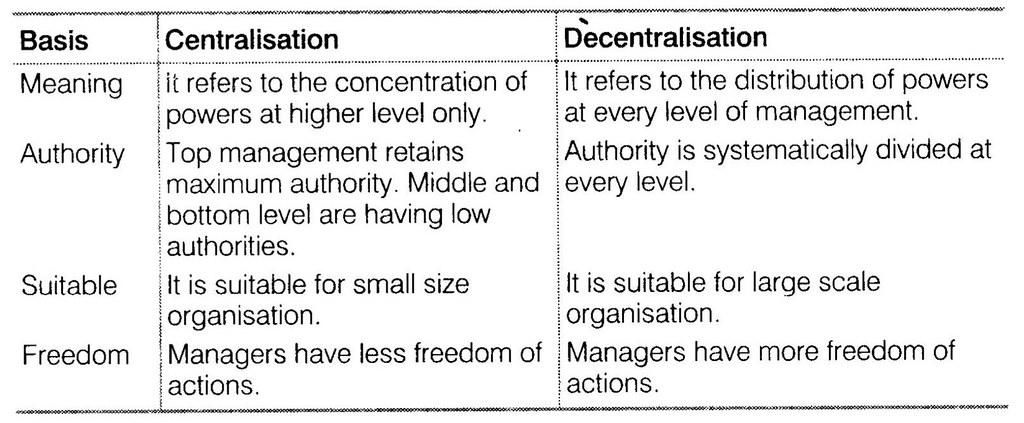
Q4. Distinguish between centralisation and decentralisation.
Answer:
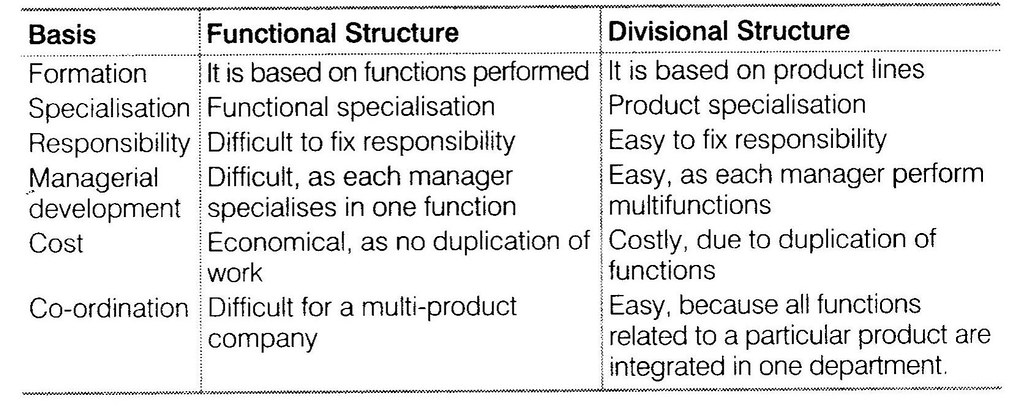
Q5. How is functional structure different from a divisional structure?
Answer:
Q6. A company, which manufactures a popular brand of toys, has been enjoying good market reputation. It has a functional organisational structure with separate departments for Production, Marketing, Finance, Human Resources and Research and Development.
Lately to use its brand name and also to cash on to new business opportunities it is thinking to diversify into manufacture of new range of electronic toys for which a new market is emerging.
Answer: Which organisation structure should be adopted in this situation? Give concrete reasons with regard to benefits the company will derive from the steps it should take.
The company should adopt a divisional organisation structure as it is the ideal structure for this organisation.
Following are the benefits that can be obtained by following this structure
- Each of the department will have a head who will be accountable for the overall performance of the department. The performance of individual departments can be determined easily and the best and worst performers can be identified and necessary steps can be taken.
- Decision making will be quick as each department has a specialist to manage it.
- Having a divisional structure allows adding more divisions without impacting the functions of the organisation.
Q7. A company manufacturing sewing machines set up in 1945 by the British promoters follows formal organisation culture in totality. It is facing lot of problems in delays in decision-making. As the result it is not able to adapt to changing business environment. The work force is also not motivated since they cannot vent their grievances except through formal channels, which involve red tape. Employee turnover is high. Its market share is also declining due to changed circumstances and business environment.
Answer: The company need to change complete formal organisation culture and accept some informal structure. The management should encourage employees to interact and socialise with each other. This will help the company in following ways.
- Information spreads faster as prescribed lines of communication are not followed.
- It gives them a sense of belongingness in the organisation and give more satisfied workforce.
- It helps in achievement of organisational objectives in better manner.
Q8. A company X limited manufacturing cosmetics, which has enjoyed a pre-eminent position in business, has grown in size. Its business was very good till 1991. But after that, new liberalised environment has seen entry of many MNC’s in the sector.
Answer: The company had followed a very centralised business model with Directors and divisional heads making even minor decisions. Before 1991 this business model had served the company very well as consumers had no choice. But now the company is under pressure to reform.
We Think the given NCERT Solutions for class 12 Business Studies book Chapter 5 Organising with Answers Pdf free download will assist you. If you’ve got any queries regarding CBSE Class 12 Business Studies Organising NCERT Solutions with Answers, drop a comment below and that we will come back to you soons.