We have Provided the NCERT/CBSE Solutions chapter-wise for Class 10 Science Chapter 4 Carbon and Its Compounds with Answers by expert subject teacher for latest syllabus and examination. Students can take a free NCERT Solutions of Carbon and Its Compounds. Each question has right answer Solved by Expert Teacher.
CBSE Solutions Class 10 Science Carbon and Its Compounds
Page No: 61
Q1. What would be the electron dot structure of carbon dioxide which has the formula CO2?
Answer:

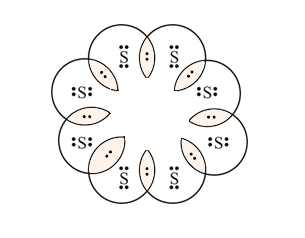
Q2. What would be the electron dot structure of a molecule of sulphur which is made up of eight atoms of sulphur? (Hint – the eight atoms of sulphur are joined together in the form of a ring.)
Answer:
Page No: 68
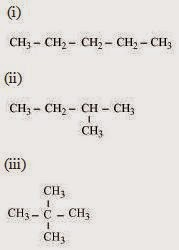
Q1. How many structural isomers can you draw for pentane?
Answer: Three structural isomers are possible for pentane.
Q2. What are the two properties of carbon which lead to the huge number of carbon compounds we see around us?
Answer:
- Catenation: Carbon has the unique property of self linking which is known as catenation. In fact, any number of carbon atoms can be linked to one another by covalent bonds. This is on account of the stability of C—C bonds since the size of the carbon atom is quite small.
- Linking of carbon with other atoms. Carbon is tetravalent in nature and can readily unite with atoms like hydrogen, oxygen, nitrogen, sulphur etc. by electron sharing.
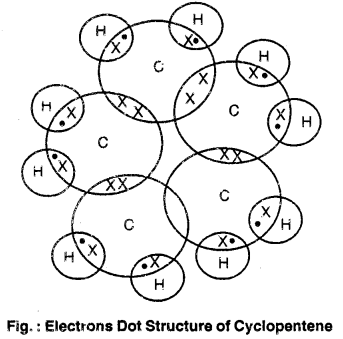
Q3. What will be the formula and electron dot structure of cyclopentane?
Answer: Formula of cyclopentane : C5H10
Q4. Draw the structures for the following compounds.
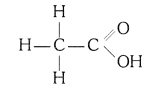
(i) Ethanoic acid
Answer: Ethanoic acid (CH3COOH)
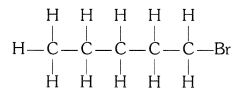
(ii) Bromopentane*
Answer: Bromopentane (C5H11Br)
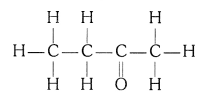
(iii) Butanone
Answer: Butanone (CH3 — CH2 — COCH3)
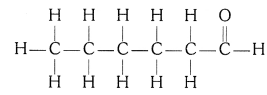
(iv) Hexanal
Answer: Hexanal (C5H11CHO)
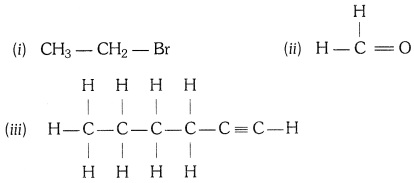
Q5. How would you name the following compounds ?
Answer:
Page 71
Q1. Why is the conversion of ethanol to ethanoic acid an oxidation reaction?
Answer: CH3CH2OH + (Alkaline KMnO4) → CH3COOH
Since, in this reaction one oxygen is added to ethanol, hence it is an oxidation reaction.
Q2. A mixture of oxygen and ethyne is burnt for welding. Can you tell why a mixture of ethyne and air is not used?
Answer: A high temperature is required for welding. Ethyne burn in oxygen and produce a large amount of heat and H2O and CO2 as by product. But if we used a mixture of ethyne and air it produce oxides of nitrogen with H2O and CO2. The oxides of nitrogen are the major air pollutants so they pollute the environment, that is why a mixture of air and ethylene is not used for welding.
Page 74
Q1. How would you distinguish experimentally between an alcohol and a carboxylic acid?
Answer:
| Test | Alcohol | Carboxylic acid |
| (i) Litmus test | No change in colour. | Blue litmus solution turns red. |
| (ii) Sodium hydrogen carbonate test | C2H5OH + NaHCO3 → No reaction No brisk effervescence. | CH3COOH + NaHCO3 → CH3COONa + H2O + CO2 Brisk effervescence due to evolution of CO2. |
| (iii) Alkaline potassium permanganate | On heating, pink colour disappears. | Does not happen so. |
Q2. What are oxidising agents?
Answer: Oxidising agents are the substances which either on their own or on reacting with another substance release oxygen in order to carry oxidation reactions. The commonly used oxidising agents are: ozone, bromine water, a mixture of potassium dichromate and sulphuric acid or a mixture of potassium permanganate and sulphuric acid, etc.
Page 76
Q1. Would you be able to check if water is hard by using a detergent?
Answer: Detergent gives lather with hard and soft water both, while a soap gives lather with soft water only. Thus, it is not possible to check if water is hard; by using a detergent.
Q2. People use a variety of methods to wash clothes. Usually after adding the soap, they ‘beat’ the clothes on a stone, or beat it with a paddle, scrub with a brush or the mixture is agitated in a washing machine. Why is agitation necessary to get clean clothes?
Answer: Soaps or detergents forms micelles with the greasy or oily material associated with the clothes. To remove oily or greasy material it is necessary to mix soaps with clothes in such a way so that it combine with greasy/oily material to form a micelles. On agitation the oily dirt tends to lift the dirty surface.
So agitation is necessary for the throughout mixing of a soap with the clothes and it give rises to the formation of micelles and we can get clean clothes.
Page 77
Exercise
Q1. Ethane, with the molecular formula C2H6 has
(a) 6 covalent bonds.
(b) 7 covalent bonds.
(c) 8 covalent bonds.
(d) 9 covalent bonds.
Answer: (b) 7 covalent bonds.
Q2. Butanone is a four-carbon compound with the functional group
(a) carboxylic acid.
(b) aldehyde.
(c) ketone.
(d) alcohol.
Answer: (c) ketone.
Q3. While cooking, if the bottom of the vessel is getting blackened on the outside, it means that
(a) the food is not cooked completely.
(b) the fuel is not burning completely.
(c) the fuel is wet.
(d) the fuel is burning completely.
Answer: (b) the fuel is not burning completely.
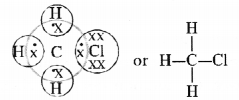
Q4. Explain the nature of the covalent bond using the bond formation in CH3Cl.
Answer: The molecule of chloromethane (CH3Cl) consists of three elements i.e., carbon (Z = 6) hydrogen (Z = 1) and chlorine (Z = 17). Carbon atom has four valence electrons (2, 4) ; hydrogen has one (1) while chlorine has seven electrons in the valence shell (2, 8, 7). In order to complete its octet, carbon shares three valence electrons with three hydrogen atoms while one is shared with the electron of chlorine atom. The structure of covalent molecule may be written as follows :
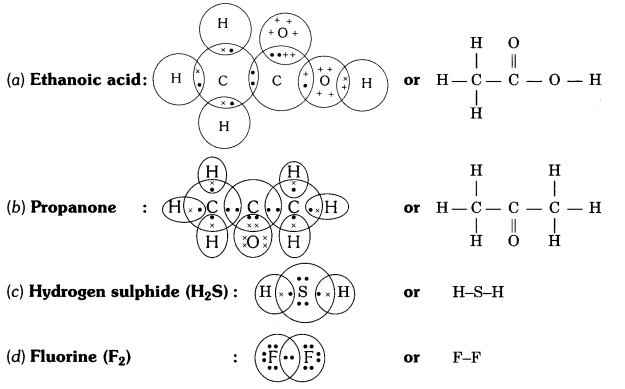
Q5. Draw the electron dot structures for
(a) ethanoic acid.
(b) H2S.
(c) propanone.
(d) F2.
Answer:
Q6. What is a homologous series? Explain with an example.
Answer: A homologous series is a series of carbon compounds that have different numbers of carbon atoms but contain the same functional group. It can be represented by the same general formula. Compounds of homologous series differ by CH2 from their consecutive members. All the compounds of a homologous series show similar chemical and physical properties. For example, alkanes such as methane, ethane, propane, butane, etc. belong to the same homologous series. Similarly, all alkenes belong to a particular homologous series and all alkynes belong to another homologous series.
Q7. How can ethanol and ethanoic acid be differentiated on the basis of their physical and chemical properties?
Answer:
| Ethanol | Ethanoic acid |
| Does not react with sodium hydrogen carbonate | Bubbles and fizzes with sodium hydrogen carbonate |
| A good smell | Smells like vinegar |
| No action in litmus paper | Blue litmus paper to red |
| Burning taste | Sour taste |
Q8. Why does micelle formation take place when soap is added to water? Will a micelle be formed in other solvents such as ethanol also?
Answer: Soap molecule has two ends. One end is hydrophilic and another end is hydrophobic. When soap is dissolved in water and clothes are put in the soapy solution, soap molecules converge in a typical fashion to make a structure; called micelle. The hydrophobic ends of different molecules surround a particle of grease and make the micelle; which is a spherical structure. In this, the hydrophilic end is outside the sphere and hydrophobic end is towards the centre of the sphere. This is why micelle formation takes place when soap is added to water.
Since ethanol is not as polar as soap, so micelles will not be formed in other solvents such as ethanol.
Q9. Why are carbon and its compounds used as fuels for most applications?
Answer: Carbon, in all its allotropic forms, burns in oxygen to give carbonoxide along with the release of heat and light on combustion. Carbon and its compounds have a very high calorific value.
C + O2 → CO2 + heat + light
CH4 + 2O2 → CO2 + 2H2O + heat + light
CH2CH2OH + 3O2 → 2CO2 + 3H2O + heat + light
There are the oxidation reactions.
Due to high calorific value, carbon and its compounds are used as a fuel.
Q10. Explain the formation of scum when hard water is treated with soap.
Answer: Soap is basically sodium or potassium salt of higher fatty acids. Hard water contains in it Ca2+ and Mg2+ ions as their salts. When soap is added to hard water, the corresponding calcium and magnesium salts are formed. These are in the form of precipitates, also called ‘scum’.

Q11. What change will you observe if you test soap with litmus paper (red and blue)?
Answer: Red litmus will turn blue because soap is alkaline in nature. Blue litmus remains blue in soap solution.
Q12. What is hydrogenation? What is its industrial application?
Answer: Hydrogenation is a chemical reaction between molecular hydrogen (H2) and another compound or element, usually in the presence of a catalyst such as nickel, palladium or platinum. The process is commonly employed to reduce or saturate organic compounds. Catalytic hydrogenation has diverse industrial uses. Most frequently, industrial hydrogenation relies on heterogeneous catalysts.
In petrochemical processes, hydrogenation is used to convert alkenes and aromatics into saturated alkanes (paraffins) and cycloalkanes (naphthenes), which are less toxic and less reactive. For example, mineral turpentine is usually hydrogenated, hydro cracking of heavy residues into diesel, etc.
Q13. Which of the following hydrocarbons undergo addition reactions:
C2, H6, C3H8, C3H6, C2H2 and CH4.
Answer: Unsaturated hydrocarbons undergo addition reactions. C3H6 and C2H2 are unsaturated hydrocarbons which undergo addition reactions.
Q14. Give a test that can be used to differentiate chemically between butter and cooking oil.
Answer: Butter contains saturated fats. Therefore, it cannot be hydrogenated. On the other hand, oil has unsaturated fats. That is why it can be hydrogenated to saturated fats (solids).
Q15. Explain the mechanism of the cleaning action of soaps.
Answer: Soaps molecules have two different ends, one is Hydrophillic (water soluble) while the other end is hydrophobic (water repelling), When soap is at the surface, the Hydorpholbic tail of soap will not be soluble in water and the soap will align along the surface of water with the ionic end in water and the hydrocarbon ‘tail’ protruding out of water.
Inside water, those molecules have unique orientation that keeps the hydrophobic end out of the water. This is achieved by forming clusters of molecules in which the hydrophobic tails are in the interior of the duster and the ionic ends are on the surface of the duster. This formation is called a micelle. Soap in the form of a micelle is able to dean, since the oily dirt will be collected in the centre of the micelle. The micelle stay in solution as a colloid and will not come together to precipitate because of ion-ion repulsion. So the dirt suspended in the micelles is also easily rinsed away.
We Think the given NCERT Solutions for class 10 Science Chapter 4 Carbon and Its Compounds with Answers Pdf free download will assist you. If you’ve got any queries regarding CBSE Class 10 Science Carbon and Its Compounds NCERT Solutions with Answers, drop a comment below and that we will come back to you soons.