
We have Provided the NCERT/CBSE Solutions chapter-wise for Class 10 Science Chapter 3 Metals and Non-metals with Answers by expert subject teacher for latest syllabus and examination. Students can take a free NCERT Solutions of Metals and Non-metals. Each question has right answer Solved by Expert Teacher.
CBSE Solutions Class 10 Science Metals and Non-metals
Page 40
QUESTIONS
Q1. Give an example of a metal which
(i) is a liquid at room temperature.
(ii) can be easily cut with a knife.
(iii) is the best conductor of heat.
(iv) is a poor conductor of heat.
Answer:
(i) Mercury,
(ii) Sodium,
(iii) Silver,
(iv) Lead.
Q2. Explain the meanings of malleable and ductile.
Answer: Malleable:Substances that can be beaten into thin sheets are called malleable. For example, most of the metals are malleable.
Ductile: Substances that can be drawn into thin wires are called ductile. For example, most of the metals are ductile.
Page 46
QUESTIONS
Q1. Why is sodium kept immersed in kerosene oil?
Answer: Sodium is high reactive element. If it is kept in open it can explosively react with oxygen to catch fire. Hence to prevent accidental damage sodium is immersed in kerosene oil.
Q2. Write equations for the reactions of
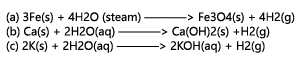
(i) iron with steam
(ii) calcium and potassium with water
Answer:
Q3. Samples of four metals A, B, C and D were taken and added to the following solution one by one. The results obtained have been tabulated as follows.
| Metal | Iron(II) sulphate | Copper(II) sulphate | Zinc sulphate | Silver nitrate |
| A B C D | No reaction Displacement No reaction No reaction | Displacement No reaction No reaction | No reaction No reaction No reaction | Displacement No reaction |
Use the Table above to answer the following questions about metals A, B, C and D.
(i) Which is the most reactive metal?
(ii) What would you observe if B is added to a solution of copper (II) sulphate?
(iii) Arrange the metals A, B, C and D in the order of decreasing reactivity.
Answer:
(i) B is most reactive metal.
(ii) B will displace copper from copper sulphate.
(iii) Arrangement of metals in the order of decreasing reactivity B>A>C>D.
Q4. Which gas is produced when dilute hydrochloric acid is added to a reactive metal? Write the chemical reaction when iron reacts with dilute H2SO4.
Answer: Hydrogen gas is liberated when dilute HCl is added to a reactive metal.
Fe(s) + H2SO4(aq) → FeSO4(aq) + H2(g)
Q5. What would you observe when zinc is added to a solution of iron (II) sulphate? Write the chemical reaction that takes place.
Answer: The green colour of the solution would slowly disappear. Zinc would gradually dissolve and iron would get precipitated at the bottom of the beaker.
Zn(s) + FeSO4(aq)→ AzSO4(aq) + Fe(s)
Page No: 49
Q1. (i) Write the electron-dot structures for sodium, oxygen and magnesium.
Answer:

(ii) Show the formation of Na2O and MgO by the transfer of electrons.
Answer:
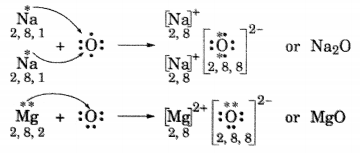
(iii) What are the ions present in these compounds?
Answer: In Na2O, ions present are Na+ and O2–.
In MgO, ions present are Mg2+ and O2-.
Q2. Why do ionic compounds have high melting points?
Answer: Ionic compounds are the ones which has both positive and negative charges. Hence there will be strong force of attraction between them. This make expenditure of lot of heat to break this force of attraction hence ionic compounds have high melting points.
Page No: 53
Q1. Define the following terms.
(i) Mineral
(ii) Ore
(iii) Gangue
Answer:
(i) Mineral: The naturally occurring compounds of elements are known as Mineral.
(ii) Ore: Minerals from which metals can be extracted profitably are known as ores.
(iii) Gangue: The impurities present in the ore such as sand, rocks etc are non as gangue.
Q2. Name two metals which are found in nature in the free state.
Answer: Gold, Silver.
Q3. What chemical process is used for obtaining a metal from its oxide?
Answer: The chemical process is known as reduction.
Page No: 55
Q1. Metallic oxides of zinc, magnesium and copper were heated with the following metals.
| Metal | Zinc | Magnesium | Copper |
| Zinc oxide Magnesium oxide Copper oxide |
In which cases, will you find displacement reactions taking place?
Answer:
Magnesium (Mg) will displace both zinc (Zn) and copper (Cu) from their oxides
Mg + ZnO ➝ MgO + Zn
Mg + CuO ➝ MgO + Cu
Zinc will displace copper from copper oxide.
Zn + CuO ➝ ZnO + Cu
Copper is the least reactive metal and will not participate in the displacement reaction.
Q2. Which metals do not corrode easily?
Answer: Metals such as gold (Au) and platinum (Pt) present at the bottom of the activity series do not corrode easily.
Q3. What are alloys?
Answer: Alloys are the homogeneous mixture of two or more metals or even metals and non-metals.
Page No: 56
Excercise
Q1. Which of the following pairs will give displacement reactions:
(a) NaCl solution and copper metal
(b) MgCl2 solution and aluminium metal
(c) FeSO4 solution and silver metal
(d) AgNO3 solution and copper metal
(d) AgNO3 solution and copper metal.
(d)
Q2. Which of the following methods is suitable for preventing an iron frying pan from rusting.
(a) applying grease
(b) applying paint
(c) applying a coating of zinc
(d) all of the above
(d) All of the above
Q3. An element reacts with oxygen to give a compound with a high melting point. This compound is also soluble in water. The element is likely to be:
(a) calcium
(b) carbon
(c) silicon
(d) iron
(d) Calcium.
Q4. Food cans are coated with tin and not with zinc because:
(a) zinc is costlier than tin
(b) zinc has a higher melting point than tin
(c) zinc is more reactive than tin
(d) zinc is less reactive than tin
(a) Zinc is costlier than tin
Q5. You are given a hammer, a battery, a bulb, wires and a switch.
(a) How could you use them to distinguish between samples of metals and non-metals?
Answer: Metals are malleable and can be easily drown into sheets by hitting with hammer. On the other hand if we beat non-metals they break down and they cannot be drawn into sheets as they are non-malleable. Metals of good conductors of electricity hence they make bulb when you connect metals with a battery, wire and bulb. Similarly If non-metals are bad conductors of electricity chance they fail to lit up the bulb on connecting with wire and battery.
(b) Assess the usefulness of these tests in distinguishing between metals and non-metals.
Answer: The above tests are useful in distinguishing between metals and non-metals as these are based on the physical properties. No chemical reactions are involved in these tests.
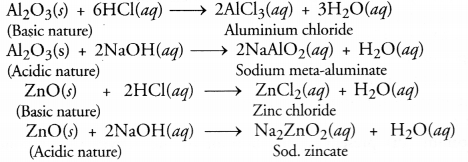
Q6. What are amphoteric oxides? Give two examples of amphoteric oxides.
Answer:
Q7. Name two metals which will displace hydrogen from dilute acids, and two metals which will not.
Answer: Sodium and calcium can displace hydrogen from dilute acids Copper and silver can not displace hydrogen from dilute acids.
Q8. In the electrolytic refining of a metal M, what would you take as the anode, the cathode and the electrolyte?
Answer: Cathode – Pure metal
Anode – Impure metal
Electrolyte – Metal salt solution
Q9. Pratyush took sulphur powder on a spatula and heated it. He collected the gas evolved by inverting a test tube over it, as shown in the figure.
(a) What will be the action of gas on
(i) dry litmus paper ?
(ii) moist litmus paper ?
Answer: (i) There will be no action on dry litmus paper.
(ii) The colour of litmus paper will turn red because sulphur is a non-metal and the oxides of non-metal are acidic in nature.
(b) Write a balanced chemical equation for the reaction taking place.
Answer: S (s) + O2(g) → SO2 (g)
Q10. State two ways to prevent the rusting of iron.
Answer: –
- Iron can be prevented from rusting by coating the surface of the iron with rust proof paints
- By applying Oil/grease on the surface of iron objects as it will prevent the iron surface to get in contact with air consisting of moisture.
Q11. What type of oxides are formed when non-metals combine with oxygen?
Answer: When non-metals are combined with oxygen then neutral or acidic oxides are formed. Examples of acidic oxides are NO2, SO2 and examples of neutral oxides are NO, CO etc.
Q12. Give reasons
(a) Platinum, gold and silver are used to make jewellery.
Answer: Platinum, gold and silver are used to make jewellery because these are malleable and ductile. These are highly resistant to corrosion.
(b) Sodium, potassium and lithium are stored under oil.
Answer: Sodium, potassium, and lithium are very reactive metals and react very vigorously with air as well as water.Therefore, they are kept immersed in kerosene oil in order to prevent their contact with air and moisture.
(c) Aluminium is a highly reactive metal, yet it is used to make utensils for cooking.
Answer: When exposed to air, the metal changes into its oxide called aluminium oxide (Al2O3). It gets deposited over the surface of the metal and forms a protective coating on the surface. Due to the presence of this layer, aluminium becomes unreactive and can be used for making cooking utensils.
(d) Carbonate and sulphide ores are usually converted into oxides during the process of extraction.
Answer: It is easier to reduce a metal oxide into free metal. Since it is easier to obtain metals from their oxides than from their carbonates or sulphides directly. therefore, the carbonate and sulphide ores are first converted to oxides for extracting the metals.
Q13. You must have seen tarnished copper vessels being cleaned with lemon or tamarind juice. Explain why these sour substances are effective in cleaning the vessels.
Answer: Copper metal slowly reacts with water, carbon dioxide and oxygen present in air to form basic copper carbonate which is green in colour. Its layer slowly gets deposited on the surface of the metal. Now lemon

juice contains citric acid while tartaric acid is present is tamrind, Both these acids react with basic copper carbonate to form soluble salts such as copper acetate (with citric acid) and copper tartarate (with tartaric acid). The equations for the reactions are complicated and are not given. These salts are removed from the surface of the copper metal and the surface of the metal shines.
Q14. Differentiate between metal and non-metal on the basis of their chemical properties.
Answer:
| Metals | Non-metals |
| When metals are heated with oxygen, they form ionic oxides which are basic in nature and form bases on dissolving with water. This turn red litmus paper to blue. | When non-Metals are heated with oxygen, they form covalent oxides which are acidic in nature which form acid on dissolving with water. This turn blue litmus paper to red. |
| They are electro positive, lose electrons readily and become a positive ion. | They are electro negative, gain electrons and become negative ions. |
| Metals are lustrous. | Non-metals are non-lustrous; graphite is the exception |
| Reducing agents. | Good oxidizing agents. |
| Metals are the good conductors of electricity and heat. | Non-metals are non-conductors of electricity and heat; graphite is the exception |
| All metals are solids except mercury. | Non-metals are in solid-liquid and gaseous states |
Q15. A man went door to door posing as a goldsmith. He promised to bring back the glitter of old and dull gold ornaments. An unsuspecting lady gave a set of gold bangles to him which he dipped in a particular solution. The bangles sparkled like new but their weight was reduced drastically. The lady was upset but after a futile argument the man beat a hasty retreat. Can you play the detective to find out the nature of the solution he had used?
Answer: The solution he had used was Aqua regia. Aqua regia is Latin word which means ‘Royal Water’. It is the mixture of concentrated Hydrochloric acid and concentrated nitric acid in the ratio of 3:1. It is capable of dissolving metals like Gold and Platinum. Since the outer layer of the gold bangles is dissolved in aqua regia so their weight was reduced drastically.
Q16. Give reasons why copper is used to make hot water tanks and not steel (an alloy of iron).
Answer: Copper is a better conductor of heat than steel which is an alloy of iron. Though copper is costlier than steel, it is used to make hot water tanks for storing hot water in preference to steel.
We Think the given NCERT Solutions for class 10 Science Chapter 3 Metals and Non-metals with Answers Pdf free download will assist you. If you’ve got any queries regarding CBSE Class 10 Science Metals and Non-metals NCERT Solutions with Answers, drop a comment below and that we will come back to you soons.