
We have Provided the NCERT/CBSE Solutions chapter-wise for Class 10 Social Science GEography Chapter 1 Resource and Development with Answers by expert subject teacher for latest syllabus and examination. Students can take a free NCERT Solutions of Resource and Development. Each question has right answer Solved by Expert Teacher.
CBSE Solutions Class 10 Social Science Geography Resource and Development
Page No 12
Q1. Multiple choice questions.
(i) Which one of the following type of resource is iron ore?
(a) Renewable
(b) Biotic
(c) Flow
(d) Non-renewable
Answer: Non-renewable
(ii) Under which of the following type of resource tidal energy cannot be put?
(a) Replenishable
(b) Human-made
(c) Abiotic
(d) Non-recyclable
Answer: Replenishable
(iii) Which one of the following is the main cause of land degradation in Punjab?
(a) Intensive cultivation
(b) Deforestation
(c) Over irrigation
(d) Overgrazing
Answer: Over irrigation
(iv) In which one of the following states is terrace cultivation practised?
(a) Punjab
(b) Plains of Uttar Pradesh
(c) Haryana
(d) Uttarakhand
Answer: Uttarakhand
(v) In which of the following states black soil is predominantly found?
(a) Jammu and Kashmir
(b) Maharashtra
(c) Rajasthan
(d) Jharkhand
Answer: Maharashtra
Q2. Answer the following questions in about 30 words.
(i) Name three states having black soil and the crop which is mainly grown in it.
Answer: The states having black soil are:
(i) Maharashtra
(ii) Gujarat
(iii) Madhya Pradesh.
The name of the crop which is mainly grown in black soil is cotton.
(ii) What type of soil is found in the river deltas of the eastern coast? Give three main features of this type of soil.
Answer: The river deltas of the eastern coast have alluvial soil.
Three features of alluvial soil:
- Alluvial soils are very fertile.
- Alluvial soil consists of various proportions of sand, silt and clay..
- These soils contain ample amount of phosphoric acid, potash and lime so they are ideal for growing sugarcane, wheat and paddy.
(iii) What steps can be taken to control soil erosion in the hilly areas?
Answer: In hilly areas, soil erosion can be controlled by contour which refers ploughing across contour-lines, making use of terrace farming techniques and using strips of grasses to check soil erosion by wind and water.
(iv) What are the biotic and abiotic resources? Give some examples.
Answer:
- Biotic Resources: Resources which are obtained from biosphere and have life are called biotic resources.
For example, human beings, flora and fauna, fisheries, livestock, etc. - Abiotic Resources: Resources which are composed of non-living things are called abiotic resources.
For example, rocks and metals.
Q3. Answer the following questions in about 120 words.
(i) Explain land use pattern in India and why has the land under forest not increased much since 1960-61?
Answer: Total geographical area of India is 3.28 million sq km. Land use data, however, is available only for 93 per cent of the total area due to varied reasons. Out of this 43.41 per cent accounts for net sown, 8.96 per cent is under permanent pastures, grazing land, tree crop and culturable waste land (left uncultivated for more than 5 years), 10.85 per cent constitutes current fallow and other than current fallow, 14.21 per cent land is not available for cultivation because it is barren waste land, or used for non-agricultural use. Forest lands have risen marginally from 18.11 per cent to 22.57 per cent since 1960-61 due to increasing pressure of population on land and rapid industrialisation and urbanisation and infrastructure development activities.
(ii) How have technical and economic development led to more consumption of resources?
Answer: Technical and economic development have led to more consumption of resources on account of various factors such as:
- Technological development provides sophisticated equipment. As a result, production increases ultimately leading to consumption of more resources.
- Technological development also leads to economic development. When the economic condition of a country rises, the needs of people also rise. It again results into more consumption of resources.
- Economic development provides favourable environment for the development of latest technologies. It helps to make or convert various materials found around us into resources. Finally, it results into the consumption of new available resources too.
Q4. Solve the puzzle by following your search horizontally and vertically to find the hidden answers.
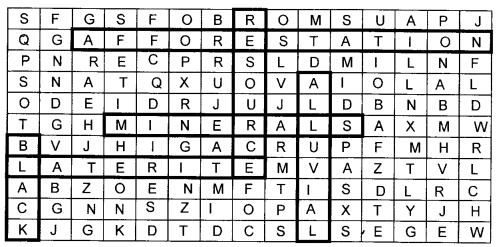
(i) Natural endowments in the form of land, water, vegetation and minerals.
Answer: Resource
(ii) A type of non-renewable resource.
Answer: Minerals
(iii) Soil with high water retaining capacity.
Answer: Laterite
(iv) Intensively leached soils of the monsoon climate.
Answer: Black
(v) Plantation of trees on a large scale to check soil erosion.
Answer: Afforestation
(vi) The Great Plains of India are made up of these soils.
Answer: Alluvial.
We Think the given NCERT Solutions for class 10 Geography Social Science Chapter 1 Resource and Development with Answers Pdf free download will assist you. If you’ve got any queries regarding CBSE Class 10 Social Science Resource and Development NCERT Solutions with Answers, drop a comment below and that we will come back to you soons.