Learn the complete SSC preparation strategy for beginners, including how to select the right SSC exam, understand the syllabus, build subject-wise basics, practice PYQs, use mock tests, improve speed and accuracy, maintain an error notebook, revise effectively and follow a practical 90-day or 6-month study plan.
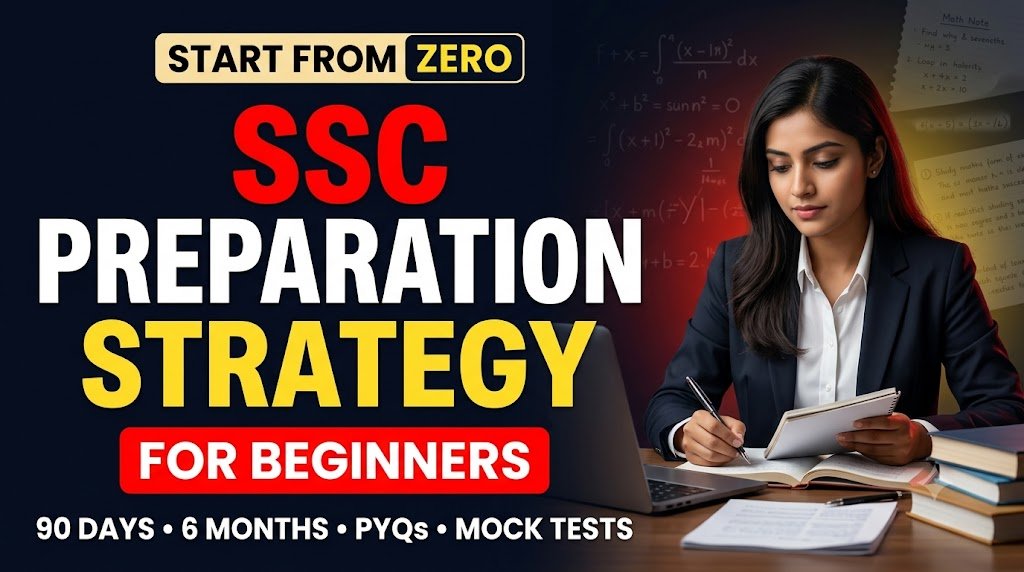
SSC Preparation Strategy for Beginners: Complete Roadmap from Zero to Selection
SSC exams are among the most popular government job examinations in India. Every year, a large number of candidates prepare for examinations such as SSC CGL, SSC CHSL, SSC MTS, SSC GD, SSC CPO, SSC JE, SSC Stenographer, SSC Translator and SSC Selection Post.
For someone starting from zero, the biggest challenge is usually not a lack of hard work. It is a lack of a clear direction.
Many beginners start by watching random classes, downloading study PDFs, purchasing several books and attempting mock tests without first understanding the exam. After some time, they become confused about what to study, which topics are important, how much time to give each subject and when to begin full-length tests.
A structured approach can make SSC preparation much more manageable.
A simple preparation cycle is:
Understand the exam → Learn the basics → Practice questions → Solve PYQs → Attempt tests → Analyze mistakes → Revise → Improve accuracy and speed
This guide explains a practical SSC preparation strategy for beginners that can be followed by students preparing from home, college students and working aspirants.
What Is SSC?
SSC stands for Staff Selection Commission. It conducts recruitment examinations for various posts in central government ministries, departments, offices and organizations.
SSC jobs attract candidates because they can offer:
- Government employment
- Stable career opportunities
- Salary and applicable allowances
- Promotion opportunities
- Different job profiles
- Central government service benefits
- Opportunities for candidates with different educational qualifications
Some major SSC examinations are:
- SSC CGL
- SSC CHSL
- SSC MTS
- SSC GD Constable
- SSC CPO
- SSC JE
- SSC Stenographer
- SSC Translator
- SSC Selection Post
The eligibility criteria, syllabus, examination pattern and selection stages differ between these examinations. Therefore, beginners should first identify their target examination.
Why Beginners Need a Proper SSC Preparation Strategy
Starting preparation without a plan can lead to several problems.
Common difficulties include:
- Not knowing which SSC exam to target
- Confusion between CGL, CHSL, MTS, GD and CPO
- Weak mathematical fundamentals
- Low confidence in English
- Difficulty managing General Awareness
- Lack of regular practice
- Ignoring previous year questions
- Taking mock tests without analysis
- Collecting too many books and PDFs
- Irregular revision
- Poor time management
- Repeating the same mistakes
A proper strategy gives your preparation a direction.
Instead of studying everything randomly, you can divide your preparation into foundation, practice, PYQ, mock test and revision phases.
Step 1: Select the Right SSC Exam
The first decision should be your target examination.
Your choice should depend on your educational qualification, age eligibility, interest, preferred job profile and career objective.
Preparing simultaneously for several unrelated SSC exams can create unnecessary confusion because their selection processes and requirements are not identical.
SSC Exams Based on Qualification
| Qualification | Suitable SSC Exams |
|---|---|
| 10th Pass | SSC MTS, SSC GD, Havaldar, Matric-Level Selection Post |
| 12th Pass | SSC CHSL, SSC Stenographer, Higher Secondary-Level Selection Post |
| Graduation | SSC CGL, SSC CPO, Graduate-Level Selection Post |
| Engineering Diploma/Degree | SSC JE |
| Relevant Language Qualification | SSC Translator |
How to Select Your Target Examination
Choose SSC CGL If:
- You are a graduate.
- You want Group B or Group C government positions.
- You are comfortable with a competitive examination.
- You want opportunities for career progression.
- You are ready to study Quant, Reasoning, English and General Awareness seriously.
Choose SSC CHSL If:
- You have completed Class 12.
- You are interested in clerical or office-oriented government positions.
- You are willing to develop typing or data-entry skills where required.
- You want to enter central government service after 12th.
Choose SSC MTS If:
- You are eligible with the required 10th-level qualification.
- You want to target entry-level central government positions.
- You prefer a comparatively basic-level written examination.
Choose SSC GD If:
- You meet the educational eligibility.
- You are interested in uniformed service.
- You are physically fit.
- You are prepared for physical and medical requirements.
Choose SSC CPO If:
- You are a graduate.
- You want a Sub-Inspector-level uniformed career.
- You are ready for written examination as well as physical and medical stages.
Choose SSC JE If:
- You have the required engineering qualification.
- Your background is Civil, Mechanical or Electrical Engineering, depending on the post.
- You are interested in a technical government position.
- You are prepared to study technical subjects in depth.
Choose SSC Stenographer If:
- You have completed the required 12th-level qualification.
- You are interested in shorthand and transcription.
- You prefer a skill-based office career.
Keep One Main Exam and One Backup
A useful strategy for beginners is to select one primary examination and one compatible backup examination.
| Main Exam | Possible Backup Exam |
| SSC CGL | Selection Post |
| SSC CHSL | MTS / Selection Post |
| SSC GD | MTS / Havaldar |
| SSC CPO | CGL / GD |
| SSC JE | Selection Post |
| SSC Stenographer | CHSL / Selection Post |
Do not change your target every few weeks. A focused preparation plan is generally more productive than constantly switching examinations.
Step 2: Understand the SSC Exam Pattern
After selecting the exam, study its current examination pattern carefully.
Before beginning preparation, know:
- Number of examination stages
- Subjects
- Number of questions
- Marks
- Time limit
- Negative marking
- Skill or typing requirements
- Physical requirements, if applicable
- Technical paper requirements, if applicable
- Final selection process
For example, candidates preparing for SSC CHSL should understand its current Tier-I, Tier-II and applicable skill or typing requirements.
Similarly, SSC GD candidates need to understand the written examination along with PET, PST, medical and document-related stages.
SSC JE candidates need to give special attention to the technical portion along with the relevant written papers.
Make an Exam Information Sheet
Write the following information in your notebook:
- Target examination
- Eligibility
- Examination stages
- Subjects
- Marks
- Time duration
- Negative marking
- Skill/physical requirements
- Final selection procedure
Keeping this information in front of you helps prevent unnecessary preparation.
Step 3: Understand the SSC Syllabus
The syllabus works like a boundary for your preparation.
Without syllabus awareness, beginners often spend hours studying topics that have little value for their target exam while missing important areas.
Common SSC subjects include:
- Quantitative Aptitude
- Reasoning
- English
- General Awareness
Depending on the examination, candidates may also need:
- Computer Knowledge
- Typing
- Data Entry Skills
- Stenography
- Physical preparation
- Technical subjects
- Translation
- Essay or descriptive preparation
Build a Subject-Wise Checklist
Quantitative Aptitude Checklist
- Number System
- Simplification
- Percentage
- Ratio and Proportion
- Average
- Profit and Loss
- Simple Interest
- Compound Interest
- Time and Work
- Time, Speed and Distance
- Algebra
- Geometry
- Mensuration
- Data Interpretation
Reasoning Checklist
- Analogy
- Classification
- Series
- Coding-Decoding
- Blood Relation
- Direction Test
- Ranking
- Syllogism
- Venn Diagram
- Non-Verbal Reasoning
English Checklist
- Parts of Speech
- Tenses
- Articles
- Prepositions
- Subject-Verb Agreement
- Error Detection
- Sentence Improvement
- Vocabulary
- Reading Comprehension
- Cloze Test
- Synonyms and Antonyms
- Idioms and Phrases
- One Word Substitution
General Awareness Checklist
- History
- Geography
- Indian Polity
- Economy
- General Science
- Current Affairs
- Static GK
- Important government schemes
- Awards
- Sports
- Important days
- Books and authors
Step 4: Build Your Basics Before Chasing Speed
One of the biggest mistakes beginners make is trying to learn advanced shortcuts immediately.
A better approach is:
Concept → Formula/Rule → Basic Questions → Moderate Questions → PYQs → Timed Practice
If your fundamentals are weak, shortcuts may create more confusion.
Quantitative Aptitude Preparation
Mathematics can become a scoring section with regular practice.
Start with fundamental arithmetic topics such as:
- Number System
- Percentage
- Ratio
- Average
- Profit and Loss
- Simple Interest
- Compound Interest
- Time and Work
- Speed and Distance
Recommended Quant Practice Cycle
- Understand the concept.
- Learn the required formula.
- Solve simple examples.
- Practice 30–50 questions.
- Solve topic-wise PYQs.
- Take a short topic test.
- Record and revise mistakes.
Do not focus only on shortcuts. First understand why a method works.
Reasoning Preparation
Reasoning can become highly scoring when practiced consistently.
Begin with:
- Analogy
- Classification
- Series
- Coding-Decoding
- Direction
- Blood Relation
- Ranking
- Syllogism
- Venn Diagram
Reasoning Practice Method
- Complete one topic at a time.
- Understand common patterns.
- Start with easy questions.
- Move toward moderate questions.
- Practice mixed question sets.
- Use timed quizzes after developing accuracy.
Reasoning improves mainly through pattern recognition and practice.
English Preparation
English should be part of your daily routine, especially for exams where it carries significant weight.
Start with:
- Parts of Speech
- Tenses
- Articles
- Prepositions
- Subject-Verb Agreement
- Error Detection
- Sentence Improvement
- Vocabulary
- Reading Comprehension
Simple Daily English Routine
- Learn 10 new words.
- Solve 10 grammar questions.
- Practice 5 error-detection questions.
- Solve 5 sentence-improvement questions.
- Read one short passage.
- Revise previously learned vocabulary.
English generally improves gradually. Daily practice is more useful than studying it intensively for only a few days.
General Awareness Preparation
General Awareness can appear difficult because it covers a broad range of subjects.
Focus on:
- History
- Geography
- Polity
- Economy
- General Science
- Static GK
- Current Affairs
Smart GK Strategy
- Use concise notes.
- Practice MCQs.
- Revise frequently.
- Focus on important recurring areas.
- Record facts you repeatedly forget.
- Avoid continuously changing study sources.
The key to GK is not simply reading. Revision is equally important.
Step 5: Create a Practical Daily Study Plan
Beginners often make a timetable that looks impressive on paper but cannot be followed consistently.
Instead of immediately planning 10–12 hours, start with a manageable schedule.
Daily SSC Study Plan for Beginners
| Study Time | Activity |
| 1 Hour | Quantitative Aptitude |
| 1 Hour | Reasoning |
| 1 Hour | English |
| 45 Minutes | General Awareness |
| 30 Minutes | Revision |
| 30 Minutes | Practice Questions |
This gives approximately 4–5 focused hours of preparation.
Study Plan for College or Working Candidates
| Time | Activity |
| 45 Minutes | Quant |
| 45 Minutes | Reasoning |
| 45 Minutes | English |
| 30 Minutes | GK / Current Affairs |
| Weekend | Mock Test + Analysis |
The most important factor is not how many hours you study once. It is whether you can maintain the routine for months.
Step 6: Follow a Weekly Study Structure
A weekly plan helps distribute subjects without creating monotony.
| Day | Primary Focus |
| Monday | Quant + English |
| Tuesday | Reasoning + GK |
| Wednesday | Quant + Vocabulary |
| Thursday | English + Reasoning |
| Friday | GK + Quant |
| Saturday | Sectional Test |
| Sunday | Mock Analysis + Revision |
You can modify this schedule according to your target examination and personal routine.
Step 7: Make Previous Year Questions Your Core Practice
Previous Year Questions (PYQs) are one of the most valuable resources for SSC preparation.
They show you how questions are actually framed and help identify recurring concepts.
Why SSC PYQs Matter
PYQs help you understand:
- Actual question style
- Important topics
- Repeated concepts
- Difficulty level
- Time requirements
- Common traps
- Topic importance
- Real examination trends
How Beginners Should Solve PYQs
Use two stages.
Stage 1: Topic-Wise PYQs
After completing a chapter, solve questions from that specific topic.
Examples:
- Percentage PYQs
- Ratio PYQs
- Coding-Decoding PYQs
- Error Detection PYQs
- Polity PYQs
Stage 2: Full Previous Year Papers
Once a significant portion of the syllabus has been completed, solve complete papers under timed conditions.
This helps combine individual subjects into a realistic examination experience.
A useful rule is:
Every completed topic should eventually be followed by PYQ practice.
Step 8: Introduce Mock Tests Gradually
Mock tests are essential, but beginners do not necessarily need full-length mocks from the first day.
If your basics are still weak, start with smaller tests.
Recommended Mock Test Progression
| Preparation Stage | Recommended Test |
| First 20–30 Days | Topic Tests |
| Basic Concepts Developed | Sectional Tests |
| 50–60% Syllabus Completed | Full-Length Mocks |
| Final Preparation | Full Mocks + PYQ Papers |
Benefits of Mock Tests
Mock tests help improve:
- Speed
- Accuracy
- Time management
- Question selection
- Exam temperament
- Confidence
- Weak-area identification
A mock test should not simply be treated as a scorecard. It should become a learning tool.
Step 9: Analyze Every Mock Test
Giving a mock without analyzing it wastes much of its potential.
Your score tells you where you are. Analysis tells you what needs to change.
Mock Test Error Analysis
| Mistake Category | What It Indicates | What to Do |
| Concept Error | Concept is unclear | Revise the topic |
| Calculation Error | Arithmetic mistake | Practice calculations |
| Silly Error | Lack of attention | Slow down slightly |
| Time Error | Too much time spent | Practice timed sets |
| Guessing Error | Poor question selection | Reduce uncertain attempts |
Questions to Ask After a Mock
- Which section was weakest?
- Which topic produced the most errors?
- Did I spend too long on difficult questions?
- Did I leave easy questions?
- Did I make avoidable calculation mistakes?
- Did I attempt uncertain questions?
- What should I revise before the next test?
For a full mock, spend meaningful time reviewing your answers instead of immediately starting another test.
Step 10: Maintain an SSC Error Notebook
An error notebook can become one of the most useful resources during revision.
Write down:
- Incorrect formulas
- Calculation errors
- Grammar rules
- Vocabulary mistakes
- Forgotten GK facts
- Reasoning patterns
- Difficult questions
- PYQ observations
- Mock-test mistakes
How to Use Your Error Notebook
- Add mistakes after tests.
- Review it weekly.
- Read it before important practice sessions.
- Increase revision frequency during the final month.
The objective is simple:
Do not make the same mistake repeatedly.
Step 11: Improve Speed and Accuracy Together
SSC examinations are time-bound, so candidates need both speed and accuracy.
However, trying to become extremely fast before becoming accurate can increase negative marks.
Ways to Improve Speed
- Practice timed quizzes.
- Improve calculation skills.
- Memorize essential formulas.
- Solve PYQs repeatedly.
- Develop reading speed.
- Identify easy questions quickly.
- Avoid getting stuck on lengthy questions.
Ways to Improve Accuracy
- Read questions carefully.
- Avoid blind guessing.
- Revise weak concepts.
- Analyze incorrect answers.
- Attempt questions according to confidence.
- Control unnecessary over-attempting.
- Practice under exam-like conditions.
Best Rule for Beginners
Accuracy first, speed second.
Once your accuracy becomes stable, increase your speed through timed practice.
Step 12: Prepare General Awareness Through Revision
General Awareness can save valuable examination time because many questions do not require lengthy calculations.
Important areas include:
- History
- Polity
- Geography
- Economy
- General Science
- Current Affairs
- Static GK
- Sports
- Awards
- Books and Authors
- Important Days
- Government Schemes
GK Preparation Rules
- Study a manageable amount every day.
- Prepare short notes.
- Solve MCQs.
- Revise weekly.
- Focus on relevant SSC areas.
- Keep a list of frequently forgotten facts.
Avoid These GK Mistakes
- Collecting unlimited PDFs
- Studying without revision
- Changing sources repeatedly
- Depending entirely on current affairs
- Ignoring static GK
- Reading facts without testing yourself
Step 13: Practice English Every Day
English should not be postponed until the final month.
Daily English Practice Plan
| Activity | Daily Target |
| Vocabulary | 10 Words |
| Grammar Questions | 10 |
| Error Detection | 5 |
| Sentence Improvement | 5 |
| Reading | 1 Passage |
| Previous Vocabulary | Revision |
Important English Topics
- Tenses
- Subject-Verb Agreement
- Articles
- Prepositions
- Active and Passive Voice
- Direct and Indirect Speech
- Error Detection
- Sentence Improvement
- Cloze Test
- Reading Comprehension
- One Word Substitution
- Idioms and Phrases
The most effective method is simple:
Learn → Practice → Check → Revise → Repeat
Step 14: Prepare for Additional Selection Stages
Some SSC examinations involve skill tests, physical tests or technical components.
| Exam | Additional Requirement |
| SSC CHSL | Typing / Data Entry Skill Test |
| SSC Stenographer | Shorthand and Transcription |
| SSC GD | PET/PST and Medical |
| SSC CPO | PET/PST and Medical |
| SSC JE | Technical Subject |
| SSC Translator | Translation and Essay |
Do not wait until the written result before starting preparation for these stages.
For example:
- CHSL candidates can practice typing regularly.
- GD and CPO candidates can develop physical fitness early.
- Stenographer candidates should practice shorthand consistently.
- JE candidates should study technical subjects from the beginning.
- Translator candidates should regularly practice translation.
90-Day SSC Preparation Strategy for Beginners
A three-month plan can provide a clear structure for candidates who need a focused roadmap.
Days 1–30: Foundation Phase
Focus on:
- Understanding the target exam
- Studying the syllabus
- Learning Quant basics
- Building Reasoning fundamentals
- Starting English grammar
- Creating GK notes
- Building vocabulary
- Solving basic questions
Target by Day 30
- Basic concepts understood
- Formula notebook started
- Vocabulary notebook created
- Topic-wise practice started
- Daily revision habit established
Days 31–60: Practice Phase
Focus on:
- Topic-wise questions
- Previous year questions
- Sectional tests
- English practice
- GK MCQs
- Formula revision
- Error notebook
Target by Day 60
- Major topics covered
- PYQ practice underway
- Sectional tests introduced
- Weak areas identified
- Accuracy gradually improving
Days 61–90: Mock and Revision Phase
Focus on:
- Full-length mocks
- Mock analysis
- Previous year papers
- Formula revision
- GK revision
- Error notebook
- Weak-topic improvement
- Speed and accuracy
Target by Day 90
- Better examination familiarity
- Improved time management
- Stronger accuracy
- Organized revision material
- Clear attempt strategy
6-Month SSC Preparation Strategy
Candidates with more preparation time can use a six-month roadmap.
Month 1: Foundation
- Understand the examination.
- Study the syllabus.
- Start Quant basics.
- Begin Reasoning.
- Learn English grammar.
- Start GK notes.
- Establish a daily routine.
Month 2: Topic Development
- Complete major arithmetic fundamentals.
- Cover important reasoning topics.
- Continue grammar practice.
- Study static GK.
- Solve basic and moderate questions.
Month 3: PYQ Phase
- Begin topic-wise PYQs.
- Introduce sectional tests.
- Revise formulas.
- Revise grammar rules.
- Maintain an error notebook.
Month 4: Intensive Practice
- Solve mixed question sets.
- Attempt timed quizzes.
- Work on weak topics.
- Practice GK MCQs.
- Start full mocks if your preparation is sufficiently advanced.
Month 5: Mock Test Phase
- Attempt regular full-length mocks.
- Analyze every test.
- Solve complete PYQ papers.
- Track accuracy.
- Reduce repeated mistakes.
- Improve question selection.
Month 6: Final Revision
- Revise the error notebook.
- Revise formulas.
- Revise GK notes.
- Attempt exam-level mocks.
- Finalize your attempt strategy.
- Avoid unnecessary new study sources.
Best SSC Study Material Strategy for Beginners
One common mistake is collecting too much study material.
Having ten books does not guarantee better preparation.
A simpler approach is to use limited, reliable resources and revise them repeatedly.
| Subject | Recommended Resource Approach |
| Quant | One Concept Source + PYQs |
| Reasoning | One Practice Source + PYQs |
| English | Grammar + Vocabulary + PYQs |
| GK | Static Notes + Relevant Current Affairs |
| Mock Tests | One Reliable Test Series |
| Revision | Self-Made Short Notes |
The goal should be:
Fewer resources + more revision + more practice.
Common SSC Preparation Mistakes Beginners Should Avoid
Avoid these mistakes during your preparation:
- Starting without selecting an exam
- Ignoring the official syllabus
- Not understanding the examination pattern
- Collecting too many books
- Changing teachers and sources repeatedly
- Learning shortcuts without understanding concepts
- Avoiding PYQs
- Taking mocks without analysis
- Ignoring revision
- Leaving English for the end
- Studying GK without practicing MCQs
- Ignoring typing or physical preparation
- Comparing your preparation with other candidates
- Changing your timetable every few days
- Preparing inconsistently
A consistent average routine is often better than an ambitious routine that lasts only one week.
Practical SSC Preparation Strategy for Beginners
A beginner can remember the entire preparation process through this simple sequence:
1. Select your target exam.
2. Check eligibility and selection stages.
3. Understand the syllabus.
4. Learn the examination pattern.
5. Build subject fundamentals.
6. Practice questions topic by topic.
7. Solve previous year questions.
8. Start sectional tests.
9. Move to full-length mocks.
10. Analyze every test.
11. Maintain an error notebook.
12. Revise repeatedly.
13. Improve speed and accuracy.
14. Prepare for additional skill or physical stages.
15. Stay consistent until the examination.
SSC Preparation Strategy: Subject-Wise Priority
| Subject | Beginner Priority | Main Focus |
| Quant | High | Concepts, formulas, PYQs, calculations |
| Reasoning | High | Patterns, practice, timed questions |
| English | High | Grammar, vocabulary, comprehension |
| General Awareness | High | Static GK, science, current affairs, revision |
| Computer | As Applicable | Basic concepts and practice |
| Typing | As Applicable | Regular speed and accuracy practice |
| Physical | As Applicable | Fitness and required standards |
| Technical | As Applicable | Core technical syllabus |
How to Know Whether Your SSC Preparation Is Improving
Do not judge your preparation only by the number of hours studied.
Track measurable improvements such as:
- Increasing mock-test accuracy
- Reducing silly mistakes
- Solving questions faster
- Improving sectional scores
- Completing more PYQs
- Remembering formulas better
- Improving vocabulary
- Reducing time spent on difficult questions
- Increasing confidence during timed tests
Your progress should be measured through performance, not just study hours.
FAQs on SSC Preparation for Beginners
Q1. How should I start SSC preparation from zero?
Start by selecting the appropriate SSC examination. Then understand its eligibility, syllabus, examination pattern and selection stages. Build basic concepts in Quant, Reasoning, English and General Awareness before moving toward extensive PYQ and mock-test practice.
Q2. Which SSC exam is easiest for beginners?
There is no single SSC exam that is easiest for everyone. The suitable exam depends on your educational qualification, skills, interests and career goals. Candidates should compare the eligibility, syllabus, competition and selection process before deciding.
Q3. How many hours should a beginner study for SSC?
A beginner can start with around 4–5 focused hours per day and gradually increase study time if required. Consistency, concentration and quality of practice are more important than simply counting hours.
Q4. Can SSC preparation be done without coaching?
Yes. Candidates can prepare independently using quality study material, previous year papers, mock tests, revision notes and a disciplined timetable. Coaching may provide additional guidance, but self-study can also be effective when the preparation is structured.
Q5. Which subject should I study first for SSC?
Instead of completing one subject entirely before starting another, it is generally better to study the major subjects together. Give regular time to Quant, Reasoning, English and General Awareness according to your target examination.
Q6. Are SSC previous year questions important?
Yes. PYQs help candidates understand question patterns, frequently tested concepts, difficulty levels and time requirements. Topic-wise PYQs are particularly useful during the foundation and practice stages.
Q7. When should beginners start mock tests?
Start with topic-wise and sectional tests after building basic concepts. Full-length mocks can be introduced once a substantial portion of the syllabus has been completed.
Q8. How can I improve my SSC mock-test score?
Do not focus only on taking more mocks. Analyze every test, identify conceptual errors, calculation mistakes, time-management problems and unnecessary attempts, then revise those areas before taking the next test.
Q9. Is English important in SSC preparation?
Yes. English is an important component of several SSC examinations. Beginners should practice grammar, vocabulary, comprehension and question-solving regularly instead of postponing English preparation.
Q10. How can I remember General Awareness for SSC?
Use concise notes, practice MCQs and revise repeatedly. Instead of continuously collecting new material, focus on revising the material you have already studied.
Conclusion
A successful SSC preparation strategy for beginners does not require studying everything at once. It requires a clear target, organized study material, regular practice and continuous improvement.
Start by choosing the right examination and understanding its syllabus and pattern. Build your foundation before focusing heavily on speed. Use SSC previous year questions to understand real question trends and introduce mock tests gradually.
Most importantly, analyze your mistakes.
Your preparation should follow this cycle:
Learn → Practice → Solve PYQs → Test → Analyze → Revise → Improve
Do not become discouraged by low scores in your initial tests. Early mistakes are useful when you learn from them.
With consistent study, proper revision, regular PYQ practice and disciplined mock-test analysis, beginners can build a strong foundation for their SSC journey and move steadily toward their selection goal.