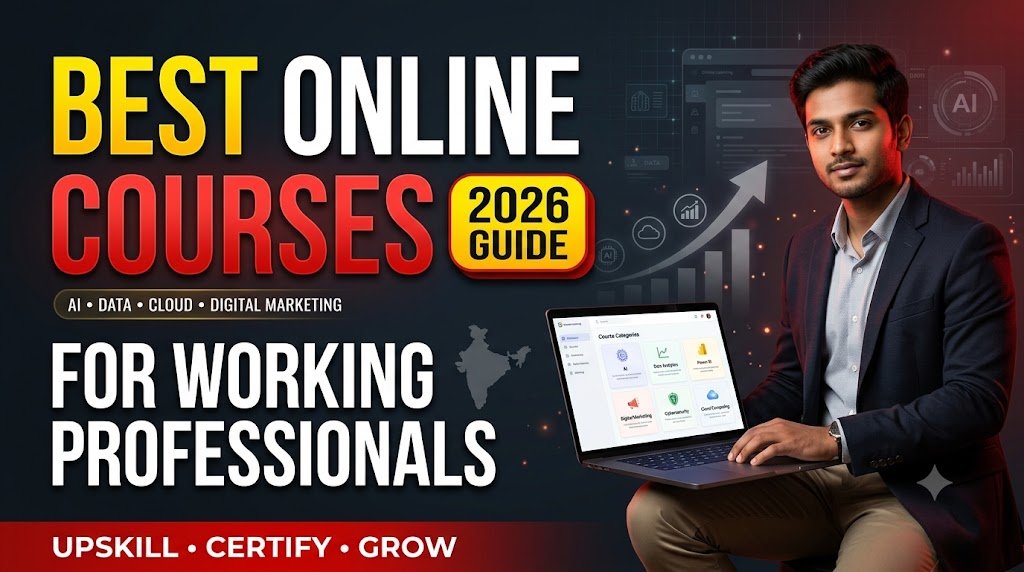
India’s professional landscape is changing rapidly. Artificial Intelligence, automation, cloud technology, data-driven decision-making, and digital transformation are reshaping how companies hire, manage, and develop talent. For working professionals, simply relying on existing qualifications may no longer be enough to remain competitive.
Continuous upskilling can help professionals prepare for promotions, career transitions, better-paying roles, and changing workplace requirements. The good news is that professionals no longer need to leave their jobs to continue their education. Online courses for working professionals provide flexible learning options that can fit around office hours, family responsibilities, and other commitments.
From Generative AI and Data Analytics to Digital Marketing, Cybersecurity, Leadership, Project Management, and Financial Management, there are numerous programs designed to develop practical and career-oriented skills.
This guide explores the best online courses for working professionals in India, the benefits of online learning, important factors to consider before enrolling, and the skills that can support long-term career growth.
Why Should Working Professionals Choose Online Courses?
Online education has become a practical alternative to traditional classroom learning. Professionals can develop new skills without taking a career break or relocating to another city.
Some major benefits include:
- Learn from anywhere with an internet connection
- Study before or after office hours
- Choose self-paced or flexible programs
- Reduce commuting and classroom expenses
- Learn job-relevant and emerging skills
- Work on practical assignments and projects
- Earn professional certificates
- Improve your resume and LinkedIn profile
- Prepare for promotions or career changes
- Explore high-demand career fields
A well-designed online working professional course can make it easier to combine employment with continuous professional development.
Benefits of Online Courses for Working Professionals
1. Flexibility and Convenience
One of the biggest advantages of online education is flexibility. Professionals can study during evenings, weekends, or other free hours instead of following a rigid classroom timetable.
This makes online learning particularly useful for people working full-time.
2. Affordable Learning Options
Many online programs cost less than traditional full-time courses because learners do not need to relocate or spend money on daily transportation and accommodation.
There are also free and low-cost courses available for professionals who want to explore a subject before making a larger investment.
3. Industry-Relevant Skills
Online programs can focus on practical skills currently used in workplaces. Areas such as AI, Power BI, digital marketing, cybersecurity, cloud computing, and data analytics are increasingly relevant across different industries.
4. Professional Certifications
A certificate from a credible institution or recognized training provider can demonstrate that you have completed structured learning in a particular area.
However, professionals should evaluate the reputation, curriculum, practical training, and industry relevance of a certification rather than choosing a course based only on the certificate.
5. Career Growth Opportunities
Upskilling can help professionals prepare for:
- Promotions
- Internal job opportunities
- Career changes
- New responsibilities
- Freelancing opportunities
- Management positions
- Higher-value technical roles
13 Best Online Courses for Working Professionals in India
The best course depends on your existing experience, career objective, industry, and desired role. The following options cover several high-demand technical, business, and professional skills.
1. Generative AI and Prompt Engineering
Generative AI has become an important workplace technology. Professionals across marketing, software development, HR, finance, education, and business operations can use AI tools to improve productivity.
A Generative AI course can introduce learners to AI applications, prompt engineering, automation, AI-assisted content creation, and workplace productivity.
Best For
- Software professionals
- Marketing professionals
- Business owners
- Managers
- HR professionals
- Content professionals
Skills You Can Learn
- Prompt Engineering
- Generative AI fundamentals
- AI productivity tools
- AI-assisted content creation
- Workflow automation
- Business applications of AI
2. Business Intelligence with Power BI
Businesses generate large amounts of information every day. Power BI helps professionals convert data into interactive dashboards, reports, and business insights.
A Power BI certification course can be useful for professionals who work with reporting, business operations, finance, sales, HR, or analytics.
Skills You Can Learn
- Data visualization
- Dashboard creation
- Interactive reporting
- KPI tracking
- Business intelligence
- Data interpretation
Suitable For
- Business analysts
- Finance professionals
- HR professionals
- Managers
- Data professionals
3. Digital Marketing
Businesses increasingly depend on online channels to attract customers and build their brands. Digital marketing therefore remains a useful skill for both marketing professionals and entrepreneurs.
A digital marketing certification course can cover search, advertising, social media, analytics, and content strategies.
Topics May Include
- Search Engine Optimization
- Social Media Marketing
- Google Ads
- Content Marketing
- Email Marketing
- Web Analytics
- Online Branding
Professionals can also combine digital marketing knowledge with AI tools to improve content production and campaign efficiency.
4. Data Analytics
Data Analytics enables organizations to understand business performance and make better decisions.
Professionals who develop analytical skills can explore opportunities in industries such as banking, healthcare, retail, e-commerce, consulting, and technology.
Key Skills
- Microsoft Excel
- SQL
- Data cleaning
- Data visualization
- Reporting
- Business insights
- Analytical thinking
A data analytics course for working professionals can be particularly useful for people looking to transition into analytical roles.
5. Leadership and Management
Technical expertise alone may not be enough when professionals move into senior positions. Leadership and management skills become increasingly important as responsibilities grow.
A leadership program can help professionals strengthen decision-making, communication, delegation, conflict management, and team-building abilities.
Suitable For
- Team leaders
- Managers
- Project heads
- Department executives
- Entrepreneurs
- Professionals preparing for management roles
Skills Covered
- Team management
- Decision-making
- Delegation
- Conflict resolution
- Strategic thinking
- Emotional intelligence
6. Business Communication and Professional Skills
Strong communication can directly influence workplace performance. Professionals regularly need to communicate with colleagues, clients, managers, and business partners.
A business communication course can help improve professional writing, presentations, meetings, and interpersonal communication.
Skills You Can Develop
- Business communication
- Presentation skills
- Public speaking
- Professional email writing
- Client communication
- Interpersonal skills
- Workplace confidence
7. Project Management
Project management skills are valuable across IT, construction, consulting, finance, marketing, operations, and many other sectors.
A project management course teaches professionals how to organize resources, manage deadlines, control risks, and coordinate teams.
Key Areas
- Project planning
- Resource allocation
- Budget management
- Risk management
- Team coordination
- Agile methodologies
- Project execution
Professionals can also consider recognized certifications such as PMP or Agile-related credentials depending on their career goals and eligibility.
8. Cybersecurity Fundamentals
As organizations become increasingly dependent on digital systems, cybersecurity awareness and expertise have become essential.
A cybersecurity course for working professionals can provide foundational knowledge of cyber threats, data protection, network security, and risk management.
Topics Include
- Cybersecurity fundamentals
- Common cyber threats
- Network security basics
- Data protection
- Password and access security
- Security awareness
- Risk management
Technical professionals can progress toward advanced cybersecurity certifications after building the required foundational knowledge.
9. Cloud Computing
Cloud platforms are widely used for software, storage, databases, applications, and business infrastructure.
Learning cloud fundamentals can benefit IT professionals who want to move toward cloud administration, development, infrastructure, or security.
Skills May Include
- Cloud computing fundamentals
- Virtual machines
- Cloud storage
- Databases
- Cloud services
- Cloud security
- Infrastructure concepts
Popular cloud ecosystems include AWS, Microsoft Azure, and Google Cloud.
10. Financial Management
Financial knowledge is valuable beyond traditional finance roles. Managers, entrepreneurs, business owners, and professionals involved in decision-making can benefit from understanding financial concepts.
A financial management course may cover:
- Budgeting
- Financial planning
- Business finance
- Investment fundamentals
- Financial analysis
- Cash-flow management
- Business performance
These skills can help professionals make more informed business decisions.
11. AI for Business Professionals
Not every professional who wants to use AI needs to become a programmer.
AI for business courses can focus on practical applications such as productivity improvement, document processing, business analysis, workflow automation, customer support, and decision-making.
Perfect For
- HR professionals
- Sales teams
- Marketing professionals
- Managers
- Entrepreneurs
- Operations professionals
Useful Skills
- AI-assisted productivity
- Business automation
- AI workflow design
- AI-based research
- Business applications of AI
- Responsible AI usage
12. Retail and Sales Management
Retail and sales professionals can improve their performance by learning modern customer management, sales strategies, and operational practices.
A specialized program may cover:
- Sales techniques
- Customer relationship management
- Retail operations
- Inventory management
- Customer experience
- Sales performance
- Business development
These skills can be useful for professionals working in retail stores, e-commerce, consumer businesses, and sales organizations.
13. Entrepreneurship and Business Development
Professionals planning to launch a startup, family business, consultancy, or side venture can benefit from entrepreneurship education.
An entrepreneurship course can introduce learners to the fundamentals of planning, marketing, finance, customer acquisition, and business growth.
Ideal For
- Startup founders
- Entrepreneurs
- Small business owners
- Family business professionals
- Aspiring business owners
Topics May Include
- Business planning
- Market research
- Branding
- Marketing strategy
- Financial planning
- Customer acquisition
- Business development
Top Online Course Categories at a Glance
| Course Category | Best For | Key Skills |
|---|---|---|
| Generative AI | Professionals across industries | Prompt Engineering, AI Tools, Automation |
| Power BI | Analysts and business professionals | Dashboards, Reporting, Data Visualization |
| Digital Marketing | Marketing professionals and entrepreneurs | SEO, Ads, Social Media, Analytics |
| Data Analytics | Data-focused professionals | Excel, SQL, Reporting, Data Analysis |
| Leadership | Managers and team leaders | Team Management, Decision-Making |
| Communication | Professionals in all industries | Presentation, Writing, Public Speaking |
| Project Management | Project professionals | Planning, Risk, Budget, Agile |
| Cybersecurity | IT and security professionals | Threats, Security, Data Protection |
| Cloud Computing | IT professionals | Cloud Services, Storage, Infrastructure |
| Financial Management | Managers and entrepreneurs | Budgeting, Financial Planning |
| AI for Business | Non-technical professionals | Automation, AI Productivity |
| Retail & Sales | Retail and sales professionals | CRM, Sales, Operations |
| Entrepreneurship | Business owners and founders | Business Planning, Marketing, Growth |
Advanced Education and Professional Certifications
Working professionals may also consider advanced programs when their career requires deeper specialization or formal qualifications.
| Program | Career Relevance | Potential Learning Areas |
| Online MBA | Management and career advancement | Strategy, Marketing, Finance, Leadership |
| Executive Management Programs | Experienced professionals | Business Strategy, Decision-Making |
| HR Certifications | Human resource careers | Talent Management, Recruitment, Employee Relations |
| Leadership Certifications | Management positions | Change Management, Team Leadership |
| Project Management Certifications | Project-based careers | Agile, Planning, Risk Management |
| Six Sigma Certifications | Process improvement | Quality Management, Process Optimization |
| IT Service Management | IT operations | Service Management, IT Processes |
| Data & Analytics Certifications | Data-driven careers | Analytics, Visualization, Business Intelligence |
The right qualification depends on your current experience and long-term career direction. Professionals should always check eligibility requirements and the recognition of a certification before enrolling.
How to Choose the Best Online Course for Working Professionals
With hundreds of programs available online, selecting the right course can be challenging. Consider these factors before making a decision.
1. Define Your Career Objective
Start by identifying what you want to achieve.
Ask yourself:
- Do I want a promotion?
- Am I planning a career switch?
- Do I want to increase my earning potential?
- Do I need a new technical skill?
- Am I preparing for a management position?
- Do I want to start a business?
Your objective should determine your course selection.
2. Check Industry Demand
Look for skills that are relevant to your target industry and desired role.
For example:
- IT professionals may explore cloud computing or cybersecurity.
- Analysts may consider Power BI and Data Analytics.
- Marketing professionals may learn SEO, advertising, and AI.
- Managers may benefit from leadership and project management.
- Entrepreneurs may explore business development and financial management.
3. Evaluate the Course Curriculum
Do not select a course based only on its title.
Review whether the curriculum includes:
- Current industry topics
- Practical assignments
- Real-world projects
- Case studies
- Tools used by professionals
- Assessments
- Updated learning materials
A practical curriculum can be more valuable than a program focused only on theory.
4. Verify Certification and Provider Credibility
Before paying for a course, research the organization providing it.
Consider:
- Institutional reputation
- Trainer expertise
- Industry relevance
- Certification details
- Student reviews
- Course duration
- Learning support
- Refund or enrollment policies
A certificate should complement actual skills rather than replace them.
5. Choose a Schedule You Can Maintain
Working professionals should select a learning format that fits their lifestyle.
Depending on the provider, options may include:
- Self-paced learning
- Evening classes
- Weekend sessions
- Recorded lectures
- Live online classes
- Hybrid learning
Consistency is more important than choosing the longest or most expensive course.
6. Compare Cost and Expected ROI
Course fees should be considered alongside the potential career benefit.
Instead of asking only “How much does this course cost?”, consider:
What skills will I gain, and how useful are those skills for my target role?
Compare curriculum quality, practical learning, certification, support, and career relevance before making a decision.
Why Choose SAGE Extension for Professional Learning?
Professionals searching for career-focused online learning may explore programs offered by SAGE Extension.
Its learning options include professional and technology-oriented areas such as:
- Generative AI
- Business Intelligence with Power BI
- Communication Skills
- Leadership Skills
- AI-Based Virtual Assistants
- AI-Powered Facial Recognition
- Professional Skill Development
The suitability of any program depends on the learner’s career objective, existing knowledge, and desired specialization. Before enrollment, professionals should review the latest curriculum, duration, certification details, and course requirements.
Online Courses vs Traditional Courses
| Factor | Online Courses | Traditional Courses |
| Flexibility | High | Usually fixed schedule |
| Location | Learn remotely | Usually campus/classroom based |
| Working While Studying | Easier | Can be difficult |
| Learning Pace | Often flexible | Usually structured |
| Commuting | Not required | Often required |
| Course Variety | Very broad | Depends on institution |
| Practical Learning | Depends on provider | Depends on program |
| Certification | Available for many programs | Available depending on institution |
For working professionals, online learning can be especially convenient because it allows education to continue alongside employment.
Career Benefits of Upskilling
Learning a new skill does not automatically guarantee a promotion or salary increase. However, relevant skills can strengthen a professional’s profile and improve readiness for new opportunities.
Upskilling may help professionals:
- Qualify for new responsibilities
- Apply for internal positions
- Transition into another career field
- Improve workplace productivity
- Build a stronger professional profile
- Develop confidence with new technologies
- Prepare for leadership positions
- Create additional freelance opportunities
The strongest results generally come when learning is combined with practical experience and demonstrable projects.
Final Thoughts
The modern workplace rewards professionals who are willing to learn and adapt. As AI, automation, analytics, cloud computing, cybersecurity, and digital business continue to influence organizations, acquiring relevant skills can help professionals remain prepared for future opportunities.
The best online courses for working professionals in India are not necessarily the most expensive or popular programs. The right choice is the course that matches your career objective, current skill level, available time, budget, and target industry.
Whether you want to learn Generative AI, Power BI, Data Analytics, Digital Marketing, Cybersecurity, Cloud Computing, Project Management, Leadership, or Financial Management, focus on practical learning and skills that you can apply in your professional life.
For working professionals, continuous learning is no longer simply an educational activity. It can become an important part of long-term career development.
Frequently Asked Questions (FAQs)
Which is the best online course for working professionals in India?
Popular options include Generative AI, Data Analytics, Power BI, Digital Marketing, Cybersecurity, Cloud Computing, Project Management, Leadership, and Business Communication. The best course depends on your career goal and existing experience.
Are online certification courses useful for working professionals?
Yes, a credible certification can demonstrate structured learning and add value to a professional profile. However, practical skills, experience, and the reputation of the certification provider are also important.
Can I study an online course while working full-time?
Yes. Many online programs offer self-paced learning, recorded classes, evening sessions, or weekend schedules designed to accommodate working professionals.
Which online courses have strong career potential?
Fields such as Artificial Intelligence, Data Analytics, Cybersecurity, Cloud Computing, Business Intelligence, and Digital Marketing can offer strong career opportunities, depending on industry demand and the learner’s skills.
Is an online MBA suitable for working professionals?
An online MBA can be useful for professionals seeking broader business knowledge or management-oriented career paths. Before enrolling, check the institution, accreditation/recognition, curriculum, specialization, and program suitability.
How long does it take to complete an online course?
Duration varies considerably. Short certification programs may take a few weeks, while advanced professional programs can take several months or longer.
How do I choose the right online course?
Start with your career goal, then compare industry demand, curriculum, practical projects, certification value, course provider, flexibility, cost, and learner reviews before enrolling.
Can online courses help with a career switch?
They can help you build foundational knowledge and demonstrate commitment to a new field. For a successful career switch, combine the course with practical projects, portfolio work, networking, and relevant experience whenever possible.