
We have Provided the CBSE Solutions chapter-wise. Class 7 English Honeycomb Prose Chapter 7 The Invention of Vita Wonk with Answers by expert subject teacher for latest syllabus and examination. Students can take a free CBSE Solutions of The Invention of Vita Wonk. Each question has right answer Solved by Expert Teacher.
CBSE Solutions Class 7 English Honeycomb Prose
Page No. 101
Comprehension Check
Q1. Choose the right answer.
(i) Mr Willy Wonka is
(a) a cook,
(b) an inventor,
(c) a manager.
Answer: (b) an inventor
(ii) Wonka-Vite makes people
(a) older,
(b) younger.
Answer: (b) younger
(iii) Mr Wonka wants to invent a new thing which will make people
(a) younger,
(b) older.
Answer: (b) older
Q2. Can anyone’s age be a minus number ? What does “minus 87” mean?
Answer: No, it is impossible for anyone’s age to be a minus number? “Minus 87” means that it will take 87 years for the person to be bom.
Q3. Mr Wonka begins by asking himself two questions.
What are they?
(i) What is ….
(ii) What lives …….
Answer:
(i) What is the oldest living thing in the world?
(ii) What lives longer than anything else?
Working with the Text
Q1. (i) What trees does Mr Wonka mention? Which tree does he say lives the longest?
Answer: Mr Wonka mentions several trees. The four important ones are—Douglas Fir, Oak and Bristlecone pine. Of them he says Bristlecone pine lives the longest. It lives for 4000 years.
(ii) How long does this tree live? Where can you find it?
Answer: The bristlecone tree lives around 4000 years and we can find that tree upon the slopes of wheeler peak in Nevada, USA.
Q2. How many of the oldest living things can you remember from Mr Wonka’s list? (Don’t look back at the story!) Do you think all these things really exist, or are some of them purely imaginary?
Answer: Here are the oldest living things that are enlisted by Mr Wonka:
A 4000-year-old bristlecone pine
A 168-year-old Russian farmer
A 200-year-old tortoise
A 51-year-old horse
A 36-year-old cat
A 207-year-old giant rat
A 97-year-old grimalkin
A 700-year-old cattalo
A 36-year-old-flea
I think most of them exist while some might be purely imaginary.
Q3. Why does Mr Wonka collect items trom the oldest things? Do you think this is the right way to begin his invention?
Answer: In his invention Mr. Wonka wants the things to grow old. That is why he collects items from the oldest living things. I think this is the right way to begin his invention. And it gave him positive results also.
Q4. What happens to the volunteer who swallows four drops of the new invention? What is the name of the invention?
Answer: The volunteer who swallows the four drops of the new invention, suddenly becomes very old. His hair drop off, his teeth start falling. He begins wrinkling and shrivelling up all over. He is a twenty-year-old man but now he looks seventy five.
Working with Language
Q1. What do you call these insects in your language?
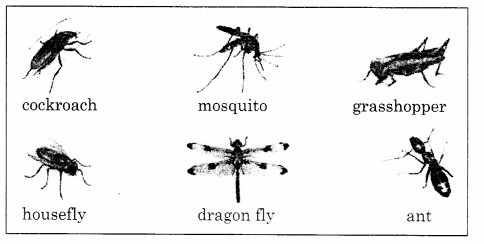
How do these insects effect your health? Have a discussion
in the class.
Answer: The cockroach is also a cockroach in our language, the mosquito is named as “Machar”, the grasshopper is known as “ankh futta”, housefly as “makkhi”, dragonfly as “vyat patang”, and the ant is known as “chinti” in Hindi.
Insects cause various diseases by affecting health. They are the carrier of microorganisms. Mosquitoes cause malaria, dengue. Houseflies spread unhealthy particles.
Q2. Fill in the blanks in the recipe given below with words from the box.
shred cooker times tomatoes half onion oilEasy Palak–Dal
- One ………
- One cup dal
- Two thin green chillies
- ………. a teaspoon red chilli powder
- Eight small bunches of palak
- Two ……..
- Salt to taste
Wash and cut the vegetables : ……. the palak. Put everything in a pressure …….. . Let the cooker whistle three …….. , then switch it off. Fry a few cumin seeds in …….. and add to the palak-dal.
Answer:
- One onion
- One cup dal
- Two thin green chillies
- Half a teaspoon red chilli powder
- Eight small bunches of palak
- Two tomatoes
- Salt to taste
Wash and cut the vegetables; shred the palak. Put everything in a pressure cooker. Let the cooker whistle three times, then switch it off. Fry a few cumin seeds in oil and add to the palak–dal.
Q3. A ‘family tree’ is a diagram that shows the relationship between the different members of a family. Fill in the family tree below with names, ages, and other details you think are relevant (you may even stick photographs, if you have them). Put your family trees up in the class.
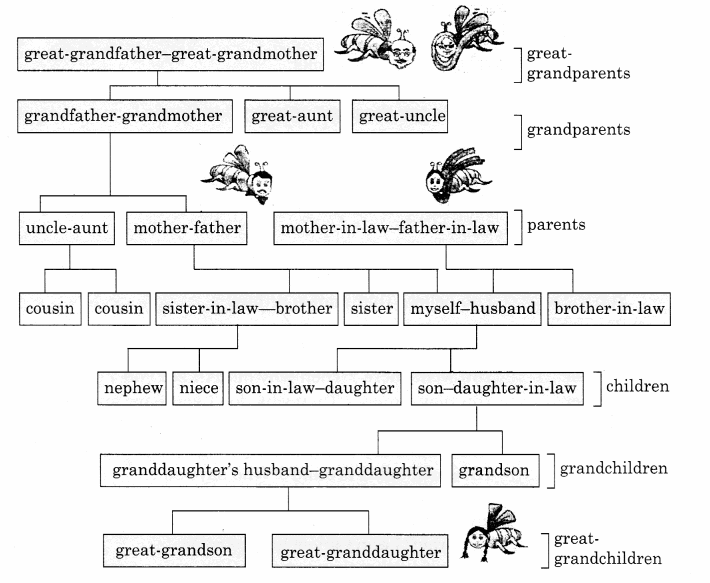
Answer: Do Yourself
Writing
Q1. (i) Make a list of the trees Mr Wonka mentions. Where do these trees grow? Try to find out from an encyclopaedia. Write a short paragraph about two or three of these trees.
Answer: The trees mentioned by Mr Wonka are— Douglas Fir, oak, cedar and bristlecone pine. These trees mainly grow in the forests located in mountain regions with colder climates. Douglas fir is mainly found in Northwest America. This is named after famous botanist David Douglas who first described this species. The oak tree is found all over the world and its wood is used for making houses, furniture etc. Cedar trees are used also to build furniture and ships. Bristlecone pine is found all over America. This tree’s unique name comes from its prickly female cones.
(ii) Name some large trees commonly found in your area. Find out something about them (How old are they? Who planted them ? Do birds eat their fruit ?), and write two or three sentences about each one of them.
Answer: Some of the trees commonly found in my locality are the neem, peepul and gulmohar tree. You can recognize the gulmohar tree very easily through a sheet of orange-red coloured flowers. Its flowers can be seen between April and June. It can be found in both dry as well as tropical conditions. The tree spreads and offers a dense shade. The flowers of this tree are large and orange-red in colour.
The peepal tree is a semi-evergreen tree. Its one rare quality is that it releases oxygen both in the day and the night. Its leaves are heart-shaped and have an extended drip tip.
The neem is a very popular tree, and grows in both tropical and sub-tropical regions. Neem has countless medicinal properties. It can be used to control insects and viruses. Neem is considered to be healthy for our skin.
Q2. Find out something interesting about age, or growing old, and write a paragraph about it. Following are a few topics, suggested as examples.
- The age profile of a country’s population-does it have more young people than old people, or vice versa ? What are the consequences of this ?
- How can we tell how old a tree, a horse, or a rock is ?
- What is the ‘life expectancy’ of various living things, and various populations (how long can they reasonably expect to live) ?
Answer: Do Yourself
We Think the given CBSE Solutions for class 7 English Honeycomb Prose, Chapter 7 The Invention of Vita Wonk with Answers Pdf free download will assist you. If you’ve got any queries regarding CBSE Class 7 English The Invention of Vita Wonk CBSE Solutions with Answers, drop a comment below and that we will come back to you soons.