We have compleed the NCERT/CBSE Solutions chapter-wise for Class 12 Biology Chapter 11 Biotechnology: Principles and Processes with Answers by expert subject teacher for latest syllabus and examination. Prepare effectively for the exam taking the help of the Class 12 Biology NCERT Solutions PDF free of cost from here. Students also can take a free NCERT Solutions of Biotechnology: Principles and Processes. Each question has right answer Solved by Expert Teacher. Download the Biology NCERT Solutions with Answers for Class 12 Biology Pdf and prepare to help students understand the concept very well.
NCERT Solutions for Class 12 Biology
Page No. 205
Exercises
Q1. Can you list 10 recombinant proteins which are used in medical practice? Find out where they are used as therapeutics (use the internet).
Answer: Recombinant proteins are obtained from the recombinant DNA technology. This technology involves the transfer of specific genes from an organism into another organism using vectors and restriction enzymes as molecular tools.
Ten recombinant proteins used in medical practice are:
(i) Insulin: used for the treatment of diabetes mellites
(ii) Interferon-α: Used for chronic hepatitis C
(iii) Interferon: Used for herpes and viral enteritis
(iv) Coagulation factor VII: Treatment of haemophilia A
(v) Coagulation factor IX: Treatment of haemophilia B
(vi) DNAase I: Treatment of cystic fibrosis
(vii) Anti-thrombin III: Prevention of blood clot
(viii) Interferon B: For treatment of multiple sclerosis
(ix) Human recombinant growth hormone: For promoting growth in an individual
(x) Tissue plasminogen activator: Treatment of acute myocardial infection
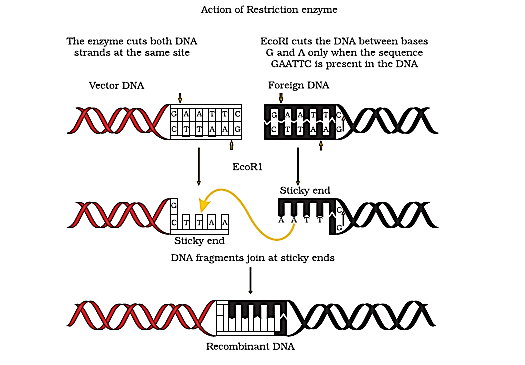
Q2. Make a chart (with diagrammatic representation) showing a restriction enzyme, the substrate DNA on which it acts, the site at which it cuts DNA and the product it produces.
Answer: Steps in the formation of recombinant DNA by action of restriction endonuclease enzyme – EcoRI
It can be diagrammatically represented as follows:
Q3. From what you have learnt, can you tell whether enzymes are bigger or DNA is bigger in molecular size? How did you know?
Answer: Both DNA (deoxyribonucleic acid) and enzymes are macromolecules. DNA is a polymer of deoxyribonucleotides and enzymes are proteins hence these are polymers of amino acids. But DNA is bigger in molecular size as compared to proteins because synthesis of proteins is regulated by a small segment of DNA, called genes and also a large number of proteins can be synthesised by a DNA molecule.
Q4. What would be the molar concentration of human DNA in a human cell? Consult your teacher.
Answer: DNA is present at a molar concentration of 2 mg/ml in human cells.
Q5. Do eukaryotic cells have restriction endonucleases? Justify your answer.
Answer: No, eukaryotic cells do not have restriction endonucleases. This is because the DNA of eukaryotes is highly methylated by a modification enzyme, called methylase. Methylation protects the DNA from the activity of restriction enzymes .These enzymes are present in prokaryotic cells where they help prevent the invasion of DNA by virus.
Q6. Besides better aeration and mixing properties, what other advantages do stirred tank bioreactors have over shake flasks?
Answer: The shake flask method is used for a small-scale production of biotechnological products in a laboratory. On the other hand, stirred tank bioreactors are used for a large-scale production of biotechnology products.
Stirred tank bioreactors have several advantages over shake flasks:
(1) Small volumes of culture can be taken out from the reactor for sampling or testing.
(2) It has a foam breaker for regulating the foam.
(3) It has a control system that regulates the temperature and pH.
Q7. Collect 5 examples of palindromic DNA sequences by consulting your teacher. Better try to create a palindromic sequence by following base-pair rules.
Answer: palindromes in DNA are base pair sequences that are the same when read forward (left to right) or backward (right to left) from a central axis of symmetry. For example, the following sequences read the same on the two strands in the 5′ → 3′ direction as well as 3′ → 5′ direction.
5′ – G – G – A – T – C – C – 3′
3′ – C – C – T – A – G – G – 5′
5′ – G – A – A – T – T – C – 3′
5′ – C – T – T – A – A – G – 5′
5′ – A – A – G – C – T – T – 3′
3′ – T – T – C – G – A – A – 5′
5′ – G – T – C – G – A – C – 3′
3′ – C – A – G – C – T – G – 5′
5′ – A – C – T – A – G – T – 3′
3′ – T – G – A – T – C – A – 5′
Q8. Can you recall meiosis and indicate at what stage a recombinant DNA is made?
Answer: A process involving a reduction in the quantity of genetic material is termed as Meiosis, which is a type of cell division. It occurs in two phases, namely – meiosis I and meiosis II.
In the pachytene event of prophase I, chromosomes cross-over wherein the exchange of segments between non-sister chromatids of homologous chromosomes occurs. This leads to the formation of recombinant DNA in the process of meiosis.
Q9. Can you think and answer how a reporter enzyme can be used to monitor transformation of host cells by foreign DNA in addition to a selectable marker?
Answer: Reporter gene can be used to monitor the transformation of cells by foreign DNA. The foreign gene is linked to the DNA construct that is incorporated into the host. The reporter gene when expressed gives signals that the cell has transformed. These are often used as an indication of whether a certain gene has been taken up by or expressed in the cell or organism population. For example green fluorescent protein (GFP) used as a reporter gene causes cells that express it to glow green under blue light thus indicating the transformation of the cell by the foreign DNA.
Q10. Describe briefly the following:
(a) Origin of replication
Answer: Origin of replication -Origin of replication is defined as the DNA sequence in a genome from where replication initiates. The initiation of replication can be either uni-directional or bi-directional. A protein complex recognizes the ‘on’ site, unwinds the two strands, and initiates the copying of the DNA.
(b) Bioreactors
Answer: They are large vessels that are used for the large-scale production of biotechnological products from raw resources. In order to obtain the required product, these bioreactors offer optimal conditions by supplying optimum pH, temperature, vitamin, oxygen etc. They have an oxygen delivery system, a foam control system, a temperature and pH control system. Also, it consists of a sampling port to withdraw a small quantity of culture for the purpose of sampling.s
(c) Downstream processing
Answer: The product obtained is subjected to a series, of processes collectively called downstream processing before it is made into a finished product ready for marketing. The two main processes are separation and purification. The product is then formulated with suitable preservatives. Such formulations have to undergo clinical trials, in case of drugs.
Q11. Explain briefly
(a) PCR
Answer: The polymerase chain reaction (PCR) is an in vitro molecular biology method that combines enzymatic amplification of a single DNA strand and creating millions of copies of the specified DNA sequence in just a few hours (about 2 hours).
PCR consists of three steps:
(i) Denaturing (at 96°C) the double-stranded DNA into single-stranded DNA.
(ii) Annealing of the primer (at 55-65 oC) to ssDNA (single standard).
(iii) Taq DNA polymerase, an enzyme isolated from Thermus aquaticus, synthesized new strands (at 72 oC).
An amplified gene is used to clone the desired gene.
Advantage – Higher productivity, higher efficiency, reduced error proneness, and fewer human errors, cyclic and automated.
(b) Restriction enzymes and DNA
Answer: Restriction enzymes are molecular scissors used in molecular biology for cutting DNA sequences from a specific site. It plays an important role in gene manipulation. The enzymes recognize a specific six-box pair sequence known as the recognition sequence and cut the sequence at a specific site. For example, the recognition site for enzyme ECORI is as follows:

Restriction enzyme are categorized into two types −
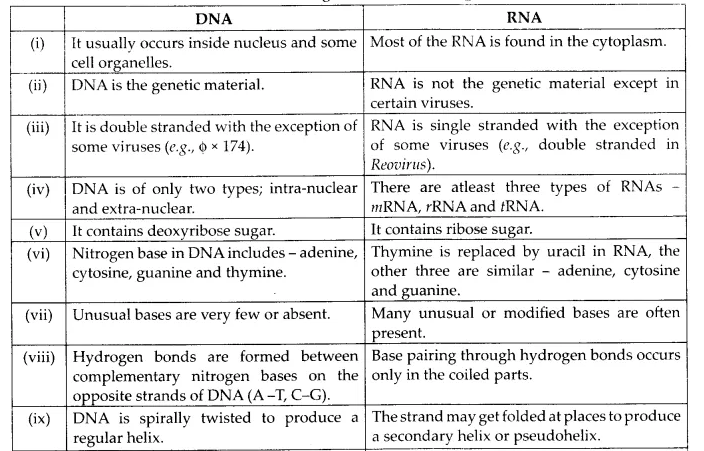
(i) Exonuclease − It is a type of restriction enzyme that removes the nucleotide from either 5’ or 3’ ends of the DNA molecule.
(ii) Endonuclease − It is a type of restriction enzyme that makes a cut within the DNA at a specific site. This enzyme acts as an important tool in genetic engineering. It is commonly used to make a cut in the sequence to obtain DNA fragments with sticky ends, which are later joined by enzyme DNA ligase.
(c) Chitinase
Answer: Chitinase is a class of enzymes used for the degradation of chitin, which forms a major component of the fungal cell wall. Therefore, to isolate the DNA enclosed within the cell membrane of the fungus, enzyme chitinase is used to break the cell for releasing its genetic material.
Q12. Discuss with your teacher and find out how to distinguish between
(a) Plasmid DNA and Chromosomal DNA
Answer:
| Plasmid DNA | Chromosomal DNA |
| It is an extra chromosomal DNA molecule found in bacteria, capable of replicating and is independent of chromosomal DNA | It forms the complete DNA of an entity found inside the chromosomes |
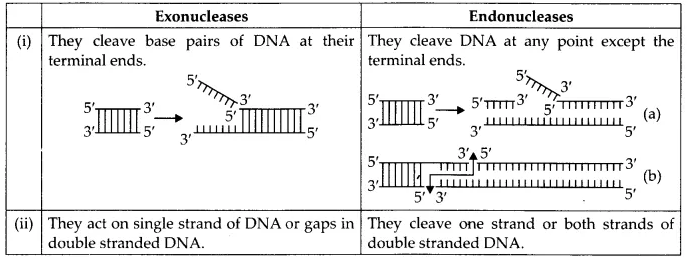
(b) RNA and DNA
Answer:
(c) Exonuclease and Endonuclease
Answer:
We Think the given NCERT Solutions for class 12 Biology book Chapter 11 Biotechnology: Principles and Processes with Answers Pdf free download will assist you. If you’ve got any queries regarding CBSE Class 12 Biology Biotechnology: Principles and Processes NCERT Solutions with Answers, drop a comment below and that we will come back to you soon.