
We have compleed the NCERT/CBSE Solutions chapter-wise for Class 12 Biology Chapter 12 Biotechnology and its Applications with Answers by expert subject teacher for latest syllabus and examination. Prepare effectively for the exam taking the help of the Class 12 Biology NCERT Solutions PDF free of cost from here. Students also can take a free NCERT Solutions of Biotechnology and its Applications. Each question has right answer Solved by Expert Teacher. Download the Biology NCERT Solutions with Answers for Class 12 Biology Pdf and prepare to help students understand the concept very well.
NCERT Solutions for Class 12 Biology
Page No. 215
Exercises
Q1. Crystals of Bt toxin produced by some bacteria do not kill the bacteria themselves because –
(a) bacteria are resistant to the toxin
(b) toxin is immature;
(c) toxin is inactive;
(d) bacteria encloses toxin in a special sac.
Answer: (c) toxin is inactive
Toxins in bacteria are found in an inactive form known as protoxin. This gets converted into an active form when it moves into the body of an insect.
Q2. What are transgenic bacteria? Illustrate using any one example.
Answer: Bacteria having gene or genes usually from an unrelated organism incorporated into their genome are called transgenic bacteria. For example, when human insulin gene is introduced into the isolated plasmid of E.coli bacterium and this recombinant DNA is transferred into a fresh bacterium, then the later is said to be transgenic or transformed bacterium.
Q3. Compare and contrast the advantages and disadvantages of production of genetically modified crops.
Answer: The production of genetically modified (GM) or transgenic plants has several advantages.
(i) Most of the genetically modified crops have been developed for pest resistance, which increases the crop productivity and reduces the reliance on chemical pesticides.
(ii) Many varieties of genetically modified food crops have been developed, which has good nutritional quality. For example, golden rice is a transgenic variety in rice, which is rich in vitamin A.
(iii) These plants prevent the loss of fertility of soil by increasing the efficiency of mineral usage.
(iv) They are highly resistant to unfavourable abiotic conditions.
(v) The use of genitically modified crops decreases the post harvesting loss of crops.
But, there are certain controversies regarding the use of genetically modified crops around the world. The use of these crops can affect the native biodiversity in an area. For example, the use of Bt toxin to decrease the amount of pesticide is posing a threat for beneficial insect pollinators such as honey bee. If the gene expressed for Bt toxin gets expressed in the pollen, then the honey bee might be affected. As a result, the process of pollination by honey bees would be affected. Also, genetically modified crops are affecting human health. They supply allergens and certain antibiotic resistance markers in the body. Also, they can cause genetic pollution in the wild relatives of the crop plants. Hence, it is affecting our natural environment.
Q4. What are Cry proteins? Name an organism that produce it. How has man exploited this protein to his benefit?
Answer: Cry proteins are those poisonous proteins that are insecticidal and are known to be secreted in crystal form and the toxin is produced by a gene which is known as cry.
An organism that produces this protein is a bacterium called Bacillus thuringiensis.
In recent times, man has exploited this protein to produce crops that are transgenic such as BT cotton, BT brinjal, and many more which has developed resistance against the insects.
Q5. What is gene therapy? Illustrate using the example of adenosine deaminase (ADA) deficiency.
Answer: Gene therapy is a technique for correcting a defective gene through gene manipulation. It involves the delivery of a normal gene into the individual to replace the defective gene, for example, the introduction of gene for adenosine deaminase (ADA) in ADA deficient individual. The adenosine deaminase enzyme is important for the normal functioning of the immune system. The individual suffering from this disorder can be cured by transplantation of bone marrow cells. The first step involves the extraction of lymphocyte from the patient’s bone marrow. Then, a functional gene for ADA is introduced into lymphocytes with the help of retrovirus. These treated lymphocytes containing ADA gene are then introduced into the patient’s bone marrow. Thus, the gene gets activated producing functional T- lymphocytes and activating the patient’s immune system.
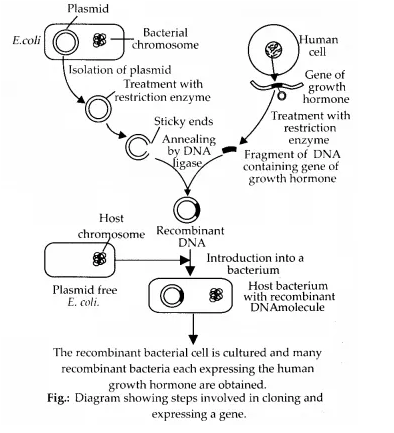
Q6. Digrammatically represent the experimental steps in cloning and expressing an human gene (say the gene for growth hormone) into a bacterium like E. coli ?
Answer: The given diagram represents the experimental steps in cloning and expressing a human gene for growth hormone into a bacterium E. coli.
Q7. Can you suggest a method to remove oil (hydrocarbon) from seeds based on your understanding of rDNA technology and chemistry of oil?
Answer: Recombinant DNA technology (rDNA) is a technique used for manipulating the genetic material of an organism to obtain the desired result. For example, this technology is used for removing oil from seeds. The constituents of oil are glycerol and fatty acids. Using rDNA, one can obtain oilless seeds by preventing the synthesis of either glycerol or fatty acids. This is done by removing the specific gene responsible for the synthesis.s
Q8. Find out from internet what is golden rice.
Answer: Golden rice, a variety of rice, Oryza sativa is a genetically modified crop which is developed as a fortified food to supply them to areas where there is scarcity of dietary Vitamin A, as golden rice is richly supplied with Vitamin A. Golden rice consists of a precursor of pro-Vitamin A, known as the beta-carotene, inserted into the rice through the process of genetic engineering.
Rice plants synthesize the beta-carotene pigment naturally in its leaves but it is not found in the seed’s endosperm as the pigment aids in photosynthesis and photosynthesis does not take place in the endosperm. As the beta-carotene is a precursor of pro-vitamin A, it is inserted into the rice variety to compensate for the dearth of dietary Vitamin A. Compared to vitamin supplements, this is a simpler and low-priced alternative. But they are still not available for human consumption, as this variety of rice has faced a considerable opposition from environmental activists.
Q9. Does our blood have proteases and nucleases?
Answer: No, human blood does not include the enzymes, nucleases and proteases. In human beings, blood serum contains different types of protease inhibitors, which protect the blood proteins from being broken down by the action of proteases. The enzyme, nucleases, catalyses the hydrolysis of nucleic acids that is absent in blood.
Q10. Consult internet and find out how to make orally active protein pharmaceutical. What is the major problem to be encountered?
Answer: To make orally active and protein pharmaceuticals, the drugs must be undergone coating with the help of a film that is protein degrading enzyme resistant. The problem associated with the pharmaceutical drugs which can be consumed orally is that those drugs if made without proper coating or film, can be easily degraded by the enzymes such as proteases that are present in our alimentary canal.
We Think the given NCERT Solutions for class 12 Biology book Chapter 12 Biotechnology and its Applications with Answers Pdf free download will assist you. If you’ve got any queries regarding CBSE Class 12 Biology Biotechnology and its Applications NCERT Solutions with Answers, drop a comment below and that we will come back to you soon.