We have completed the NCERT/CBSE Solutions chapter-wise for Class 12 Biology Chapter 14 Ecosystem with Answers by expert subject teacher for latest syllabus and examination. Prepare effectively for the exam taking the help of the Class 12 Biology NCERT Solutions PDF free of cost from here. Students also can take a free NCERT Solutions of Ecosystem. Each question has right answer Solved by Expert Teacher. Download the Biology NCERT Solutions with Answers for Class 12 Biology Pdf and prepare to help students understand the concept very well.
NCERT Solutions for Class 12 Biology
Page No. 256
Exercises
Q1. Fill in the blanks.
(a) Plants are called as_________because they fix carbon dioxide.
(b) In an ecosystem dominated by trees, the pyramid (of numbers) is_________type.
(c) In aquatic ecosystems, the limiting factor for the productivity is_________.
(d) Common detritivores in our ecosystem are_________.
(e) The major reservoir of carbon on earth is_________.
Answer:
(a) Autotrophs
(b) inverted
(c) Light
(d) Earthworm
(e) Ocean
Q2. Which one of the following has the largest population in a food chain?
(a) Producers
(b) Primary consumers
(c) Secondary consumers
(d) Decomposers
Answer: (d) Decomposers
Q3. The second trophic level in a lake is
(a) Phytoplankton
(b) Zooplankton
(c) Benthos
(d) Fishes
Answer: (b) Zooplankton
Q4. Secondary producers are
(a) Herbivores
(b) Producers
(c) Carnivores
(d) None of the above
Answer: (d) None of the above
Q5. What is the percentage of photosynthetically active radiation (PAR) in the incident solar radiation?
(a) 100%
(b) 50 %
(c) 1-5%
(d) 2-10%
Answer: (b) 50%
Q6. Distinguish between
(a) Grazing food chain and detritus food chain
Answer:
| Grazing Food Chain | Detritus Food Chain |
| i. Energy for the food chain comes from the Sun. ii. First trophic level organisms are producers. | i. Energy comes from detritus (organic matter). ii. First trophic level organisms are detritivores and decomposers. |
(b) Production and decomposition
Answer:
| Production | Decomposition |
| i. It refers to the process of synthesis of organic compounds from inorganic substances utilising sunlight. ii. Example: Plants perform the function of production of food. | i. It is the phenomenon of degradation of waste biomass. ii. Example: Bacteria and fungi decompose dead organic matter. |
(c) Upright and inverted pyramid
Answer:
| Upright Pyramid | Inverted Pyramid |
| When the number of producers or their biomass is maximum in an ecosystem and it decreases progressively at each trophic level in a food chain, an upright pyramid is formed. | When the number of individuals or their biomass at the producer level is minimum and it increases progressively at each trophic level in a food chain, an inverted pyramid is formed. |
(d) Food chain and Food web
Answer:
| Food Chain | Food Web |
| i. A food chain is a single pathway where energy is transferred from producers to successive orders of consumers. ii. All food chains start with green plants which are the original source of all food. | i. A food web is a network of various food chains which are interconnected with each other like an interlocking pattern. ii. It has many linkages and intercrosses among producers and consumers. |
(e) Litter and detritus
Answer:
| Litter | Detritus |
| The dead remains of plants (leaves, flowers etc.) and animals and animal excreta which falls on the surface of the Earth in terrestrial ecosystems is called litter. | The dead remains of plants and animals constitute detritus. It is differentiated into litter fall (above ground detritus) and below ground detritus. |
(f) Primary and secondary productivity
Answer:
| Primary Productivity | Secondary Productivity |
| i. It is the rate at which organic matter is built up by producers. ii. It is due to photosynthesis. | i. It is the rate of synthesis of organic matter by consumers. ii. It is due to herbivory and predation. |
Q7. Describe the components of an ecosystem.
Answer: An ecosystem is defined as an interacting unit that includes both the biological community and the non-living components of an area. The living and the non-living components of an ecosystem interact amongst themselves and function as a unit, which gets evident during the processes of nutrient cycling, energy flow, decomposition, and productivity. There are many ecosystems such as ponds, forests, grasslands, etc.
The two components of an ecosystem are:
Biotic component: It is the living component of an ecosystem that includes biotic factors such as producers, consumers, decomposers, etc. Producers include plants and algae. They contain chlorophyll pigment, which helps them carry out the process of photosynthesis in the presence of light. Thus, they are also called converters or transducers. Consumers or heterotrophs are organisms that are directly (primary consumers) or indirectly (secondary and tertiary consumers) dependent on producers for their food. Decomposers include microorganisms such as bacteria and fungi. They form the largest population in a food chain and obtain nutrients by breaking down the remains of dead plants and animals.
Abiotic component: They are the non-living component of an ecosystem such as light, temperature, water, soil, air, inorganic nutrients, etc.
Q8. Define ecological pyramids and describe with examples, pyramids of number and biomass.
Answer: An ecological pyramid is a graphical representation of various ecological parameters such as the number of individuals present at each trophic level, the amount of energy, or the biomass present at each trophic level. Ecological pyramids represent producers at the base, while the apex represents the top level consumers present in the ecosystem. There are three types of pyramids:
(a) Pyramid of numbers
(b) Pyramid of energy
(c) Pyramid of biomass
Pyramid of numbers: It is a graphical representation of the number of individuals present at each trophic level in a food chain of an ecosystem. The pyramid of numbers can be upright or inverted depending on the number of producers. For example, in a grassland ecosystem, the pyramid of numbers is upright. In this type of a food chain, the number of producers (plants) is followed by the number of herbivores (mice), which in turn is followed by the number of secondary consumers (snakes) and tertiary carnivores (eagles).
Hence, the number of individuals at the producer level will be the maximum, while the number of individuals present at top carnivores will be on the other hand, in a parasitic food chain, the pyramid of numbers is inverted. In this type of a food chain, a single tree (producer) provides food to several fruit eating birds, which in turn support several insect species.
Pyramid of energy: An energy pyramid is a graphical model of energy flow in a community. The different levels represent different groups of organisms that might compose a food chain. From the bottom-up, they are as follows: Producers bring energy from nonliving sources into the community.
Pyramid of biomass: A pyramid of biomass is a graphical representation of the total amount of living matter present at each trophic level of an ecosystem. It can be upright or inverted. It is upright in grasslands and forest ecosystems as the amount of biomass present at the producer level is higher than at the top carnivore level. The pyramid of biomass is inverted in a pond ecosystem as the biomass of fishes far exceeds the biomass of zooplankton (upon which they feed).east.
Q9. What is primary productivity? Give brief description of factors that affect primary productivity.
Answer: It is defined as the amount of organic matter or biomass produced by producers per unit area over a period of time. Primary productivity of an ecosystem depends on the variety of environmental factors such as light, temperature, water, precipitation, etc. It also depends on the availability of nutrients and the availability of plants to carry out photosynthesis.
Q10. Define decomposition and describe the processes and products of decomposition.
Answer: Decomposition can be defined as a process that involves the disintegration of complex organic matter from the body of dead animals and plants with the action of decomposers into inorganic raw materials such as water, carbon dioxide and other such nutrients. The different processes in decomposition are as follows:
(i) Fragmentation – It is the first phase in the decomposition process, it includes the disintegration of detritus into fine particles through the action of detritivores such as earthworms.
(ii) Leaching – here, the water-soluble nutrients penetrate into the layers of soil and get sealed as unavailable salts
(iii) Catabolism – Fungi and bacteria degrade detritus into fine particles through different enzymes
(iv) Humification – this phase causes the formation of humus – a dark colored colloidal substance that serves as a reservoir of nutrients for plants
(v) Mineralization – further degradation of humus through the activity of microbes takes place in this stage wherein inorganic nutrients are finally released into the soil. This phenomena of releasing inorganic nutrients from the humus is known as mineralization. Humus degrades to release inorganic raw materials such as water, carbon dioxide, and other nutrients in the soil.
Q11. Give an account of energy flow in an ecosystem.
Answer: Flow of energy in an ecosystem is unidirectional. The ultimate source of energy is sun. The solar energy is captured by the green plants which utilize it in synthesizing their own food. The energy fixed by the green plants is transferred to herbivores which feed on them. The energy is then transferred to higher trophic levels (carnivores). At every step, considerable amount of energy is lost. According to 10% law, only 10% of total energy stored in a trophic level is transferred to the next trophic level of a food chain.
Q12. Write important features of a sedimentary cycle in an ecosystem.
Answer: Sedimentary cycles have their reservoir pool in deep sediments or in the earth’s crust or rocks. Nutrient elements that are found in the sediments of the Earth are Sulphur, phosphorus, potassium, and calcium. There is absence of a gaseous phase in this cycle.
This cycle is very slow. A longer period of time is taken to complete their circulation and is considered a less perfect cycle. Since, In the process of recycling, nutrient elements get locked in the reservoir pool, which thereby takes a long time to come out and continue circulation. Thus, it always goes out of circulation for an extended time.
Q13. Outline salient features of carbon cycling i n an ecosystem.
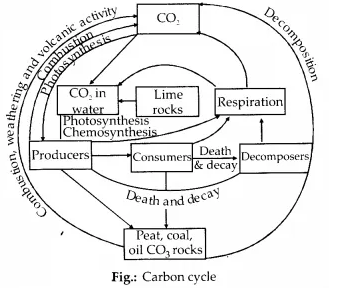
Answer: Carbon constitutes 49 percent of the dry weight of organisms and is next only to water. 71 percent of carbon is found dissolved in oceans. This ocean reservoir regulates the amount of carbon dioxide in the atmosphere. Fossil fuels also represent a reservoir of carbon. Carbon cycling occurs through the atmosphere, ocean, and living and dead organisms. 4 x 10¹³ kg of carbon is fixed in the biosphere through photosynthesis annually.
A considerable amount of carbon returns to the atmosphere as Co2 through respiratory activities of the producers and consumers. Decomposers also contribute substantially to the CO2 pool by their processing of waste materials and dead organic matter of land or oceans. Some amount of fixed carbon is lost to sediments and removed from circulation. Burning of wood, forest fire and combustion of organic matter, fossil fuels, volcanic activity are additional sources for releasing Co2 into the atmosphere.
Human activities have significantly influenced the carbon cycle. Rapid deforestation and the massive burning of fossil fuels for energy and transport have significantly increased the rate of release of carbon dioxide into the atmosphere.
We Think the given NCERT Solutions for class 12 Biology book Chapter 14 Ecosystem with Answers Pdf free download will assist you. If you’ve got any queries regarding CBSE Class 12 Biology Ecosystem NCERT Solutions with Answers, drop a comment below and that we will come back to you soon.