
We have completed the NCERT/CBSE Solutions chapter-wise for Class 12 Biology Chapter 13 Organisms and Populations with Answers by expert subject teacher for latest syllabus and examination. Prepare effectively for the exam taking the help of the Class 12 Biology NCERT Solutions PDF free of cost from here. Students also can take a free NCERT Solutions of Organisms and Populations. Each question has right answer Solved by Expert Teacher. Download the Biology NCERT Solutions with Answers for Class 12 Biology Pdf and prepare to help students understand the concept very well.
NCERT Solutions for Class 12 Biology
Page No. 239
Exercises
Q1. How is diapause different from hibernation?
Answer: Differences between diapause and hibernation
| Diapause | Hibernation |
| 1) It is a dormant stage during the development of an organism. 2) It occurs both in summer and winter. 3) During this period there is reduction in the amout of free water. | 1) It is state of inactivity in animals where the metabolism is slowed down. The amials hide enter a state of deep sleep. 2) It occurs during winter only. 3) There is no such adaptation. |
Q2. If a marine fish is placed in a fresh water aquarium, will the fish be able to survive? Why or why not?
Answer: If a marine fish is placed in a fresh water aquarium, then its chances of survival will diminish. This is because their bodies are adapted to high salt concentrations of the marine environment. In fresh water conditions, they are unable to regulate the water entering their body (through osmosis). Water enters their body due to the hypotonic environment outside. This results in the swelling up of the body, eventually leading to the death of the marine fish.
Q3. Define phenotypic adaptation. Give one example.
Answer: Phenotypic adaptation involves non-genetic changes in individuals such as physiological modifications like acclimatization or behavioural changes.
Q4. Most living organisms cannot survive at temperature above 45°C. How are some microbes able to live in habitats with temperatures exceeding 100°C?
Answer: Thermophiles or Archaebacteria are ancient forms of bacteria that are present in deep sea hydrothermal vents and hot water springs. They are able to withstand the high temperature (exceeding 100 degree C) as their bodies have adapted to these extreme environmental conditions. Such entities comprise of specialized thermo-resistant enzymes that perform metabolic functions which do not get destructed at these extreme temperatures.
Q5. List the attributes that populations but not individuals possess.
Answer: A population can be defined as a group of individuals of the same species residing in a particular geographical area at a particular time and functioning as a unit. For example, all human beings living at a particular place at a particular time constitute the population of humans.
The main attributes or characteristics of a population residing in a given area are:-
(a) Birth rate (Natality): It is the ratio of live births in an area to the population of an area. It is expressed as the number of individuals added to the population with respect to the members of the population.
(b) Death rate (Mortality): It is the ratio of deaths in an area to the population of an area. It is expressed as the loss of individuals with respect to the members of the population.
(c) Sex ratio: It is the number of males or females per thousand individuals.
(d) Age Distribution: It is the percentage of individuals of different ages in a given population. At any given time, the population is composed of individuals that are present in various age groups. The age distribution pattern is commonly represented through age pyramids.
(e) Population density: It is defined as the number of individuals of a population present per unit area at a given time.
Q6. If a population growing exponentially double in size in 3 years, what is the intrinsic rate of increase (r) of the population?
Answer: If adequate quantity of food resources are available to individuals in a population, it grows exponentially. The integral form of exponential growth equation can be used to estimate the exponential growth, which is as follows:
Nt = No ert ————– equation (1)
Where, Nt is the population density after ‘t’ time
No is the population density at time zero
e is the base of natural logarithm = 2.71828
r is the intrinsic rate of natural increase
Let the current population density be ‘x’
∴ The population density after two years will be 2x and t given is 3 years
Substituting these values in equation (1)
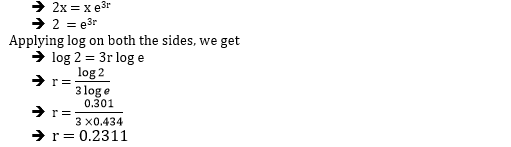
Hence, the intrinsic rate of increase for the above illustrated population is 0.2311.
Q7. Name important defence mechanisms in plants against herbivory.
Answer: Several plants have evolved various mechanisms both morphological and chemical to protect themselves against herbivory.
(i) Morphological defence mechanisms:
(a) Sharp thorns along with leaves are present in Acacia to deter herbivores
(b) Cactus leaves (Opuntia) are modified into sharp spines (thorns) to deter herbivores from feeding on them.
(c) In some plants, the margins of their leaves are spiny or have sharp edges that prevent herbivores from feeding on them.
(ii) Chemical defence mechanisms:
(a) Chemical substances such as nicotine, caffeine, quinine, and opium are produced in plants as a part of self-defense
(b) All parts of Calotropis w
Q8. An orchid plant is growing on the branch of mango tree. How do you describe this interaction between the orchid and the mango tree?
Answer: An orchid growing on the branch of a mango tree is an epiphyte. Epiphytes are plants growing on other plants which however, do not derive nutrition from them. Therefore, the relationship between a mango tree and an orchid is an example of commensalisms, where one species gets benefited while the other remains unaffected.Here, the orchid is benefited as it gets support while the mango tree remains unaffected.
Q9. What is the ecological principle behind the biological control method of managing with pest insects?
Answer: Predation is the ecological principle behind the biological control method of managing with pest insects. Predation is referred to as the biological interaction between a predator and a prey wherein the predator feeds on the prey, thereby regulating the population of pest insects. Example – The Gawbusia fish checks the mosquito larvae in water bodies.
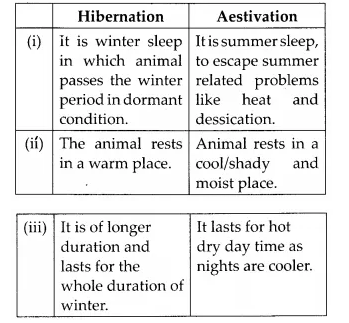
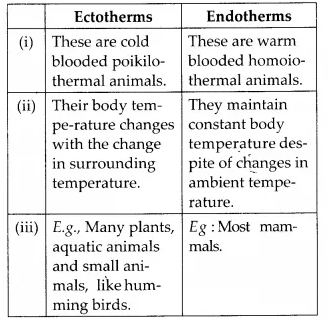
Q10. Distinguish between the following:
(a) Hibernation and Aestivation
Answer:
(b) Ectotherms and Endotherms
Answer:
Q11. Write a short note on
(a) Adaptations of desert plants and animals
Answer: Desert plants have very small leaves or no leaves at all, and carrying out photosynthesis through the stems. Their stem could become succulent, and can store and retain water. Animals living in hot climatic region tend to be smaller than those living in cold climates. This can be explained by the fact that the amount of heat gained from the environment is approximately proportional to the body surface area. The majority of animals living in desert are small, like kangaroo rat. It feed on dry seeds and other dry plant material and does not drink,
(b) Adaptations of plants to water scarcity
Answer: Plants found in deserts are well adapted to cope with water scarcity and the scorching heat of the desert.
Plants have an extensive root system to tap underground water.
They bear thick cuticles and sunken stomata on the surface of their leaves to reduce transpiration.
In Opuntia, the leaves are modified into spines and the process of photosynthesis is carried out by green stems.
Desert plants have special pathways to synthesize food, called CAM (C4 pathway). It enables their stomata to remain closed during the day to reduce water loss by transpiration.
(c) Behavioural adaptations in animals
Answer: Certain organisms are affected by temperature variations. These organisms undergo adaptations such as hibernation, aestivation, migration, etc. to escape environmental stress to suit their natural habitat. These adaptations in the behaviour of an organism are called behavioural adaptations. For example, ectothermal animals and certain endotherms exhibit behavioral adaptations. Ectotherms are cold blooded animals such as fish, amphibians, reptiles, etc. Their temperature varies with their surroundings.
For example, the desert lizard basks in the sun during early hours when the temperature is quite low. However, as the temperature begins to rise, the lizard burrows itself inside the sand to escape the scorching sun. Similar burrowing strategies are exhibited by other desert animals. Certain endotherms (warm-blooded animals) such as birds and mammals escape cold and hot weather conditions by hibernating during winters and aestivating during summers. They hide themselves in shelters such as caves, burrows, etc. to protect against temperature variations.
(d) Importance of light to plants
Answer: Sunlight acts as the ultimate source of energy for plants. Plants are autotrophic organisms, which need light for carrying out the process of photosynthesis. Light also plays an important role in generating photoperiodic responses occurring in plants. Plants respond to changes in intensity of light during various seasons to fulfill their photoperiodic changes in intensity of light during various seasons to meet their photoperiodic requirements for flowering. Light also plays an important role in aquatic habitats for vertical distribution of plants in the sea.
(e) Effect of temperature or water scarcity and the adaptations of animals.
Answer: Temperature is the most important ecological factor. Average temperature on the Earth varies from one place to another. These variations in temperature affect the distribution of animals on the Earth. Animals that can tolerate a wide range of temperature are called eurythermals. Those which can tolerate a narrow range of temperature are called stenothermal animals. Animals also undergo adaptations to suit their natural habitats. For example, animals found in colder areas have shorter ears and limbs that prevent the loss of heat from their body. Also, animals found in Polar regions have thick layers of fat below their skin and thick coats of fur to prevent the loss of heat.
Some organisms exhibit various behavioural changes to suit their natural habitat. These adaptations present in the behaviour of an organism to escape environmental stresses are called behavioural adaptations. For example, desert lizards are ectotherms. This means that they do not have a temperature regulatory mechanism to escape temperature variations. These lizards bask in the sun during early hours when the temperature.
Q12. List the various abiotic environmental factors.
Answer: (i) Temperature – Temperature is one of the most important environmental factors. The average temperature varies seasonally. It ranges from subzero level in polar areas and high altitudes to more than 50°C in tropical deserts in summer and exceeds 100°C in thermal springs and deep-sea hydrothermal vents.
(ii) Water – Next to temperature, water is the most important factor which influences the life of organisms. The productivity and distribution of land plants are dependent upon the availability of water. Animals are adapted according to water availability. E.g., aquatic animals are ammonotelic while xerophytic animals excrete dry feces and concentrated urine.
(iii) Light – Plants produce food through photosynthesis for which sunlight is essential to the source of energy. Light intensity, light duration and light quality influences the number of life processes in organisms, such as – photosynthesis, growth, transpiration, germination, pigmentation, movement and photoperiodism.
(iv) Humidity – Humidity refers to the moisture (water vapour) content of the air. It determines the formation of clouds, dew and fog. It affects the land organisms by regulating the loss of water as vapour from their bodies through evaporation, perspiration and transpiration.
(v) Precipitation – Precipitation means rainfall, snow, sleet or dew. Total annual rainfall, seasonal distribution humidity of the air and amount of water retained in the soil are the main criteria that limit the distribution of plants and animals on land.
(vi) Soil – The soil is one of the most important ecological factor called the edaphic factor. It comprises of different layers called horizons. The upper weathered humus containing part of soil sustains terrestrial plant life.
Q13. Give an example for:
(a) An endothermic animal
Answer: Endothermic animal: Birds such as crows, sparrows, pigeons, cranes, etc. and mammals such as bears, cows, rats, rabbits, etc. are endothermic animals.
(b) An ectothermic animal
Answer: Ectothermic animal: Fishes such as sharks, amphibians such as frogs, and reptiles such as tortoise, snakes, and lizards are ectothermic animals
(c) An organism of benthic zone
Answer: Decomposing bacteria is an example of an organism found in the benthic zone of a water body .
Q14. Define population and community.
Answer: Population can be defined as the total number of individuals of a species or any other class of an organism in a defined area or habitat or a group of individuals of the same species within a commnity.
Community can be defined as a naturally octurring assemblage of species living within a defined area or habitat.
Q15. Define the following terms and give one example for each:
(a) Commensalism
Answer: The interaction between two species wherein one species is benefited and the other remains unaffected in known as commensalism. Examples – Barnacles attached to a whale’s body and an orchid growing on the branches of a mango tree
(b) Parasitism
Answer: It is an interaction between two species in which one species (usually smaller) gets positively affected, while the other species (usually larger) is negatively affected. An example of this is liver fluke. Liver fluke is a parasite that lives inside the liver of the host body and derives nutrition from it. Hence, the parasite is benefited as it derives nutrition from the host, while the host is negatively affected as the parasite reduces the host fitness, making its body weak.
(c) Camouflage
Answer: It is a tactic taken up by the prey to escape from predators. Intrinsically, organisms are colored to easily blend with their surroundings and escape from their predators. Several insects and frog species camouflage to escape their predators.
(d) Mutualism
Answer: It is an interaction between two species in which both species involved are benefited. For example, lichens show a mutual symbiotic relationship between fungi and blue green algae, where both are equally benefited from each other.
(e) Interspecific competition
Answer: An interaction between individuals of different species wherein both are negatively affected is interspecific competition. Example – The competition between resident fishes and flamingoes in South American lakes for shared food resources, that is, zooplankton
Q16. With the help of suitable diagram describe the logistic population growth curve.
Answer:
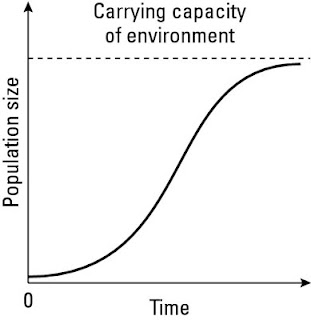
(a) Lag phase: Initially, the population of the yeast cell is very small. This is because of the limited resource present in the habitat.
(b) Positive acceleration phase: During this phase, the yeast cell adapts to the new environment and starts increasing its population. However, at the beginning of this phase, the growth of the cell is very limited.
(c) Exponential phase: During this phase, the population of the yeast cell increases suddenly due to rapid growth. The population grows exponentially due to the availability of sufficient food resources, constant environment, and the absence of any interspecific competition. As a result, the curve rises steeply upwards.
(d) Negative acceleration phase: During this phase, the environmental resistance increases and the growth rate of the population decreases. This occurs due to an increased competition among the yeast cells for food and shelter.
(e) Stationary phase: During this phase, the population becomes stable. The number of cells produced in a population equals the number of cells that die. Also, the population of the species is said to have reached nature’s carrying-capacity in its habitat.
We Think the given NCERT Solutions for class 12 Biology book Chapter 13 Organisms and Populations with Answers Pdf free download will assist you. If you’ve got any queries regarding CBSE Class 12 Biology Organisms and Populations NCERT Solutions with Answers, drop a comment below and that we will come back to you soon.