
We have completed the NCERT/CBSE Solutions chapter-wise for Class 9 Science Chapter 5 The Fundamental Unit of Life with Answers by expert subject teacher for latest syllabus and examination. Prepare effectively for the exam taking the help of the Class 9 Science NCERT Solutions PDF free of cost from here. Students also can take a free NCERT Solutions of The Fundamental Unit of Life. Each question has right answer Solved by Expert Teacher. Download the Science NCERT Solutions with Answers for Class 9 Science Pdf and prepare to help students understand the concept very well.
NCERT Solutions for Class 9 Science Chapter wise
Questions
Q1. Who discovered cells and how?
Answer: An English Botanist, Robert Hooke discovered cells. In 1665, he used self-designed microscope to observe cells in a cork slice.
Q2. Why is the cell called the structural and functional unit of life?
Answer: Cells form the structure of an entity. A group of cells form a tissue, further an organ and ultimately an organ system. They perform fundamental functions and life processes such as respiration, digestion, excretion etc in both unicellular and multicellular entities. They perform all the activities independently. Hence, cells are referred to as structural and fundamental units of life.
Questions
Q1. How do substances like CO2 and water move in and out of the cell? Discuss.
Answer: CO2 moves by diffusion and H2O move by osmosis through cell membrane.
Q2. Why is the plasma membrane called a selectively permeable membrane?
Answer: Cell membrane is semipermeable membrane for water. It permits the entry of gases through diffusion. Ions, sugar, amino acids, etc. pass through the plasma membrane by an active process. Plasma membrane is impermeable to certain other materials. Therefore, it is selectively permeable.
Questions
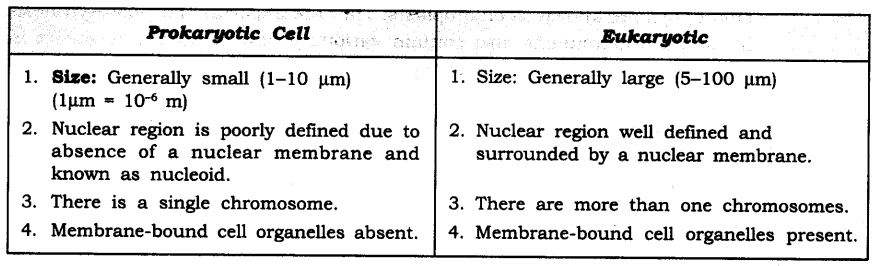
Q1. Fill in the gaps in the following table illustrating differences between prokaryotic and eukaryotic cells.
Answer:
Questions
Q1. Can you name the two organelles we have studied that contain their own genetic material?
Answer: Mitochondria and plastids are the two organelles that contain their own genetic material. Both these organelles have their own DNA and ribosomes.
Q2. If the organisation of a cell is destroyed due to some physical or chemical influence, what will happen?
Answer: If the organisation of a cell gets destroyed due to any reason then lysis of the whole cell will occur due to the enzymes released by lysosomes.
Q3. Why are lysosomes known as suicide bags?
Answer: Lysosomes are the cell organelles that are vesicular structures and contain the digestive enzymes. The function of these enzymes inside the lysosomes is to break down any foreign body that enters the cell. Sometimes, the lysosome may also act suicidal by releasing the digestive enzymes inside the cell and leads to self-destruction. Thus lysosomes are known as suicidal bags.
Q4. Where are proteins synthesized inside the cell?
Answer: The proteins are synthesized in the Ribosome inside the cell.
Exercise
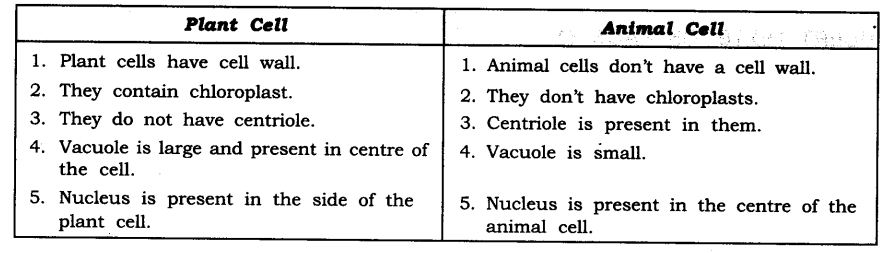
Q1. Make a comparison and write down ways in which plant cells are different from animal cells.
Answer:
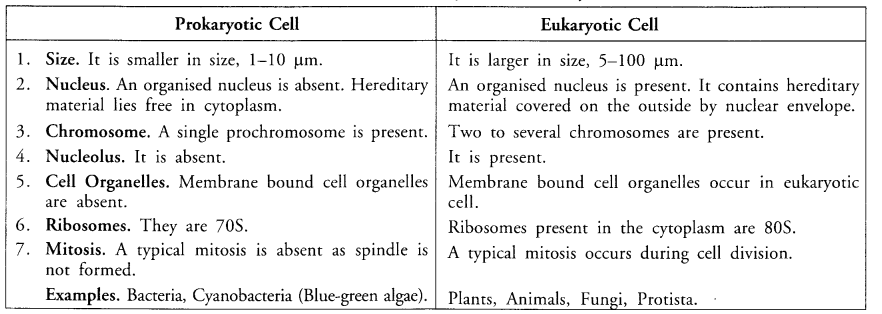
Q2. How is a prokaryotic cell different from a eukaryotic cell?
Answer:
Q3. What would happen if the plasma membrane ruptures or breaks down?
Answer: If plasma membrane ruptures or breaks down then molecules of some substances will freely move in and out of the cells. As plasma membrane acts as a mechanical barrier, exchange of material from its surroundings through osmosis or diffusion in a cell won’t take place. Consequently, the cell would die due to the disappearance of the protoplasmic material.
Q4. What would happen to the life of a cell if there was no Golgi apparatus?
Answer: If there was no Golgi apparatus in the cell, then most activities performed by the Golgi apparatus will not take place.
(i) Membranes of the Golgi apparatus are often connected to ER membranes. It collects simpler molecules and combines them to make more complex molecules. These are then packaged in small vesicles and are either stored in the cell or sent out as per the requirement. Thus, if the Golgi apparatus is absent in the cell, then the above process of storage, modification, and packaging of products will not be possible.
(ii) The formation of complex sugars from simple sugars will not be possible as this takes place with the help of enzymes present in Golgi bodies.
(iii) The Golgi apparatus is involved in the formation of lysosomes or peroxisomes. Thus, if the Golgi body is absent in a cell, the synthesis of lysosomes or peroxisomes will not be possible in the cell.
Q5. Which organelle is known as the powerhouse of the cell? Why?
Answer: Mitochondrion is known as the power house of the cell. It is because the mitochondrion is the site of cellular respiration where energy in the form of ATP (adenosine triphosphate) is generated as a consequence of oxidation of carbohydrates and fats (lipids).
Q6. Where do the lipids and proteins constituting the cell membrane get synthesized?
Answer: The proteins are synthesised on the Rough Endoplasmic Reticulum (RER) and the ribosomes attached to it. While the lipids are synthesised on the Smooth Endoplasmic Reticulum (SER).
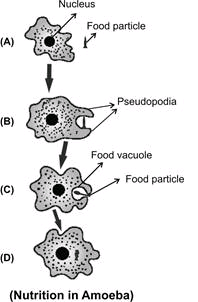
Q7. How does an Amoeba obtain its food?
Answer: Amoeba takes in food using temporary finger-like extensions of the cell surface which fuse over the food particle forming a food-vacuole as shown in figure. Inside the food vacuole, complex substances are broken down into simpler ones which then diffuse into the cytoplasm. The remaining undigested material is moved to the surface of the cell and thrown out.
Q8. What is osmosis?
Answer: The process of movement of water molecules from a region of high water concentration to a region of low water concentration through a selectively permeable membrane is called osmosis. This process continues until the solute concentration reaches equilibrium. The movement of water takes place across a concentration gradient to maintain equity on both sides of the cell.
Q9. Carry out the following osmosis experiment:
Take four peeled potato halves and scoop each one out to make potato cups. One of these potato cups should be made from a boiled potato. Put each potato cup in a trough containing water. Now,
(a) Keep cup A empty
(b) Put one teaspoon sugar in cup B
(c) Put one teaspoon salt in cup C
(d) Put one teaspoon sugar in the boiled potato cup D.
Keep these for two hours. Then observe the four potato cups and answer the following:
(i) Explain why water gathers in the hollowed portion of B and C.
(ii) Why is potato A necessary for this experiment?
(iii) Explain why water does not gather in the hollowed out portions of A and D.
Answer: (i) Water accumulates in the hollowed portions of B and C as a difference in the water concentration is observed. Thereby, endosmosis occurs as the cells act as a semipermeable membrane.
(ii) Potato A is essential in this experiment as it is significant to compare different scenarios seen in potato cups B, C and D. The potato A in this experiment clearly shows that the potato cavity on its own cannot bring about water movement.
(iii) Cup in A does not show any change in the water flow concentration for osmosis to occur, which requires the concentration to be higher than the other. Cells in cup D are dead, thus there is no existence of a semipermeable membrane for water flow. Consequently, osmosis does not occur.
Q10. Which type of cell division is required for growth and repair of body and which type is involved in formation of gametes?
Answer: There are two ways in which a cell divides:
- Mitosis
- Meiosis
Mitosis is the type of cell division that is involved in the growth and repair of body whereas meiosis is a type of cell division which results in the formation of gametes.
We Think the given NCERT Solutions for class 9 Science book Chapter 5 The Fundamental Unit of Life with Answers Pdf free download will assist you. If you’ve got any queries regarding CBSE Class 9 Science The Fundamental Unit of Life NCERT Solutions with Answers, drop a comment below and that we will come back to you soons.