
We have completed the NCERT/CBSE Solutions chapter-wise for Class 9 Science Chapter 6 Tissues with Answers by expert subject teacher for latest syllabus and examination. Prepare effectively for the exam taking the help of the Class 9 Science NCERT Solutions PDF free of cost from here. Students also can take a free NCERT Solutions of Tissues. Each question has right answer Solved by Expert Teacher. Download the Science NCERT Solutions with Answers for Class 9 Science Pdf and prepare to help students understand the concept very well.
NCERT Solutions for Class 9 Science Chapter wise
Questions
Q1. What is a tissue?
Answer: Tissue is a group of cells that are similar in structure and are organised together to perform a specific task.
Q2. What is the utility of tissues in multi-cellular organisms?
Answer: Tissues provide structural strength, mechanical strength, show division of labour.
Questions
Q1. Name types of simple tissues.
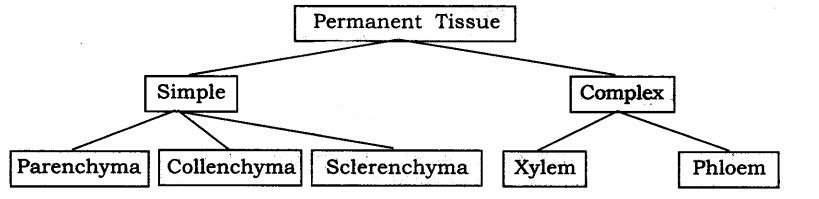
Answer: Three – parenchyma, collenchyma and sclerenchyma. (Meristematic tissue is also a simple tissue).
Q2. Where is apical meristem found?
Answer: Apical meristem is present at the growing tips of stems and roots. Their main function is to initiate growth in new cells of seedlings, at the tip of roots, and shoots.
Q3. Which tissue makes up the husk of coconut?
Answer: Sclerenchyma (fibres) makes up the husk of coconut.
Q4. What are the constituents of phloem?
Answer: The food-conducting tissue of plants is termed as phloem. Sieve tubes, Companion cells, Phloem parenchyma, and Phloem fibers are the four components.
Questions
Q1. Name the tissue responsible for movement in our body.
Answer: Muscular tissue
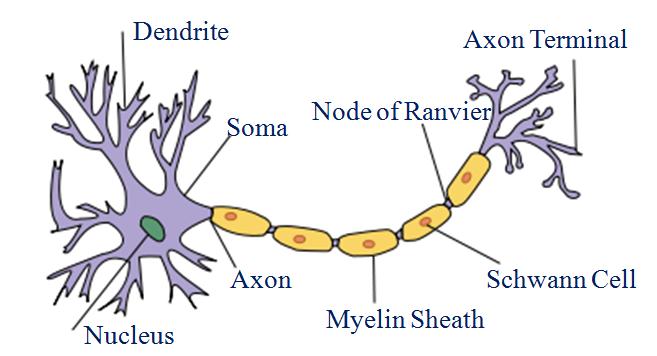
Q2. What does a neuron look like?
Answer: A neuron consists of a cell body with a nucleus and cytoplasm, from which long thin hair like parts arise. Each neuron has a single long part called the axon, and many small, short branched parts called dendrite. An individual nerve cell is called neuron, it may be up to a metre long.
Q3. Give three features of cardiac muscles.
Answer:
- Cells/Fibres: They are small, cylindrical, uninucleate striated with short lateral branches.
- Intercalated Discs: In the area of union becween the two adjacent cardiac muscle fibres, zig-zag junctions called intercalated discs develop. The intercalated discs function as impulse boosters.
- Rhythmic Contractions: The muscles are involuntary and nonfatigued which continue to contract and relax tirelessly throughout life.
Exercise
Q1. Define the term “tissue”.
Answer: Tissue is a group of cells that are similar in structure and are organized together to perform a specific task.
Q2. How many types of elements together make up the xylem tissue? Name them.
Answer: Four types of elements together make up the xylem tissue. These elements are-
- tracheids,
- vessels,
- xylem parenchyma and
- xylem fibres.
Q3. How are simple tissues different from complex tissues in plants?
Answer: Simple tissues are made of one type of cells which coordinate to perform a common function. For example parenchyma, epidermis etc
Complex tissues are made of more than one type of cells. All these coordinate to perform a common function. For example Vascular tissues.
Q4. Differentiate between parenchyma, collenchyma and sclerenchyma, on the basis of their cell wall.
Answer: Parenchyma: The cells have thin cell walls made up of cellulose. Collenchyma: The cells have cell walls thickened at the comers due to pectin deposition.
Sclerenchyma: Their walls are thickened due to lignin deposition.
Q5. What are the functions of the stomata?
Answer: The functions of stomata are:
- The exchange of gases (CO2 and O2) with the atmosphere.
- The loss of excess water in the form of water vapour which is known as transpiration.
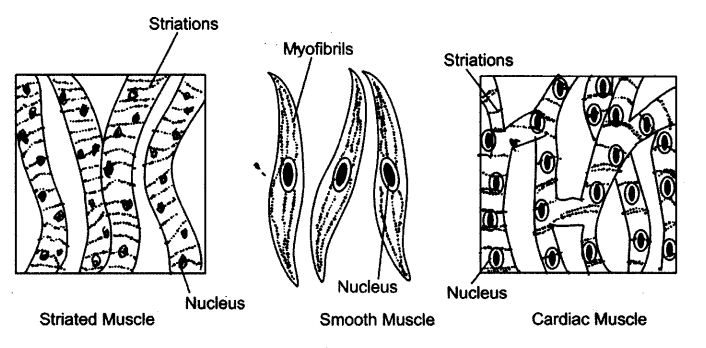
Q6. Diagrammatically show the difference between the three types of muscle fibres.
Answer: Striated muscles
(1) They are connected to bones (Skeletal muscles).
(2) They are voluntary muscles.
(3) The cells are long, cylindrical with many nucleus and are unbranched.
Smooth muscles
(1) They are found in alimentary canal and lungs.
(2) They are involuntary muscles.
(3) They are spindle in shape and have single nucleus.
Cardiac muscles
(1) They are found in heart.
(2) They are involuntary in action.
(3) They are branched and have one nucleus.
Q7. What is the specific function of the cardiac muscle?
Answer: Rhythmic contraction and relaxation continuously throughout life without getting fatigued.
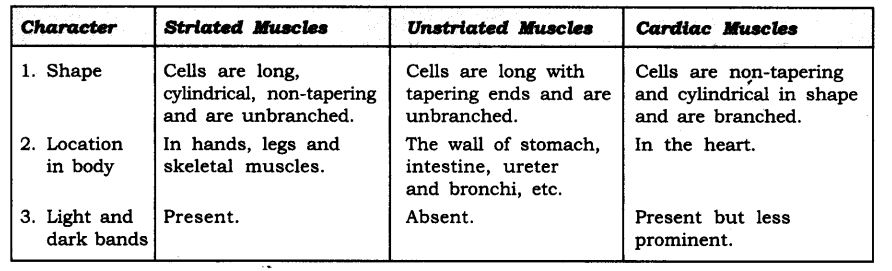
Q8. Differentiate between striated, unstriated and cardiac muscles on the basis of their structure and site/location in the body.
Answer:
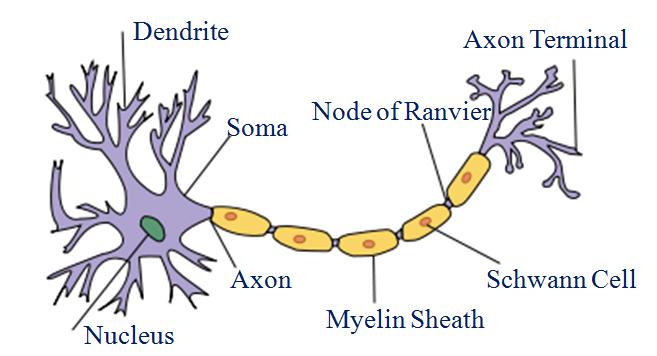
Q9. Draw a labelled diagram of a neuron.
Answer:
Q10. Name the following.
(a) Tissue that forms the inner lining of our mouth.
(b) Tissue that connects muscle to bone in humans.
(c) Tissue that transports food in plants.
(d) Tissue that stores fat in our body.
(e) Connective tissue with a fluid matrix.
(f) Tissue present in the brain.
Answer:
(a) Epithelial tissue
(b) Tendon
(c) Phloem
(d) Adipose
(e) Blood
(f) Nervous tissue.
Q11. Identify the type of tissue in the following: skin, bark of tree, bone, lining of kidney tubule, vascular bundle.
Answer: Skin—Squamous epithelium Bark of tree—Epidermal tissue/cork Bone—Supportive connective tissue or
skeletal tissue Lining of kidney tubule—Ciliated epithelium Vascular bundle—Xylem and phloem (conducting tissue).
Q12. Name the regions in which parenchyma tissue is present.
Answer: Leaves, fruits, and flowers.
Q13. What is the role of epidermis in plants?
Answer: Epidermisis present on the outer surface of the entire plant body which perform following role:
- It is a protective tissue of the plant body.
- It protects the plant against mechanical injury.
- It allows exchange of gases through the stomata.
Q14. How does the cork act as a protective tissue?
Answer: Cork acts as a protective tissue because its cells are dead and compactly arranged without intercellular spaces. They have deposition of suberin on the walls that make them impervious to gases and water.
Q15. Complete the table:
Answer:
We Think the given NCERT Solutions for class 9 Science book Chapter 6 Tissues with Answers Pdf free download will assist you. If you’ve got any queries regarding CBSE Class 9 Science Tissues NCERT Solutions with Answers, drop a comment below and that we will come back to you soons.