We have completed the NCERT/CBSE Solutions chapter-wise for Class 9 Science Chapter 7 Diversity in Living Organisms with Answers by expert subject teacher for latest syllabus and examination. Prepare effectively for the exam taking the help of the Class 9 Science NCERT Solutions PDF free of cost from here. Students also can take a free NCERT Solutions of Diversity in Living Organisms. Each question has right answer Solved by Expert Teacher. Download the Science NCERT Solutions with Answers for Class 9 Science Pdf and prepare to help students understand the concept very well.
NCERT Solutions for Class 9 Science Chapter wise
Questions
Q1. Why do we classify organisms?
Answer: There are millions of organisms on this earth. So, it is harder to study them one by one. Therefore, we look for similarities among them and classify them into different classes to study these different classes as a whole. Classification makes our study easier.
Q2. Give three examples of the range of variations that you see in life-forms around you.
Answer: Listed below are a few ranges of variations observed in life-forms:
(a) Small frog to big whale
(b) Creeper to the eucalyptus tree
(c) Black cuckoo to colourful peacock
Questions
Q1. Which do you think is a more basic characteristic for classifying organisms?
(a) The place where they live.
(b) The kind of cells they are made of. Why?
Answer: The kind of cells: Habitat is a place where diverse types of organisms live together. It cannot be used for classifying organisms. Cells have specific structure, prokaryotic in monerans and eukaryotic in the remaining organisms.
Organisms are unicellular in protista and multicellular in others. A cell wall is absent in animals. Cell wall contains chitin in fungi and cellulose in plants. Plastids occur in plant cells. They are absent in animal cells.
Q2. What is the primary characteristic on which the first division of organisms is made?
Answer: Nature of cell is the primary characteristics on which the first division of organisms is decided. Based on this criterion life forms can be classified into prokaryotes or eukaryotes.
Q3. On what basis are plants and animals put into different categories?
Answer: Plants and animals differ in many features such as the absence of chloroplasts, presence of cell wall, etc. But, locomotion is considered as the characteristic feature that separates animals from plants. This is because the absence of locomotion in plants gave rise to many structural changes such as the presence of a cell wall (for protection), the presence of chloroplasts (for photosynthesis) etc. Hence, locomotion is considered to be the basic characteristic as further differences arose because of this characteristic feature.
Questions
Q1. Which organisms are called primitive and how are they different from the so-called advanced organisms?
Answer: Primitive organisms are those which retain their ancient body designs and basic characteristic and have not changed much during the course of evolution. They differ from so called advanced organisms as the advanced organisms have acquired new body designs and have developed specialised characteristics in accordance with the demand of the changing environment through the process of organic evolution.
Q2. Will advanced organisms be the same as complex organisms? Why?
Answer: Advanced organisms may be same as complex organisms. Since there is a possibility that complexity increases with time and the organisms accumalate changes for better adaptation and survival, therefore we can say that advanced organssims are complex in nature.
Questions
Q1. What is the criterion for classification of organisms as belonging to kingdom Monera or Protista?
Answer: Based on cell structure, the criterion for classifying organisms belonging to the kingdom Monera or Protista:-
(1) Kingdom Monera consist of prokaryotic organisms that do not have a well-defined nucleus or membrane-bound organelles nor do they have cellulose cell walls.
(2) Kingdom Protista, on the other hand, are eukaryotes that include organisms with a well-defined nucleus and membrane-bound organelles with the presence of cellulosic cell walls in some organisms.
Q2. In which kingdom will you place an organism which is single-celled, eukaryotic and photosynthetic?
Answer: Kingdom Protista
Q3. In the hierarchy of classification, which grouping will have the smallest number of organisms with a maximum of characteristics in common and which will have the largest number of organisms?
Answer: (a) The organisms belonging to the Kingdom Monera will have the smallest number of organisms and with maximum characteristics in common.
(b) The organisms belonging to the Kingdom Animalia will have the largest number of organisms.
Questions
Q1. Which division among plants has the simplest organisms?
Answer: Thallophyta or algae.
Q2. How are pteridophytes different from the phanerogams?
Answer: Pteridophytes have naked embryo and inconspicuous reproductive organ whereas — phanerogams have well-differentiated reproductive organs and covered embryo.
Q3. How do gymnosperms and angiosperms differ from each other?
Answer: Seeds are naked in Gymnosperms and are covered in angiosperms.
Questions
Q1. How do poriferan animals differ from coelenterate animals?
Answer:
- Animals from Porifera show cellular level of organisation, while those from Coelenterata show tissue level of organisation.
- In Porifera there is no division of labour, while in Coelenterata some division of labour is seen.
- Porifera do not have coelom, while coelenterata have coelom.
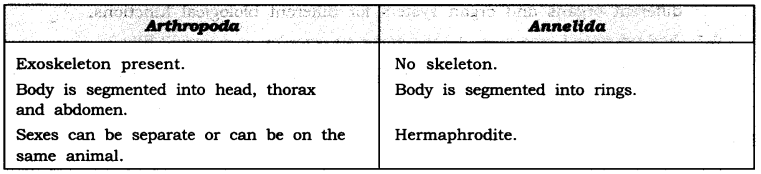
Q2. How do annelid animals differ from arthropods?
Answer:
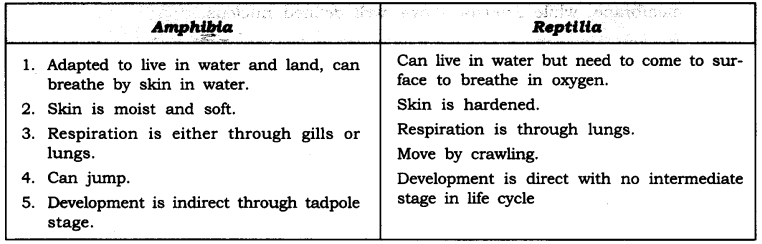
Q3. What are the differences between amphibians and reptiles?
Answer:
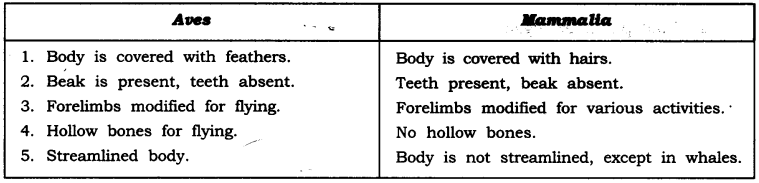
Q4. What are the differences between animals belonging to the Aves group and those in the mammalia group?
Answer:
Excercise
Q1. What are the advantages of classifying organisms?
Answer: There are a wide range of life forms (about 10 million-13 million species) around us. These life forms have existed and evolved on the Earth over millions of years ago. The huge range of these life forms makes it very difficult to study them one by one. Therefore, we look for similarities among them and classify them into different classes so that we can study these different classes as a whole. This makes our study easier.
Therefore, classification serves the following advantages:
(i) It determines the methods of organising the diversity of life on Earth.
(ii) It helps in understanding millions of life forms in detail.
(iii) It also helps in predicting the line of evolution.
Q2. How would you choose between two characteristics to be used for developing a hierarchy in classification?
Answer: Before developing a hierarchy in classification, we need to decide which characteristics should be used as the basis for making the broadest divisions. Then we should pick up next set of characteristics for making sub-groups. This process must continue and each time new characteristics should be used. The characteristics that decide the broadest divisions among living organisms should be independent of any other characteristics. For example, nature of cell and form of the body is considered to classify organisms into broad divisions. The characteristics in the next level should be dependent on the previous one that will decide the subsequent divisions of the groups. ^
Q3. Explain the basis for grouping organisms into five kingdoms.
Answer: The basis for grouping organisms into five kingdom are:
(i) Cell structure
(ii) Mode
(iii) Source of nutrition
(iv) Body organisation.
Q4. What are the major divisions in the Plantae? What is the basis for these divisions?
Answer: (1) Kingdom Plantae has been classified into mainly five major divisions which include, Bryophyta, Thallophyta, Gymnosperms, Pteridophyta, and Angiosperms.
(2)The five groups of plants are classified based on the following criteria:
Plant bodies that are differentiated or undifferentiated, vascular tissues that are present or absent, and plants with or without seeds; if seeds are present, they may be bare or inside the fruit.
Q5. How are the criteria for deciding divisions in plants different from the criteria for deciding the subgroups among animals?
Answer: The characteristics used to classify plants is different from animals because the basic design are different, based on the need to make their own food (plants) or acquire food (animals).
Criteria for deciding divisions in plants are:
- Differentiated/ Undifferentiated plant body
- Presence/ absence of vascular tissues
- With/without seeds
- Naked seeds/ seeds inside fruits
But the animals can’t be divided into groups on these criteria. It is because the basic designs of animals are very different from plants. They are divided on the basis of their body structure.
Q6. Explain how animals in Vertebrata are classified into further subgroups.
Answer: Vertebrata has two subclasses namely
- Pisces
- Tetrapod
Wherein, organisms belonging to Pisces subclass have a streamlined body with tails and fins which help them in their movement (swim) whereas, the Tetrapoda species have four limbs for their movement.
Furthermore, The tetrapod animals are classified as:
- Amphibia: The animals belonging to this group are adaptive in nature. They dwell both in the land as well as in water. They show the presence of specialized organs, which allows them to breathe underwater.
- Reptilia: The animals belonging to this class crawl. Their skin is very thick and withstands extreme temperatures.
- Aves: The forelimbs of these organisms are modified which help them in their flight. They lack teeth and instead have a beak and feathers that cover up their body.
- Mammalia: The animals belonging to this group show nurturing skills as they contain mammary glands to support them. Their skin is covered with hair and most of them are viviparous in nature.
We Think the given NCERT Solutions for class 9 Science book Chapter 7 Diversity in Living Organisms with Answers Pdf free download will assist you. If you’ve got any queries regarding CBSE Class 9 Science Diversity in Living Organisms NCERT Solutions with Answers, drop a comment below and that we will come back to you soons.