
We have completed the NCERT/CBSE Solutions chapter-wise for Class 9 Science Chapter 9 Force and Laws of Motion with Answers by expert subject teacher for latest syllabus and examination. Prepare effectively for the exam taking the help of the Class 9 Science NCERT Solutions PDF free of cost from here. Students also can take a free NCERT Solutions of Force and Laws of Motion. Each question has right answer Solved by Expert Teacher. Download the Science NCERT Solutions with Answers for Class 9 Science Pdf and prepare to help students understand the concept very well.
NCERT Solutions for Class 9 Science Chapter wise
Questions
Q1. Which of the following has more inertia: (a) a rubber ball and a stone of the same size? (b) a bicycle and a train? (c) a five-rupees coin and a one-rupee coin?
Answer: Inertia is the measure of the mass of the body. The greater is the mass of the body; the greater is its inertia and vice-versa.
(a) Mass of a stone is more than the mass of a rubber ball for the same size. Hence, inertia of the stone is greater than that of a rubber ball.
(b) Mass of a train is more than the mass of a bicycle. Hence, inertia of the train is greater than that of the bicycle.
(c) Mass of a five rupee coin is more than that of a one-rupee coin. Hence, inertia of the five rupee coin is greater than that of the one-rupee coin.
Q2. In the following example, try to identify the number of times the velocity of the ball changes:
“A football player kicks a football to another player of his team who kicks the football towards the goal. The goalkeeper of the opposite team collects the football and kicks it towards a player of his own team”.
Also identify the agent supplying the force in each case.
Answer: The velocity of football changes four times. First, when a football player kicks a football to another player, second when that player kicks the football to the goalkeeper. Third when the goalkeeper stops the football. Fourth, when the goalkeeper kicks the football towards his team player.
Agent supplying the force:
a) The First case is the First player
b) The Second case is the Second player
c) The Third case is Goalkeeper
d) The Fourth case is Goalkeeper
Q3. Explain why some of the leaves may get detached from a tree if we vigorously shake its branch.
Answer: Because of the inertia of rest, when the branch is quickly moved, the leaves attached to it tend to stay in their resting position. The leaves and branch junctions are put under a lot of stress as a result of this. This strain causes some leaves to detach off the branch.
Fourth change-The goalkeeper kicks the ball to his teammates. As a result, the ball’s velocity increases from zero to a certain number. As a result, its velocity shifts once more. In this case, the goalkeeper used force to change the ball’s velocity.
Q4. Why do you fall in the forward direction when a moving bus brakes to a stop and fall backwards when it accelerates from rest?
Answer: When a moving bus brakes-to a stop: When the bus is moving, our body is also in motion, but due to sudden brakes, the lower part of our body comes to rest as soon as the bus stops. But the upper part of our body continues to be in motion and hence we fall in forward direction due to inertia of motion.
When the bus accelerates from rest we fall backwards: When the bus’ is stationary our body is at rest but when the bus accelerates, the lower part of our body being in contact with the floor of the bus comes in motion, but the upper part of our body remains at rest due to inertia of rest. Hence we fall in backward direction.
Questions
Q1. If action is always equal to the reaction, explain how a horse can pull a cart.
Answer: The horse pushes the ground with its foot in the backward direction by pressing the ground. As a result of this force of action (i.e. backward push), the ground pushes the horse in the forward direction. Hence, the horse pulls the cart.
Q2. Explain, why is it difficult for a fireman to hold a hose, which ejects large amounts of water at a high velocity.
Answer: Due to the backward reaction of the water being ejected
When a fireman holds a hose, which is ejecting large amounts of water at a high velocity, then a reaction force is exerted on him by the ejecting water in the backward direction. This is because of Newton’s third law of motion. As a result of the backward force, the stability of the fireman decreases. Hence, it is difficult for him to remain stable while holding the hose.
Q3. From a rifle of mass 4 kg, a bullet of mass 50 g is fired with an initial velocity of 35 m s−1. Calculate the initial recoil velocity of the rifle.
Q3. From a rifle of mass 4 kg, a bullet of mass 50 g is fired with an initial velocity of 35 m s−1. Calculate the initial recoil velocity of the rifle.
Answer: Mass of the rifle, m1= 4 kg
Mass of the bullet, m2= 50g= 0.05 kg
Recoil velocity of the rifle= v1
Bullet is fired with an initial velocity, v2= 35m/s
Initially, the rifle is at rest.
Thus, its initial velocity, v= 0
Total initial momentum of the rifle and bullet system= (m1+m2)v= 0
Total momentum of the rifle and bullet system after firing:
= m1v1 + m2v2 = 0.05 × 35 = 4v1 + 1.75
According to the law of conservation of momentum:
Total momentum after the firing = Total momentum before the firing 4v1 + 1.75= 0
v1 = -1.75/4 = -0.4375 m/s
The negative sign indicates that the rifle recoils backwards with a velocity of 0.4375 m/s.
Q4. Two objects of masses 100 g and 200 g are moving along the same line and direction with velocities of 2 ms−1 and 1 ms−1, respectively. They collide and after the collision, the first object moves at a velocity of 1.67 ms−1. Determine the velocity of the second object.
Answer: Assuming that the first object is object A and the second one is object B, it is given that:
Mass of A (m1) = 100g
Mass of B (m2) = 200g
Initial velocity of A (u1) = 2 m/s
Initial velocity of B (u2) = 1 m/s
Final velocity of A (v1) = 1.67 m/s
Final velocity of B (v2) =?
Total initial momentum = Initial momentum of A + initial momentum of B
= m1u1 + m2u2
= (100g) × (2m/s) + (200g) × (1m/s) = 400 g.m.sec-1
As per the law of conservation of momentum, the total momentum before collision must be equal to the total momentum post collision.
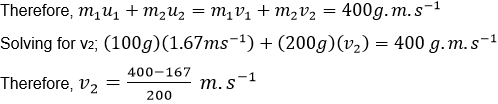
v2 = 1.165 m/s
Therefore, the velocity of object B after the collision is 1.165 meters per second.
Excercises
Q1. An object experiences a net zero external unbalanced force. Is it possible for the object to be travelling with a non-zero velocity? If yes, state the conditions that must be placed on the magnitude and direction of the velocity. If no, provide a reason.
Answer: Yes. An object can travel at a non-zero velocity even if it has a net zero external unbalanced force. This is only possible if the item moves at a consistent speed in a specified direction. As a result, the body is not subjected to any net imbalanced forces. The item will continue to travel at a velocity greater than zero. A net non-zero external unbalanced force must be supplied to the item to change its state of motion.
Q2. When a carpet is beaten with a stick, dust comes out of it. Explain.
Answer: When carpet is beaten with a stick, fibre of carpet comes in motion and the dust falls down due to inertia of rest.
Q3. Why is it advised to tie any luggage kept on the roof of a bus with a rope?
Answer: When the bus accelerates and moves forward, it acquires a state of motion. However, the luggage kept on the roof, owing to its inertia, tends to remain in its state of rest. Hence, with the forward movement of the bus, the luggage tends to remain at its original position and ultimately falls from the roof of the bus. To avoid this, it is advised to tie any luggage kept on the roof of a bus with a rope.
Q4. A batsman hits a cricket ball which then rolls on a level ground. After covering a short distance, the ball comes to rest. The ball slows to a stop because
(a) the batsman did not hit the ball hard enough.
(b) velocity is proportional to the force exerted on the ball.
(c) there is a force on the ball opposing the motion.
(d) there is no unbalanced force on the ball, so the ball would want to come to rest.
Answer: (c) : The cricket ball comes to rest after covering a short distance, because there is a force on the ball, opposing the motion. This force is due to resistance of air and also due to friction between the ball and the ground.
Q5. A truck starts from rest and rolls down a hill with a constant acceleration. It travels a distance of 400 m in 20 s. Find its acceleration. Find the force acting on it if its mass is 7 metric tonnes (Hint: 1 metric tonne = 1000 kg).
Answer: Initial velocity, u = 0 Distance travelled, s = 400 m
Time taken, t = 20 s
We know, s = ut + ½ at2
Or, 400 = 0 + ½ a (20)2
Or, a = 2 ms–2
Now, m = 7 metric tonne = 7000 kg, a = 2 ms–2
Or, F = ma = 7000 × 2 = 14000 N Ans.
Q6. A stone of 1 kg is thrown with a velocity of 20 m s−1 across the frozen surface of a lake and comes to rest after travelling a distance of 50 m. What is the force of friction between the stone and the ice?
Answer: Given, Mass of the stone (m) = 1kg
Initial velocity (u) = 20m/s
Terminal velocity (v) = 0 m/s (the stone reaches a position of rest)
Distance travelled by the stone (s) = 50 m
As per the third equation of motion
v² = u² + 2as
Substituting the values in the above equation we get,
0² = (20)² + 2(a)(50)
-400 = 100a
a = -400/100 = -4m/s² (retardation)
We know that
F = m×a
Substituting above obtained value of a = -4 in F = m x a
We get,
F = 1 × (-4) = -4N
Here the negative sign indicates the opposing force which is Friction
Q7. A 8000 kg engine pulls a train of 5 wagons, each of 2000 kg, along a horizontal track. If the engine exerts a force of 40000 N and the track offers a friction force of 5000 N, then calculate:
(a) the net accelerating force;
Answer:
Force exerted by the engine, F =40000 N
Frictional force offered by the track, Ffraction=5000 N
Net accelerating force,
Fnet=F−Ffriction
Fnet=40000−5000
Fnet=35000 N
Hence, the net accelerating force Fnet=35000N
(b) the acceleration of the train; and
Answer: Total mass of the train = mass of engine + mass of each wagon = 8000kg + 5 × 2000kg
The total mass of the train is 18000 kg.
As per the second law of motion, F = ma (or: a = F/m)
Therefore, acceleration of the train = (net accelerating force) / (total mass of the train)
= 35,000/18,000 = 1.94 ms-2
The acceleration of the train is 1.94 m.s-2.
(c) the force of wagon 1 on wagon 2.
Answer:
Mass of all the wagons except wagon 1 is 4 × 2000 = 8000 kg
Acceleration of the wagons = 3.5 m/s-2
Thus, force exerted on all the wagons except wagon 1
= 8000 × 3.5 = 28000 N
Therefore, the force exerted by wagon 1 on the remaining four wagons is 28000 N.
Hence, the force exerted by wagon 1 on wagon 2 is 28000 N.
Q8. An automobile vehicle has a mass of 1500 kg. What must be the force between the vehicle and road if the vehicle is to be stopped with a negative acceleration of 1.7 m s−2?
Answer: Given, mass of the vehicle (m) = 1500 kg
Acceleration (a) = -1.7 ms-2
As per the second law of motion, F = ma
F = 1500kg × (-1.7 ms-2) = -2550 N
Hence, the force between the automobile and the road is -2550 N, in the opposite direction of the automobile’s motion.
Q9. What is the momentum of an object of mass m, moving with a velocity v?
(a) (mv)² (b) mv² (c) ½ mv² (d) mvAnswer: (d) mv
Mass of the object =m
Velocity =v
Momentum = Mass × Velocity
Momentum =mv
Q10. Using a horizontal force of 200 N, we intend to move a wooden cabinet across a floor at a constant velocity. What is the friction force that will be exerted on the cabinet?
Answer: The cabinet will move with constant velocity, if net external force acting on it is zero. Since a horizontal force of 200 N acts on the cabinet in the forward direction, therefore, net external force acting on it will be zero if frictional force of 200 N acts on it. Thus frictional force = 200 N will be exerted on the cabinet.
Q11. Two objects, each of mass 1.5 kg are moving in the same straight line but in opposite directions. The velocity of each object is 2.5 ms−1 before the collision during which they stick together. What will be the velocity of the combined object after collision?
Answer: Mass of one of the objects, m1 = 1.5 kg Mass of the other object, m2 = 1.5 kg
Velocity of m1 before collision, u1 = 2.5 m/s
Velocity of m2, moving in opposite direction before collision, u2 = −2.5 m/s
Let v be the velocity of the combined object after collision. By the law of conservation of momentum,
Total momentum after collision = Total momentum before collision,
Or, (m1 + m2) v = m1u1 + m2u2
Or, (1.5 + 1.5) v = 1.5 × 2.5 +1.5 × (–2.5) [negative sign as moving in opposite direction]
Or, v = 0 ms–1
Q12. According to the third law of motion when we push on an object, the object pushes back on us with an equal and opposite force. If the object is a massive truck parked along the roadside, it will probably not move. A student justifies this by answering that the two opposite and equal forces cancel each other. Comment on this logic and explain why the truck does not move.
Answer: Since the truck has a very high mass, the static friction between the road and the truck is high. When pushing the truck with a small force, the frictional force cancels out the applied force and the truck does not move. This implies that the two forces are equal in magnitude but opposite in direction (since the person pushing the truck is not displaced when the truck doesn’t move). Therefore, the student’s logic is correct.
Q13. A hockey ball of mass 200 g travelling at 10 m s−1 is struck by a hockey stick so as to return it along its original path with a velocity at 5 m s−1. Calculate the change of momentum occurred in the motion of the hockey ball by the force applied by the hockey stick.
Answer: Mass of hockey ball, m = 200 g = 0.2 kg
Velocity of hockey ball before striking the hockey stick, v1 = 10 m s-1
Velocity of hockey ball after striking the hockey stick, v2 = -5 m s-1
Change of momentum = mv1 – mv2 = m(v1 – v2) = 0.2 (10 + 5) = 0.2 x 15 = 3.0 kg m s-1
Q14. A bullet of mass 10 g travelling horizontally with a velocity of 150 m s−1 strikes a stationary wooden block and comes to rest in 0.03 s. Calculate the distance of penetration of the bullet into the block. Also calculate the magnitude of the force exerted by the wooden block on the bullet.
Answer:
Initial velocity, u = 150 m/s
Final velocity, v = 0 (since the bullet finally comes to rest)
Time taken to come to rest, t = 0.03 s
According to the first equation of motion, v = u + at
Acceleration of the bullet, a
0 = 150 + (a × 0.03 s)a = -150/0.03 = -5000 m/s2
(Negative sign indicates that the velocity of the bullet is decreasing.)
According to the third equation of motion:
v²= u²+ 2as
0 = (150)²+ 2 (-5000)
= 22500 / 10000
= 2.25 m
Hence, the distance of penetration of the bullet into the block is 2.25 m.
From Newton’s second law of motion:
Force, F = Mass × Acceleration
Mass of the bullet, m = 10 g = 0.01 kg
Acceleration of the bullet, a = 5000 m/s-²
F = ma = 0.01 × 5000 = 50 N
Hence, the magnitude of force exerted by the wooden block on the bullet is 50 N.
Q15. An object of mass 1 kg travelling in a straight line with a velocity of 10 m s−1 collides with, and sticks to, a stationary wooden block of mass 5 kg. Then they both move off together in the same straight line. Calculate the total momentum just before the impact and just after the impact. Also, calculate the velocity of the combined object.
Answer:
Given, mass of the object (m1) = 1kg
Mass of the block (m2) = 5kg
Initial velocity of the object (u1) = 10 m/s
Initial velocity of the block (u2) = 0
Mass of the resulting object = m1 + m2 = 6kg
Velocity of the resulting object (v) =?
Total momentum before the collision = m1u1 + m2u2 = (1kg) × (10m/s) + 0 = 10 kg.m.s-1
As per the law of conservation of momentum, the total momentum before the collision is equal to the total momentum post the collision. Therefore, the total momentum post the collision is also 10 kg.m.s-1
Now, (m1 + m2) × v = 10kg.m.s-1
Therefore V= 10kg.m.s-1/6kg = 1.66ms-1
The resulting object moves with a velocity of 1.66 meters per second.
Q16. An object of mass 100 kg is accelerated uniformly from a velocity of 5 m s−1 to 8 m
s−1 in 6 s. Calculate the initial and final momentum of the object. Also, find the magnitude of the force exerted on the object.
Answer:
Initial velocity of the object, u = 5 m/s
Final velocity of the object, v = 8 m/s
Mass of the object, m = 100 kg
Time take by the object to accelerate, t = 6 s
Initial momentum = mu = 100 × 5 = 500 kg ms−1
Final momentum = mv = 100 × 8 = 800 kg ms−1
Force exerted on the object, F = (mv – mu)/ t
= m (v-u)/t
= 800 – 500
= 300/6
= 50 N
Initial momentum of the object is 500 kg ms−1.
Final momentum of the object is 800 kg ms−1.
Force exerted on the object is 50 N.
Q17. Akhtar, Kiran and Rahul were riding in a motorocar that was moving with a high velocity on an expressway when an insect hit the windshield and got stuck on the windscreen. Akhtar and Kiran started pondering over the situation. Kiran suggested that the insect suffered a greater change in momentum as compared to the change in momentum of the motorcar (because the change in the velocity of the insect was much more than that of the motorcar). Akhtar said that since the motorcar was moving with a larger velocity, it exerted a larger force on the insect. And as a result the insect died. Rahul while putting an entirely new explanation said that both the motorcar and the insect experienced the same force and a change in their momentum. Comment on these suggestions.
Answer:
As a result, the vehicle and insect systems have no change in momentum.
In this case, the insect experiences a bigger change in velocity, which results in a greater shift in momentum. Kiran’s assessment is correct from this perspective.
The motorcar travels at a faster speed and has a bigger mass than the insect.
Furthermore, the motorcar continues to travel in the same direction after the collision, indicating that the motorcar has the least amount of momentum change, whilst the insect has the most. As a result, Akhtar’s statement is likewise correct.
Because the momentum acquired by the bug is equal to the momentum lost by the motorcar, Rahul’s observation is likewise true. This is also in agreement with the conservation of momentum law. However, he committed an error since the system suffers from a flaw. Because the momentum before the collision is identical to the momentum after the impact, there is no change in momentum following the accident.
Q18. How much momentum will a dumbbell of mass 10 kg transfer to the floor if it falls from a height of 80 cm? Take its downward acceleration to be 10 m s−2.
Answer:
Given, mass of the dumb-bell (m) = 10kg
Distance covered (s) = 80cm = 0.8m
Initial velocity (u) = 0 (it is dropped from a position of rest)
Acceleration (a) = 10ms-2
Terminal velocity (v) =?
Momentum of the dumb-bell when it hits the ground = mv
As per the third law of motion
v2 – u2 = 2as
Therefore, v2 – 0 = 2 (10 ms-2) (0.8m) = 16 m2s-2
v = 4 m/s
The momentum transferred by the dumb-bell to the floor = (10kg) × (4 m/s) = 40 kg.m.s-1
We Think the given NCERT Solutions for class 9 Science book Chapter 9 Force and Laws of Motion with Answers Pdf free download will assist you. If you’ve got any queries regarding CBSE Class 9 Science Force and Laws of Motion NCERT Solutions with Answers, drop a comment below and that we will come back to you soons.