Introduction
Completing Class 12 is an important milestone, but it also brings a major career decision: What should I study next?
With hundreds of degree programmes, professional qualifications, diplomas and skill-based courses available, selecting the right career path can be confusing. The best course after 12th is not necessarily the one with the highest salary or the most popularity. Your decision should consider your interests, 12th stream, eligibility, skills, budget, course duration, career goals and preferred work environment.
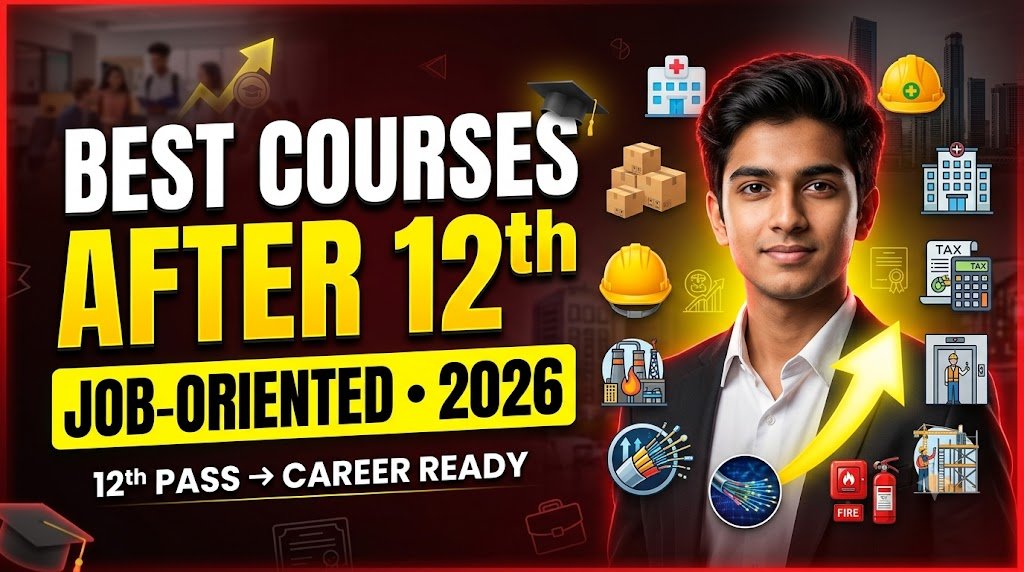
For students who want to become employment-ready with specialised skills, job-oriented courses after 12th can be an attractive option. These programmes focus on practical knowledge and industry-specific skills that can help learners enter fields such as healthcare, logistics, safety, taxation, facility management, oil and gas, technical services and telecommunications.
This guide combines traditional career pathways with career-focused and job-oriented courses after 12th, helping students understand their options before making an admission decision.
What Are Job-Oriented Courses After 12th?
Job-oriented courses are programmes designed around specific industries, occupations or practical skill sets. Unlike a broad academic programme, a specialised course may focus more directly on the knowledge and skills required for a particular type of work.
Students can consider several pathways after Class 12, including:
- Undergraduate degree programmes
- Professional qualifications
- Job-oriented courses
- Skill-based programmes
- Diploma and certificate courses
- Industry-specific training
- Vocational and technical education
- Professional certifications
- Competitive-exam preparation
The duration, eligibility, fees and recognition of these programmes can vary significantly between institutions. Therefore, students should evaluate the curriculum, practical training, certification, recognition and career progression before enrolling.
Best Courses After 12th Based on Your Stream
Your Class 12 stream can influence which courses you are eligible for and which career paths may suit you.
| 12th Stream | Popular Course & Career Options |
|---|---|
| Science PCM | Engineering, B.Tech, B.E., B.Sc, BCA, IT, Computer Science, Architecture |
| Science PCB | Medicine, Dentistry, Pharmacy, Nursing, Biotechnology, Microbiology, Allied Healthcare |
| Commerce | B.Com, BBA, Economics, Finance, Banking, CA, CS, CMA |
| Arts/Humanities | BA, Law, Psychology, Journalism, Design, Hospitality, Social Sciences |
| Various Eligible Streams | Management, Computer Applications, Safety, Healthcare, Logistics and selected professional courses |
| Career-Focused Pathways | HSE, Accounting, Healthcare, Technical Training, Logistics, Facility Management |
Eligibility differs according to the programme and institution, so students should always verify the latest admission requirements before applying.
Top Job-Oriented Courses After 12th in 2026
1. Hospital Administration Course
A Hospital Administration course after 12th can be suitable for students who want to enter the healthcare industry without pursuing a clinical medical profession.
The programme can introduce students to hospital operations, patient services, healthcare administration, coordination and facility-related activities. With healthcare facilities expanding across different regions, trained administrative professionals can find opportunities in hospitals, clinics, diagnostic centres and other healthcare organisations.
Career Opportunities
- Hospital Administrator
- Assistant Hospital Administrator
- Hospital Operations Executive
- Patient Relations Executive
- Patient Care Coordinator
- Healthcare Coordinator
- Medical Office Administrator
- Medical Records Executive
- Hospital Billing Executive
- Clinic Administrator
- Admission Coordinator
- Healthcare Quality Executive
Expected Salary
India: ₹2.5 – ₹5 LPA
GCC Countries: AED 3,000 – AED 8,000 per month
2. Healthcare Management Course
Students interested in the business and operational side of healthcare can consider a Healthcare Management course after 12th.
Healthcare management combines administrative knowledge with healthcare operations. Depending on the programme, students may learn about hospital systems, patient coordination, healthcare operations, quality management and facility administration.
Career Opportunities
- Healthcare Executive
- Healthcare Administrator
- Healthcare Operations Coordinator
- Hospital Operations Coordinator
- Medical Facility Administrator
- Clinic Administrator
- Healthcare Services Manager
- Healthcare Operations Manager
- Patient Care Coordinator
- Healthcare Quality Executive
Expected Salary
India: ₹3 – ₹6 LPA
GCC Countries: AED 3,500 – AED 9,000 per month
3. Logistics and Supply Chain Management Course
The growth of e-commerce, manufacturing, transportation and international trade has increased the importance of efficient logistics and supply chain operations.
A Logistics and Supply Chain Management course after 12th can help students understand areas such as inventory, warehousing, procurement, transportation and supply chain coordination.
Career Opportunities
- Logistics Executive
- Logistics Coordinator
- Supply Chain Executive
- Supply Chain Coordinator
- Warehouse Executive
- Warehouse Coordinator
- Procurement Assistant
- Procurement Executive
- Inventory Executive
- Inventory Controller
Expected Salary
India: ₹3 – ₹6 LPA
GCC Countries: AED 3,000 – AED 10,000 per month
4. Warehouse and Procurement Management Course
Students looking for a specialised career in warehouse operations, inventory and procurement can explore this career-focused pathway.
The course can help learners understand warehouse processes, stock control, procurement activities, vendor coordination and inventory management.
Career Opportunities
- Warehouse Executive
- Warehouse Coordinator
- Procurement Assistant
- Procurement Executive
- Logistics Executive
- Logistics Coordinator
- Inventory Controller
- Inventory Executive
- Supply Chain Coordinator
- Supply Chain Executive
Expected Salary
India: ₹3 – ₹6 LPA
GCC Countries: AED 3,000 – AED 10,000 per month
5. Health, Safety and Environment (HSE) Course
A Safety Officer or HSE course after 12th can be considered by students interested in workplace safety, industrial operations and risk management.
Safety professionals may work across construction, manufacturing, infrastructure, oil and gas, logistics, engineering, healthcare and industrial operations. Typical responsibilities can include workplace inspections, hazard identification, risk assessment, safety training, incident prevention and compliance activities.
Career Opportunities
- HSE Officer
- HSE Executive
- Safety Officer
- Safety Supervisor
- Safety Inspector
- Safety Coordinator
- Safety Trainer
- EHS Executive
- EHS Coordinator
- Occupational Health & Safety Officer
Expected Salary
India: ₹2.5 – ₹4.5 LPA
GCC Countries: AED 2,500 – AED 7,000 per month
What to Check Before Choosing an HSE Course
Before enrolling, compare:
- Course level
- Entry requirements
- Awarding organisation
- Accreditation or recognition
- Course duration
- Assessment method
- Practical learning
- Industry relevance
- Career progression
These factors are important when evaluating professional and safety qualifications.
6. Facility Management Course
A Facility Management course after 12th can prepare students for careers involving the operation and coordination of buildings, properties and facilities.
Facility-related roles can exist in hospitals, commercial buildings, residential communities, hotels, industrial sites and other large facilities.
Career Opportunities
- Facility Executive
- Facility Coordinator
- Property Coordinator
- Property Executive
- Maintenance Coordinator
- Maintenance Executive
- Facility Operations Assistant
- Facility Operations Executive
- Building Administrator
- Facilities Supervisor
Expected Salary
India: ₹3 – ₹6 LPA
GCC Countries: AED 3,500 – AED 10,000 per month
7. Enrolled Agent (EA) Course – US Taxation
Commerce students and learners interested in accounting, taxation and finance can consider an Enrolled Agent (EA) pathway.
US taxation-focused training can cover areas such as individual taxation, business taxation, tax compliance and tax-related professional services. It can be particularly relevant for students who want to explore international accounting and taxation careers.
Career Opportunities
- US Tax Associate
- US Tax Preparer
- Tax Analyst
- Tax Specialist
- Tax Consultant
- Tax Advisor
- Tax Compliance Executive
- Tax Compliance Associate
- Tax Reviewer
- Tax Accountant
Expected Salary
India: ₹4 – ₹8 LPA for freshers
Experienced Professionals: ₹10 – ₹20+ LPA
Students should verify the current eligibility, examination structure and certification requirements before enrolling.
8. Caregiving Course
Students interested in healthcare support and helping people can explore a Caregiving course after 12th.
Caregiving training can develop practical knowledge related to supporting elderly individuals, patients and people who require assistance with daily activities and care.
Potential work environments include hospitals, home healthcare services, rehabilitation centres, assisted-living facilities and elderly-care organisations.
Career Opportunities
- Caregiver
- Patient Care Assistant
- Elderly Care Assistant
- Home Healthcare Assistant
- Nursing Assistant
- Personal Care Assistant
- Patient Support Executive
- Healthcare Support Assistant
- Rehabilitation Care Assistant
- Disability Support Worker
- Palliative Care Assistant
- Hospital Care Assistant
Expected Salary
India: ₹2 – ₹4.5 LPA
GCC Countries: AED 2,500 – AED 6,000 per month
9. Oil Refinery Operations and Fire Safety Course
Students interested in oil and gas operations, industrial environments and safety can consider specialised refinery operations and fire-safety training.
Such training can introduce learners to industrial operations, refinery environments, fire prevention, emergency procedures and process-safety concepts.
Career Opportunities
- Oil & Gas Operations Assistant
- Refinery Operations Assistant
- Fire Safety Executive
- Fire & Safety Officer
- Safety Coordinator
- Safety Supervisor
- Industrial Safety Professional
- Industrial Safety Officer
- Process Safety Assistant
- HSE Executive
Expected Salary
India: ₹3 – ₹6 LPA
GCC Countries: AED 3,500 – AED 10,000 per month
10. Lift and Elevator Technician Course
A Lift Technician course after 12th can be an option for students who prefer a technical and hands-on career.
With the continued development of residential and commercial buildings, trained professionals are needed for elevator installation, maintenance, servicing and troubleshooting.
Career Opportunities
- Lift Technician
- Elevator Technician
- Lift Maintenance Technician
- Elevator Maintenance Technician
- Service Technician
- Field Service Technician
- Technical Support Technician
- Installation Technician
- Elevator Service Engineer
- Technical Support Executive
Expected Salary
India: ₹2.5 – ₹5 LPA
GCC Countries: AED 2,500 – AED 7,000 per month
11. Scaffolding Course
A Scaffolding course after 12th can be considered by students interested in construction, industrial maintenance and infrastructure projects.
The training focuses on the safe erection, inspection and dismantling of scaffolding structures. This type of work requires practical knowledge and a strong understanding of workplace safety procedures.
Career Opportunities
- Scaffolder
- Scaffolding Technician
- Scaffolding Erector
- Industrial Scaffolder
- Scaffolding Supervisor
- Scaffolding Inspector
- Scaffolding Foreman
- Construction Safety Assistant
- Scaffolding Coordinator
- Maintenance Scaffolder
- Shutdown Project Scaffolder
- Industrial Access Technician
Expected Salary
India: ₹2.5 – ₹5 LPA
GCC Countries: AED 3,000 – AED 8,000 per month
12. Fibre Optics Technology Course
The expansion of broadband, telecommunications and digital infrastructure has created demand for professionals with fibre-optic installation and maintenance skills.
A Fibre Optic Technician course after 12th can help students build technical knowledge related to optical fibre installation, network maintenance and telecom infrastructure.
Career Opportunities
- Fibre Optic Technician
- Fiber Optic Installer
- Network Support Technician
- Network Maintenance Technician
- Telecom Technician
- Telecom Infrastructure Assistant
- Optical Fiber Technician
- Broadband Network Technician
- Field Network Engineer
- Telecom Support Executive
Expected Salary
India: ₹2.5 – ₹5.5 LPA
GCC Countries: AED 2,500 – AED 8,000 per month
13. Fire Alarm Technology and Fire Safety Course
A Fire Alarm and Fire Safety course after 12th is suitable for students interested in building safety systems, fire protection and emergency response.
The training may cover fire detection systems, alarm equipment, fire protection systems, installation, maintenance, troubleshooting, emergency procedures and safety practices.
Career Opportunities
- Fire Alarm Technician
- Fire Alarm Installer
- Fire Safety Officer
- Fire & Safety Technician
- Fire Alarm Maintenance Technician
- Fire Protection Technician
- Safety Coordinator
- Safety Supervisor
- Fire Alarm System Technician
- Emergency Response Coordinator
Expected Salary
India: ₹2.5 – ₹5.5 LPA
GCC Countries: AED 2,500 – AED 8,000 per month
Other Popular Courses After 12th in India
Job-oriented training is only one part of the career landscape. Students can also choose traditional undergraduate and professional pathways depending on their stream and long-term goals.
Courses After 12th Science PCM
Students with Physics, Chemistry and Mathematics can explore:
- B.Tech
- B.E.
- B.Sc
- BCA
- Computer Science
- Information Technology
- Architecture
- Data-related programmes
- Electronics and Communication
- Civil Engineering
- Mechanical Engineering
- Electrical Engineering
These options can lead to careers in engineering, IT, software, technology, construction, manufacturing, electronics, infrastructure and technical services.
Courses After 12th Science PCB
Students with Physics, Chemistry and Biology can consider:
- MBBS
- BDS
- Pharmacy
- Nursing
- Biotechnology
- Microbiology
- Biochemistry
- Forensic Science
- Allied Healthcare
- B.Sc programmes
Depending on the qualification, career areas can include healthcare, hospitals, pharmaceutical organisations, laboratories, biotechnology, research and allied healthcare.
Courses After 12th Commerce
Commerce is a popular pathway for students interested in business, accounting, finance, taxation, banking and management.
Popular options include:
- B.Com
- B.Com Honours
- BBA
- Economics
- Finance
- Banking
- Business Management
- Chartered Accountancy (CA)
- Company Secretary (CS)
- Cost and Management Accountancy (CMA)
- Financial Planning
Career areas can include accounting, finance, banking, taxation, auditing, financial services, corporate services and entrepreneurship.
Courses After 12th Arts and Humanities
Arts and Humanities students can explore careers in communication, law, psychology, media, design, education, hospitality and social sciences.
Popular courses include:
- Bachelor of Arts
- BA Psychology
- BA Economics
- Law
- Journalism and Mass Communication
- Design
- Fashion Design
- Hotel Management
- Social Sciences
- Languages
- Fine Arts
- Management-related programmes
Career opportunities can span education, media, journalism, law, communication, design, public services, hospitality and social sciences.
Best Courses After 12th Based on Career Interest
Instead of selecting a course simply because it is popular, students can begin by identifying the type of career they want.
| Career Interest | Possible Course Areas |
| Engineering | B.Tech, B.E. and Engineering Specialisations |
| Healthcare | Medicine, Dentistry, Pharmacy, Nursing, Allied Healthcare |
| IT & Technology | B.Tech, BCA, B.Sc Computer Science, Technology Programmes |
| Finance & Accounting | B.Com, CA, CMA, Finance |
| Business & Management | BBA, BMS, Management |
| Law | Integrated Law, LLB Pathways |
| Media & Communication | Journalism, Mass Communication, Media |
| Design | Fashion, Graphic, Interior and Other Design Courses |
| Safety & HSE | Safety and HSE Qualifications |
| Hospitality | Hotel Management and Hospitality |
Starting with a preferred career field can make it easier to identify suitable education pathways.
Degree Course vs Professional Course vs Job-Oriented Course
Students often compare degrees, professional qualifications and job-oriented programmes. Each serves a different purpose.
| Course Type | Main Purpose | Suitable For |
| Degree Course | Provides broad academic and professional foundation | Students seeking undergraduate education |
| Professional Course | Develops a specialised professional pathway | Students targeting a specific profession |
| Job-Oriented Course | Focuses on practical or industry-specific skills | Students seeking focused career skills |
There is no universal winner. A degree may be the better option for one career, while a professional qualification or specialised course may suit another. Some students can also combine a degree with professional certifications to strengthen their career profile.
How to Choose the Best Course After 12th
Choosing a career because friends or relatives selected it can lead to the wrong decision. Instead, evaluate your options systematically.
1. Understand Your Interests
Ask yourself:
- Do I enjoy technology?
- Am I interested in healthcare?
- Do I like business and finance?
- Do I prefer practical work?
- Am I interested in safety?
- Do I enjoy communication?
- Do I like creative work?
- Do I enjoy analytical problem-solving?
Your interests can help narrow down the available choices.
2. Check Your Academic Strengths
Your Class 12 subjects can affect your eligibility for different programmes. Some courses require particular subjects, minimum marks or entrance examinations.
Always check the official eligibility criteria before applying.
3. Decide Your Preferred Work Environment
Think about whether you would prefer to work:
- In an office
- In a hospital
- In a laboratory
- At an industrial site
- In construction
- In technology
- In finance
- In media
- In a creative environment
Your preferred work environment can help you identify suitable career fields.
4. Research the Career, Not Just the Course
Before admission, find out:
- What jobs are available?
- Which industries hire these professionals?
- What skills are required?
- Is additional certification necessary?
- Can you pursue higher education?
- What career progression is possible?
Researching the career pathway gives you a clearer picture than looking only at the course title.
5. Verify Eligibility
Check:
- Educational qualification
- Required Class 12 subjects
- Minimum marks
- Entrance examination
- Age requirements where applicable
- Institution-specific admission rules
Never assume that every institution follows identical eligibility requirements.
6. Compare Course Duration
Consider:
- Course duration
- Examination schedule
- Internship requirements
- Practical training
- Higher-study opportunities
A shorter course is not automatically better. The right duration depends on the career you want to build.
7. Calculate the Complete Cost
Don’t look only at tuition fees. Your total education cost may include:
- Tuition fees
- Examination fees
- Study materials
- Travel
- Accommodation
- Additional certifications
- Internship or practical expenses
Prepare a realistic education budget before enrolling.
8. Check Recognition and Credibility
Before choosing a professional or certification-based course, investigate:
- Awarding organisation
- Accreditation or recognition
- Training provider credentials
- Assessment process
- Certificate issued
- Industry relevance
These checks can help you distinguish a meaningful qualification from a course based mainly on marketing claims.
9. Look for Practical Training
Practical exposure can be especially important for technical and job-oriented programmes.
Depending on the field, practical learning may include:
- Projects
- Laboratory work
- Internships
- Case studies
- Simulations
- Industry assignments
- Practical assessments
10. Think Beyond Your First Job
Your career journey should not end with your first employment opportunity.
A useful way to think about career development is:
Course → Entry-Level Job → Experience → Advanced Qualification → Senior Role
Consider what additional skills, certifications and experience you may need to progress in the future.
Why Placement Assistance Can Matter
For students choosing a career-focused course, training is only one part of becoming employment-ready. Placement assistance and career guidance can also help learners understand job opportunities and prepare for recruitment.
A strong placement-support system may include:
- Career guidance and profile assessment
- Resume development
- Professional profile building
- Soft-skills training
- Interview preparation
- Mock interviews
- Job opportunity mapping
- Candidate shortlisting
- Employer coordination
- Interview scheduling
- Follow-up support
However, students should understand the exact nature of any placement claim before admission. Placement assistance does not automatically mean a guaranteed job, and outcomes can vary according to qualifications, skills, performance, employer requirements and market conditions.
Why Choose an Industry-Focused Training Provider?
When selecting a job-oriented course, students should evaluate more than the course title. Important factors include:
- Industry-aligned curriculum
- Experienced faculty
- Practical learning
- Recognised certifications where applicable
- Career guidance
- Placement support
- Interview preparation
- Employer connections
- Online or classroom learning options
- Opportunities for further qualifications
The original source also recommends evaluating training providers based on credentials, recognition, practical learning and industry relevance rather than choosing a programme simply because it is popular.
What Is the Best Course After 12th for the Future?
There is no single course that can be called the best for every student.
Future career opportunities can depend on:
- Industry demand
- Technical skills
- Communication skills
- Practical experience
- Professional qualifications
- Adaptability
- Continuous learning
- Career specialisation
Students should be careful with claims that describe a particular programme as a guaranteed “high salary course.” Salary depends on experience, skills, employer, industry, location and other factors.
A better approach is to match your interests with a realistic career pathway:
Interested in technology? Explore IT, computer science and technology programmes.
Interested in healthcare? Consider medicine, pharmacy, nursing, healthcare administration or allied healthcare according to your eligibility.
Interested in business? Explore commerce, finance, taxation and management.
Interested in law or communication? Consider law, journalism, media and related programmes.
Interested in industrial safety? Explore HSE and safety qualifications.
Course Comparison Checklist Before Admission
| Factor | What to Check |
| Eligibility | Required qualification and subjects |
| Duration | Total course period |
| Cost | Tuition and additional expenses |
| Entrance Exam | Whether an entrance test is required |
| Curriculum | Subjects and skills taught |
| Practical Training | Projects, labs, internships or hands-on learning |
| Recognition | Awarding organisation and applicable recognition |
| Career Opportunities | Relevant industries and job roles |
| Higher Studies | Future education options |
| Career Progression | Opportunities after gaining experience |
This approach helps students make decisions based on facts instead of choosing a course only because of advertising or recommendations from friends.
Common Mistakes Students Should Avoid
Choosing a Course Because Friends Choose It
Your friend’s interests, strengths and career goals may be different from yours. Select a programme according to your own objectives.
Selecting Only on the Basis of Salary
A salary advertised by an institution does not mean every graduate will earn the same amount. Career outcomes depend on multiple factors.
Ignoring Eligibility
Always verify the latest admission requirements before paying an admission fee.
Not Researching the Institution
The same course can differ considerably between institutions in terms of curriculum, training, support and recognition.
Looking Only at the Course Name
Read the complete curriculum and understand exactly what you will learn.
Ignoring Practical Exposure
For technical and industry-focused careers, find out whether the course includes practical assignments, projects, internships, simulations or hands-on training.
These are among the key mistakes highlighted in the source guide for students selecting courses after Class 12.
Frequently Asked Questions About Job-Oriented Courses After 12th
Which course is best after 12th?
There is no single best course for everyone. The right choice depends on your 12th stream, interests, academic strengths, eligibility, budget, career goals and preferred industry.
Which are the best job-oriented courses after 12th?
Popular career-focused options include Hospital Administration, Healthcare Management, Logistics and Supply Chain Management, HSE, Facility Management, US Taxation, Caregiving, Oil & Gas Operations, Lift Technology, Scaffolding, Fibre Optics and Fire Safety.
Which course is best after 12th Science?
Science students can explore engineering, medicine, technology, computer science, pharmacy, nursing, biotechnology, allied healthcare and other specialised programmes depending on whether they studied PCM, PCB or PCMB.
Which course is best after 12th Commerce?
Commerce students can consider B.Com, BBA, Finance, Economics, Banking, CA, CS, CMA, taxation and other business-related pathways.
Which course is best after 12th Arts?
Arts and Humanities students can explore BA, Psychology, Law, Journalism, Mass Communication, Design, Hospitality, Social Sciences, Languages and other eligible programmes.
Can I choose a professional course after 12th?
Yes. Students can explore professional qualifications, certifications, diplomas and specialised training depending on eligibility and the career they want to pursue.
Is a degree better than a job-oriented course?
Neither is automatically better. A degree provides a broader academic foundation, while a job-oriented course can focus more directly on practical or industry-specific skills. The appropriate choice depends on your career objective.
Can I pursue a safety or HSE course after 12th?
Depending on the programme’s eligibility criteria, students can explore safety and HSE education after Class 12. Before enrolling, check the qualification level, awarding organisation, recognition, curriculum and career pathway.
Is a high salary guaranteed after a job-oriented course?
No. A course alone cannot guarantee a particular salary. Earnings can depend on skills, experience, employer, location, industry, certifications and market conditions.
Final Thoughts
Choosing the best course after 12th in India in 2026 is about more than finding a course with an attractive job title or salary claim.
The strongest decision usually comes from balancing:
Interest + Eligibility + Skills + Course Quality + Career Goal + Industry Opportunity
Students from Science can explore engineering, medicine, technology and science-related careers. Commerce students can build pathways in accounting, finance, banking, taxation and management, while Arts and Humanities students can consider law, media, psychology, design, hospitality and social sciences.
For students who want a more specialised career pathway, job-oriented courses after 12th can provide focused training in areas such as healthcare administration, logistics, HSE, facility management, taxation, industrial safety, technical services and telecommunications.
Before making your final decision, compare the eligibility, curriculum, duration, total cost, recognition, practical exposure, career opportunities and progression potential.
Most importantly, don’t select a course simply because it is trending. Choose a career path that matches your abilities and interests and that you are prepared to develop over the long term.
Disclaimer: Salary figures mentioned above are indicative estimates based on the supplied source material and may vary depending on employer, location, qualifications, experience, skills, certifications and prevailing market conditions. Course eligibility, recognition, certification requirements and admission rules can also vary by institution and programme. Students should verify the latest official details before enrolling.