
We have Provided the CBSE Solutions chapter-wise. Class 8 Science Chapter 6 Combustion and Flame with Answers by expert subject teacher for latest syllabus and examination. Students can take a free CBSE Solutions of Combustion and Flame. Each question has right answer Solved by Expert Teacher.
CBSE Solutions Class 8 Science Beehive Prose
Page No. 75
Exercise
Q1. List conditions under which combustion can take place.
Answer: The burning of a substance in the presence of oxygen is defined as combustion.
The conditions under which combustion can take place are
- The presence of air or oxygen.
- The presence of fuel plays a significant role.
- Ignition temperature is maintained (It is defined as the substance that catches fire at its lowest temperature.)
Q2. Fill in the blanks:
(a) Burning of wood and coal causes ___of air.
(b) A liquid fuel used in homes is _____.
(c) Fuel must be heated to its before it starts burning.
(d) Fire produced by oil cannot be controlled by __.
Answer: (a) pollution
(b) LPG.
(c) ignition temperature
(d) water.
Q3. Explain how the use of CNG in automobiles has reduced pollution in our cities.
Answer: The use of CNG in automobiles has reduced pollution in our cities as it is a quality fuel and has some benefits:
(a) It gives out less carbon dioxide gas, carbon monoxide gas, sulphur dioxide and nitrogen dioxide, which is beneficial as they play crucial role in global warming and acid rain.
(b) It leaves behind no residue after its combustion.
Q4. Compare LPG and wood as fuels.
Answer:
| LPG | Wood |
| 1) No residue after burning. 2) It can be easily stored in cylinders for convenient transportation. 3) Burns easily. 4) Low ignition temperature. 5) No smoke on burning. | 1) Leaves a lot of ash on burning. 2) Cannot be transported easily like LPG. 3) Catches fire with more difficulty. 4) High ignition temperature. 5) Burns with smoke. |
Q5. Give reasons.
(a) Water is not used to control fires involving electrical equipment.
Answer: Water is not used to control fires involving electrical equipment because water is a good conductor of electricity due to which the person may be electro-conducted and it may damage the equipment.
(b) LPG is a better domestic fuel than wood.
Answer: LPG is a better domestic fuel than wood because wood produces a lot of smoke on combustion and causes respiratory problems. Also, its efficiency is lower than LPG.
(c) Paper by itself catches fire easily whereas a piece of paper wrapped around an aluminium pipe does not.
Answer: Paper by itself catches fire easily whereas a piece of paper wrapped around an aluminum pipe does not because aluminum is a good conductor of heat which absorbs the heat from the paper and the paper does not catch fire. Whereas, the paper by itself catches fire.
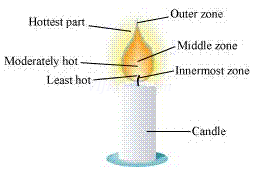
Q6. Make a labelled diagram of a candle flame.
Answer:
Q7. Name the unit in which the calorific value of a fuel is expressed.
Answer: The calorific value of a fuel is expressed in kilojoules per kilogram (kJ/kg).
Q8. Explain how CO2 is able to control fires.
Answer: (i) CO2 forms a blanket around fire due to which supply of air (oxygen) is stopped.
(ii) CO2 also brings down the temperature of the fuel.
Hence able to control fires.
Q9. It is difficult to burn a heap of green leaves but dry leaves catch fire easily. Explain.
Answer: Green leaves contain moisture and as a result, the ignition temperature of green leaves is much higher than that of dry leaves. Due to this, it is difficult to bum a heap of green leaves but dry leaves catch fire easily.
Q10. Which zone of a flame does a goldsmith use for melting gold and silver and why?
Answer: A goldsmith uses the outer part of the candle flame for melting gold and silver because in this zone the temperature is the highest which helps to melt these metals easily.
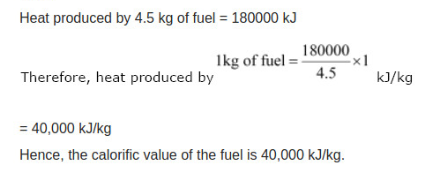
Q11. In an experiment 4.5 kg of a fuel was completely burnt. The heat produced was measured to be 180,000 kJ. Calculate the calorific value of the fuel.
Answer:
Q12. Can the process of rusting be called combustion? Discuss.
Answer: The process of rusting emits heat during the formation of its oxide. So we can call the process of rusting as slow combustion.
Q13. Abida and Ramesh were doing an experiment in which water was to be heated in a beaker. Abida kept the beaker near the wick in the yellow part of the candle flame. Ramesh kept the beaker in the outermost part of the flame. Whose water will get heated in a shorter time?
Answer: The water in the Ramesh’s beaker will heat up in a shorter time. This is because the outermost zone of a flame is the hottest zone, while the yellow zone (in which Abida had kept the beaker) is less hot.
We Think the given CBSE Solutions for class 8 Science book, Chapter 6 Combustion and Flame with Answers Pdf free download will assist you. If you’ve got any queries regarding CBSE Class 8 Science Combustion and Flame CBSE Solutions with Answers, drop a comment below and that we will come back to you soons.