
We have completed the NCERT/CBSE Solutions chapter-wise for Class 12 Business Studies Chapter 2 Principles of Management with Answers by expert subject teacher for latest syllabus and examination. Prepare effectively for the exam taking the help of the Class 12 Business Studies NCERT Solutions PDF free of cost from here. Students also can take a free NCERT Solutions of Principles of Management. Each question has right answer Solved by Expert Teacher. Download the Business Studies NCERT Solutions with Answers for Class 12 Business Studies Pdf and prepare to help students understand the concept very well.
NCERT Solutions for Class 12 Business Studies Chapter wise
Q1. What makes principles of management flexible?
Answer: Management principles are varied and not one rule can be applied for all cases. Thus, a manager has to assess the situation and then determine the best solution to the issue at hand. For this reason, management principles are flexible.
Q2. State the main objective of time study.
Answer: To determine the standard time taken to perform a well: defined job.
Q3. Name the principle that is an extension of the ‘harmony, not discord’.
Answer:
- The two causes of fatigue are:
- Long working hours without breaks,
- Dissatisfactory working conditions.
Q4. State any two causes of fatigue that may create hindrance in the employee’s performance.
Answer: Causes of fatigue that creates hindrance in performance of employees are:
- Not having cordial relationship with the people in superior positions
- Long working hours at the organisation
Q5. Sanaklal and Gagan started their career in Wales Limited (a printing press) after going through a rigorous recruitment process. Since they had no prior work experience, the firm decided to give them one year to prove themselves. Name the principle of management followed by Wales Limited.
Answer: Wales Limited followed the principle of ‘Stability of Personnel’.
Q6. Which technique is used by Taylor for distinguishing efficient and inefficient workers?
Answer: Taylor used the system of Differential Piece Wage System under which wages for workers was determined using a set standard. The workers who performed better were given higher wages than workers who performed below the standard.
Short Answer Questions
Q1. How is the principle of ‘Unity of Command’ useful to management? Explain briefly.
Answer: According to the Principle of ‘Unity of Command’ there should be one and only one boss for every individual employee. If an employee gets orders from two superiors at the same time the principle of unity of command is violated. It is very useful for a management as it prevent confusion regarding
tasks to be done. For example: a sales person is asked to clinch a deal with a buyer and is allowed to give 10% discount by the marketing manager. On the other side, finance department tells her/him not to offer more than 5% discount. This violates the principle which leads to confusion.
Q2. Define Scientific Management. State any three of its principles.
Answer: Scientific management means knowing exactly what you want men to do and seeing that they do it in best and cheapest way. Three of its principles are
- Science not Rule of Thumb
- Harmony, Not discord
- Cooperation Not Individualism
Q3. If an organisation does not provide the right place for physical and human resources in an organisation, which principle is violated? What are the consequences of it?
Answer: When the organisation does not provide the right place for physical and human resources it violate the principles of division of work propounded by Henri Fayol. The Principle of division of work may be explained in brief as follows.
Division of work
This principle tells us that as far as possible the whole work should be divided into parts and each employee should be assigned only one part of the work according to his ability and attitude.
When that employee performs that part of the work repeatedly, he will become specialised in doing that particular part of the work, consequently, the benefits of the specialisations will be achieved. According to Fayol, the principles of division of work is applicable to all kinds of work – technical as well as Managerial.
Q4. Explain any four points regarding significance of Principles of Management.
Answer: Significance of principles of management
(i) Providing Managers with Useful Insights into Reality When managers follow principles it adds to their knowledge, ability and understanding of managerial situations and circumstances. This improves managerial efficiency e.g., when managers use principle of delegation then they get more time to concentrate on critical areas of working.
(ii) Scientific Decision Making management principles help in thoughtful decision making. They emphasise on logic rather than blind faith. Here, decisions are based on the objective assessment of the situation.
(iii) Optimum Utilisation of Resources and Effective Administration Principles help the managers to conceptualise the net effect of their decision rather than going for trial and error method resulting in saved time, efforts and energy thereby increased productivity.
(iv) Management Training, Education and Research Principles of management are the base for management theory. As such they are used as a basis for management training, education and research. These principles provide basic groundwork for the development of management as a subject. Professional courses like BBA, MBA also teaches these principles as part of their curriculum.
Q5. Explain the principle of ‘Scalar Chain’ and gang plank.
Answer: Scalar chain requires the managers to follow a well defined chain of communication that flows from top to bottom. That is in a scalar chain, the information passes in a certain and defined manner from the top to bottom so as to avoid any ambiguity in communication.
Gang plank is an exception of scalar chain that states that in the situation of emergency where quick decisions and communications are needed, two managers who are working at the same managerial position can have a quick communication with one another.
For example:
- A is heading 2 teams where B and F are at the same level, C and G are at the same level and D and H are at the same level.
- Line of communication is B – C – D and F – G – H. In this D and H cannot directly contact each other, as per the principle of scalar chain.
- But if an emergency arises, then using the prescribed flow may take a lot of time to communicate with each other.
Q6. A production manager at top level in a resulted corporate, Mr. Rathore holds the responsibility for ordering raw material for the firm. While deciding on the supplier for the financial year 2017-18, he gave the order to his cousin at a higher price per unit instead of the firm’s usual supplier who was willing to lower the rates for the order. Which principle of management was violated by Mr. Rathore? What are the positive impacts of following the above identified principle?
Answer: In this case, Mr. Rathore has violated the principle of Subordination of individual interest to general interest. As per this principle an individual should put organisational goals on priority over any personal interest.
The positive impacts of this principle are:
- Harmony in working environment and a good office culture
- Increase in employee productivity
- Employees feel they are a part of the organisation
- Helps in achieving organisations goals
Long Answer Questions
Q1. Explain the Principles of Scientific management given by Taylor.
Answer: The Principles of Scientific management given by Taylor are:
Science not Rule of Thumb: Taylor introduce method of scientific inquiry into the domain of management practice. He believed that there was only one best method to maximise efficiency. This method can be developed through study and analysis. The method so developed should substitute ‘Rule of Thumb’ throughout the organisation. Scientific method involved investigation of traditional methods through work-study, unifying the best practices and developing a standard method, which would be followed throughout the organisation.
Harmony, Not Discord: According to the Taylor if manager asked there worker to “get work done” it should not be difficult for them to appreciate their performance. He emphasised that there should be complete harmony between the management and workers. Both should realise that each one is important. Management should share the gains of the company, if any, with the workers. At the same time workers should work hard and willing to embrace for the good of the company.
Cooperation, Not Individualism: There should be complete cooperation between the labour and the management instead of individualism. Competition should be replaced by cooperation. Management should not close its ears to any constructive suggestions made by the employees. They should be rewarded for their suggestions which results in substantial reduction in costs. They should be part of management and, if any important decisions are taken, workers should be taken into confidence. At the same time workers should desist from going on strike and making unreasonable demands on the management. According to the Taylor there should be almost equal division of work and responsibility between worker and management.
Q2. Explain the following Principles of management given by Fayol with examples:
(a) Unity of direction
Answer: Unity of direction: Accoding to this principkle, each group of activities having the same objective must have one head and one plan .
(b) Equity
Answer: Equity implies that employees should be treated with justice and kindness. Managers should be fair and impartial in their dealings with subordinates. They should adopt a sympathetic and unbaised attitude towards employees. Equity helps to create cordial relations between management and employees and the employees become loyal to the organisation whereas partiality breeds frustrations which adversely affects their efficiency.
(c) Espirit de corps
Answer: This principle emphasises on building harmony and team spirit among employees. In a large organisation due to a large work force teamwork is very important. Teamwork leads to better co-ordination while working. The head of each team should give credit of good result to the whole team rather than confining it to his ownself.
(d) Order
Answer: According to this principle, there should be a place for everyone and everything and each person or the thing should be found in its/ his place. It helps in carrying out the activities on time, and in a smooth manner.
(e) Centralisation and decentralisation
Answer: Centralisation and Decentralisation: Centralisation is the concentration of power or authority in hands of selected people in an organisation. Whereas decentralisation is shifting the authority to middle and lower levels of management. For e.g. if CEO has all decision-making powers it is centralisation whereas if the decision-making power is distributed to managers of middle and lower levels then it is decentralisation.
(f) Initiative
Answer: Workers should be encouraged to develop and carry out their plans for improvements according to Fayol. Initiative should be encouraged but it does not mean going against the established practices of the company for the sake of being different. A good company should have an employee suggestion system whereby initiative/ suggestions which result in substantial cost or time reduction should be rewarded.
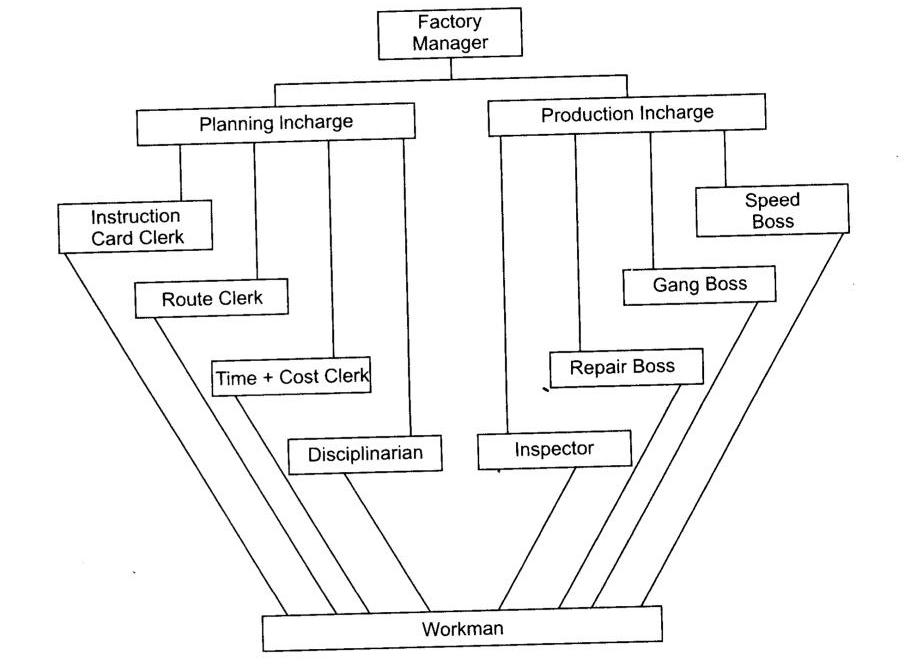
Q3. Explain the technique of ‘Functional Foremanship’ and the concept of ‘Mental Revolution’ as enunciated by Taylor.
Answer: n the factory system, the foreman represents the managerial figure with whom the workers are in face-to-face contact on a daily basis. Foreman is the lowest ranking manager and the highest ranking worker who is pivot around whom revolves the entire production planning, implementation and control. Thus, Taylor concentrated on improving the performance of this role in the factory set-up. In fact, he identified a list of qualities of a good foreman and found that no single person could fit them all. Thus, he suggested there should be eight persons through which the functions of a foreman should be accomplished. This technique was given the name Functional Foremanship.
According to this, planning and execution functions should be separated. Under the factory manager there would be a planning incharge and a production incharge. Each incharge would have four personnel under him or her.
The following are the four persons that worked under the planning incharge.
- Instruction Card Clerk- To give instructions to the workers.
- Route Clerk- To show the route of production.
- Time and Cost Clerk- To take care about the time and costs.
- Disciplinarian- To ensure that discipline is being maintained.
The following are the four persons that worked under the production incharge.
- Speed Boss- To ensure timely completion of tasks
- Gang Boss- To keep the machines and tools ready for the workers.
- Repair Boss- To ensure proper working of the machines.
- Inspector- To control the quality of work done.
Mental revolution involves a change in the attitude of workers and management towards one another from competition to cooperation. Both should realise that they require one another. Both should aim to increase the size of surplus. This would eliminate the need for any agitation. Management should share a part of surplus with workers. Workers should also contribute their might so that the company makes profits. This attitude will be good for both of them and also for the company.
Q4. Discuss the following techniques of Scientific Work Study:
(a) Time Study
Answer: It determines the standard time taken to perform a well-defined job. Time measuring devices are used for each element of task. The standard time is fixed for the whole of the task by taking several readings. The methods of time study will depend upon volume and frequency of the task, the cycle time of the operation and time measurements costs.
(b) Motion Study
Answer: Motion study refers to the study of movements like lifting, putting objects, sitting and changing positions. On close examination of body motions, e.g., it is possible to find out three types motions
(i) Motions which are productive.
(ii) Motions which are incidental.
(iii) Motions which are unproductive.
Out of the above, three workers were motivated to eliminate the third type completely and reduce the second one to the minimum. This help in increasing productivity.
(c) Fatigue Study
Answer: It seeks to determine the amount and frequency of rest intervals in completing a task to increase productivity. Rest is essential to perform the work with full capacity. This study helps to find out the standard intervals of break that help a worker to regain its energy.
(d) Method Study
Answer: The objective of this study is to find the best method of completing a particular work. It takes into consideration all the activities involved in the completion of a task. By determining the best method lower costs can be incurred along with more productivity.
(e) Simplification and standardisation of work.
Answer: tandardisation refers to the process of setting standards for every business activity such as standardisation of process, raw material, time, product, machinery, methods or working conditions. These standards are the benchmarks, which must be adhered to during production. Other techniques by Taylor, such as method study, fatigue study and time study are also based on the concept of standardisation.
Simplification aims at eliminating unnecessary diversity of products. It results in savings of cost of
labour, machines and tools. It implies reduced inventories, fuller utilisation of equipment and increasing turnover.
Q5. Discuss the differences between the contributions of Taylor and Fayol.
Answer:
Q6. Discuss the relevance of Taylor and Fayol’s contribution in the contemporary business environment.
Answer: Relevance of Taylor and Fayol’s contribution in the contemporary business environment.
Both Fayol and Taylor have given principles of management to improve efficiency in an organisation. Taylor gave us scientific principles of management which are being adopted by all organisations to improve its productivity at the shop floor level, the principles help in giving effective results. In the same manner, Henry Fayol gave in general principles of management which when implemented at any of the levels-top, middle or lower and helps in achieving better co-ordination, remove ambiguity and encourage the employees to improve their work performance.
Q7. ‘Bhasin’ limited was engaged in the business of food processing and selling its products under a popular brand. Lately the business was expanding due to good quality and reasonable prices. Also with more people working the market for processed food was increasing. New players were also coming to cash in on the new trend. In order to keep its market share in the short run the company directed its existing workforce to work overtime. But this resulted in many problems. Due to increased pressure of work the efficiency of the workers declined.
Answer: Sometimes the subordinates had to work for more than one superior resulting in declining efficiency. The divisions that were previously working on one product were also made to work on two or more products. This resulted in a lot of overlapping and wastage. The workers were becoming undisciplined. The spirit of teamwork, which had characterised the company, previously was beginning to wane. Workers were feeling cheated and initiative was declining. The quality of the products was beginning to decline and market share was on the verge of decrease.
Actually the company had implemented changes without creating the required infrastructure.
a. Identify the Principles of Management (out of 14 given by Henry Fayol) that were being violated by the company.
b. Explain these principles in brief.
c. What steps should the company management take in relation to the above principles to restore the company to its past glory?
- Following principles of management were violated:
i. Unity of Command (employees working under more than one superior)
ii. Division of Work (employees made to work on more than one product)
iii. Discipline (workers not following discipline)
iv. Espirit de corps (workers lacked spirit of team work)
v. Initiative (workers were not feeling like taking initiative) - The principles are described below
a. Unity of command: The workers should be reporting to only one superior. Employee receiving orders from more than one superior will result in confusion and affect work.
b. Division of work: Employees should be given specialised tasks so that it will be completed effectively and efficiently.
c. Discipline: Organisation should be following rules and regulations and it should be followed by both worker and management.
d. Espirit de corps: The team work motive should be developed among employees. It will improve productivity.
e. Initiative: Motivation and incentive should be provided to workers and they should be encouraged to provide suggestions for improvement.
- Steps which can be taken by company are:
i. Scientific management should be applied.
ii. Only one superior should be there to provide instruction to subordinates in order for smooth functioning.
iii. Individuals must be assigned tasks as per their specialisation. It increases productivity.
iv. Motivation and proper incentives should be provided to workers
v. Team work and coordination among workers should be promoted for organisational development.
We Think the given NCERT Solutions for class 12 Business Studies book Chapter 2 Principles of Management with Answers Pdf free download will assist you. If you’ve got any queries regarding CBSE Class 12 Business Studies Principles of Management NCERT Solutions with Answers, drop a comment below and that we will come back to you soons.