
We have completed the NCERT/CBSE Solutions chapter-wise for Class 9 Social Science Chapter 1 The Story of Village Palampur with Answers by expert subject teacher for latest syllabus and examination. Prepare effectively for the exam taking the help of the Class 9 Social Science NCERT Solutions PDF free of cost from here. Students also can take a free NCERT Solutions of The Story of Village Palampur. Each question has right answer Solved by Expert Teacher. Download the Social Science NCERT Solutions with Answers for Class 9 Social Science Pdf and prepare to help students understand the concept very well.
NCERT Solutions for Class 9 Social Science Economics Chapter wise
Page No. 14
Excercises
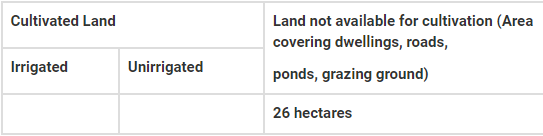
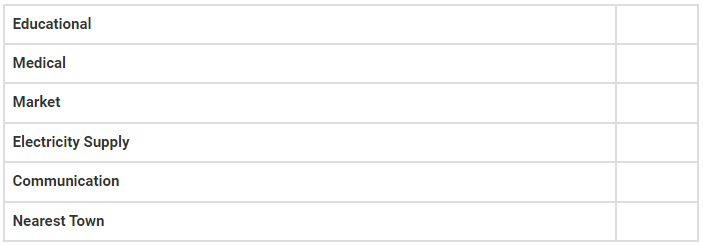
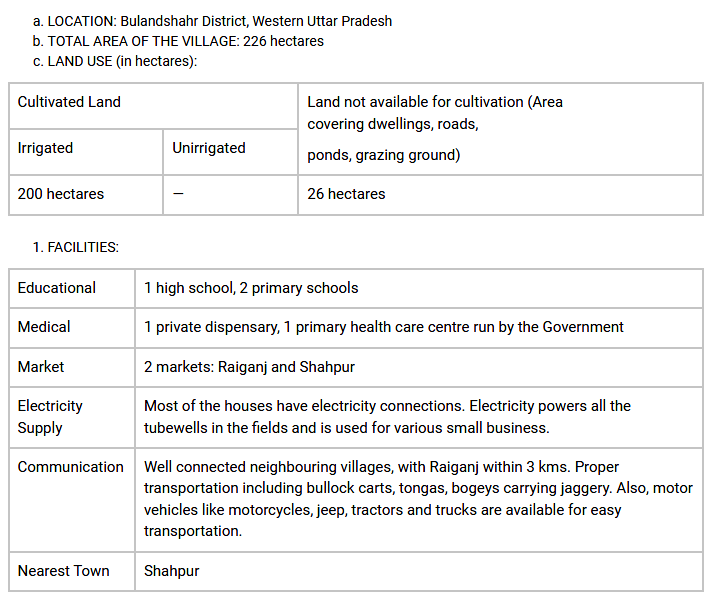
Q1. Every village in India is surveyed once in ten years during the Census and some of the details are presented in the following format. Fill up the following based on information on Palampur.
a. LOCATION:
b. TOTAL AREA OF THE VILLAGE:
c. LAND USE (in hectares):
d. FACILITIES:
Answer:
Q2. Modern farming methods require more inputs which are manufactured in industry. Do you agree?
Answer: Modern farming methods involve the use of high-yielding variety seeds. These seeds require a combination of chemical fertilisers and pesticides, agricultural implements like tractors, and proper irrigation facilities like electric tube wells to produce the best results. All these elements are manufactured in industries. Hence, it would be right to say that modern farming methods make use of a greater number of industrial outputs as compared to traditional farming methods.
Q3. How did the spread of electricity help farmers in Palampur?
Answer: The spread of electricity helped the farmers of Palampur as it helped in the transformation of the irrigation system of the village. The farmers earlier used Persian wheels to draw water from wells and irrigate small fields. But after the spread of electricity, electric tube wells replaced these Persian wheels. The first tube well was installed by the Government, but later private tube wells were also settled by the farmers, resulting in the cultivation of the entire 200 hectares of irrigated land by the 1970s.
Q4. Is it important to increase the area under irrigation? Why?
Answer: In India, nearly two-thirds of the people are dependent on farming. From that total cultivated area in the country, less than 40% is irrigated. In the other areas, farming is dependent on rainfall which is not regular. Modern farming methods are really difficult to apply in the presence of inadequate water supplies. India cannot achieve self- sufficiency in food grains until land is increased for the use of irrigation.
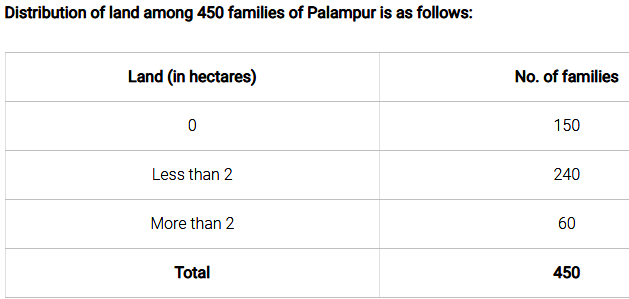
Q5. Construct a table on the distribution of land among the 450 families of Palampur.
Answer:
Q6. Why are the wages for farm labourers in Palampur less than minimum wages?
Answer: Though the minimum wage fixed by the government for a farm labourer is Rs 60 per day, farm labourers in Palampur get paid much less, about 35 to 40 rupees a day. The reason for this is the competition for work among the agricultural labourers in the village. Knowing that supply is much more than the demand, they themselves agree to work for wages that are lower than minimum wages. The large farmers too exploit this condition of excess supply, and force labourers to work for low wages. The use of modern agricultural implements like tractors, threshers and harvesters also reduces the amount of agricultural labour required. This further intensifies the competition among the labourers looking for jobs.
Q8. What are the different ways of increasing production on the same piece of land? Use examples to explain.
Answer: Following are the main ways of increasing production on the same piece of land:—
(i) Production can be increased by using modern irrigation facilities.
(ii) Production can be increased by using HYV seeds.
(iii) Production can also be increased by using chemicals like weedicides and pesticides and by using fertilizers.
(iv) Production can also be increased by using modern machinery such as tractors, combines, threshers, drilling machines, motors etc.
(v) Production can be increased by using fertilizers.
Example: In Palampur, the yield of wheat grown from the traditional varieties was 1300 kg per hectare. With the HYV seeds, the yield went up to 3200 kg per hectare. There was a large increase in the production of wheat.
Q9. Describe the work of a farmer with 1 hectare of land.
Answer: A farmer with 1 hectare of land shall put under the category of small farmer. Most of the work would be done by the farmer and his family members. The farmer will normally use a pair of bullocks to plough the field. His family members would assist him in sowing the seeds. During harvest time, he may require to hire some labourers.
Q10. How do the medium and large farmers obtain capital for farming? How is it different from the small farmers?
Answer: Large and medium farmers sell surplus farm products from a part of their produce. A part of the earnings is saved and kept for buying capital for the next season. A few of them give away the savings to small farmers and loans at high interest rates and get back the amount by the next season. Thus, they are able to arrange for the capital for farming from their own savings. Some farmers might also use the savings to buy cattle, trucks, or to set up shops.
Q11. On what terms did Savita get a loan from Tejpal Singh? Would Savita’s condition be different if she could get a loan from the bank at a low rate of interest?
Answer: Savita needed money for buying pesticides, seeds and fertilisers, and water for irrigation. She required money for the repairing of her farm instruments. Hence, she decided to borrow money from Tejpal Singh, who was a large farmer in her village. Tejpal Singh convinced to give the loan of Rs. 3000 at an interest rate of 24% for four months. He agreed with Savita to work on his field during the harvest season for Rs. 35 a day.
If Savita would have borrowed the loan from the bank, then her condition would have been better. Banks provide loans at low interest rates. Moreover, Savita should have devoted more time to her own field instead of working for Tejpal Singh as farm labourer.
Q12. Talk to some old residents in your region and write a short report on the changes in irrigation and changes in production methods during the last 30 years.
Answer: To be attempted by the students themselves.
Q13. What are the non-farm production activities taking place in your region? Make a short list.
Answer: The non-farm production activities taking place in our region are:
- Dairy
- Transportation
- General Stores
- Fishing
- Mining
Q14. What can be done so that more non-farm production activities can be started in villages?
Answer: Three things that need to be done to encourage non-farm production activities in villages:
(i) The government should set up schemes whereby landless labourers and small farmers are able to get cheap loans to start small individual/community businesses.
(ii) In addition to financial assistance, the government should set up rural workshops to enable the villagers to build on their skill levels.
(iii) The government should also work towards improving the infrastructure of villages so that the rural parts of the country are well connected to the urban areas.
We Think the given NCERT Solutions for class 9 Social Science book Chapter 1 The Story of Village Palampur with Answers Pdf free download will assist you. If you’ve got any queries regarding CBSE Class 9 Social Science The Story of Village Palampur NCERT Solutions with Answers, drop a comment below and that we will come back to you soons.