The IAS officer salary in India is one of the major attractions for candidates preparing for the UPSC Civil Services Examination. Along with a respected position in public administration, IAS officers receive a structured salary package, allowances, government facilities, and opportunities for career growth.
However, an IAS officer’s earnings are not limited to the basic salary. The overall compensation changes according to the officer’s pay level, seniority, posting, allowances, and responsibilities. As officers move from entry-level assignments to senior administrative positions, their basic pay and overall benefits increase significantly.
The job also offers an opportunity to work in district administration, state governments, central ministries, policy-making, disaster management, and other important areas of governance.
In this article, we will cover the IAS salary 2026-2027, basic pay, pay scale, allowances, perks, probation salary, job profile, career progression, roles and responsibilities, and challenges faced by IAS officers.
| IAS Officer Salary 2026-2027 | Details |
|---|---|
| Starting Basic Pay | ₹56,100 per month |
| Approx. Gross Salary | ₹56,000 to ₹1,50,000+ per month, depending on posting and allowances |
| Maximum Basic Pay | ₹2,50,000 per month |
| Highest Post | Cabinet Secretary |
| Salary During Training | Basic pay applicable to probationers, with deductions |
| Major Allowances | DA, HRA, TA and other benefits |
| Pay Structure | 7th Central Pay Commission |
What is the Salary of an IAS Officer in 2026-2027?
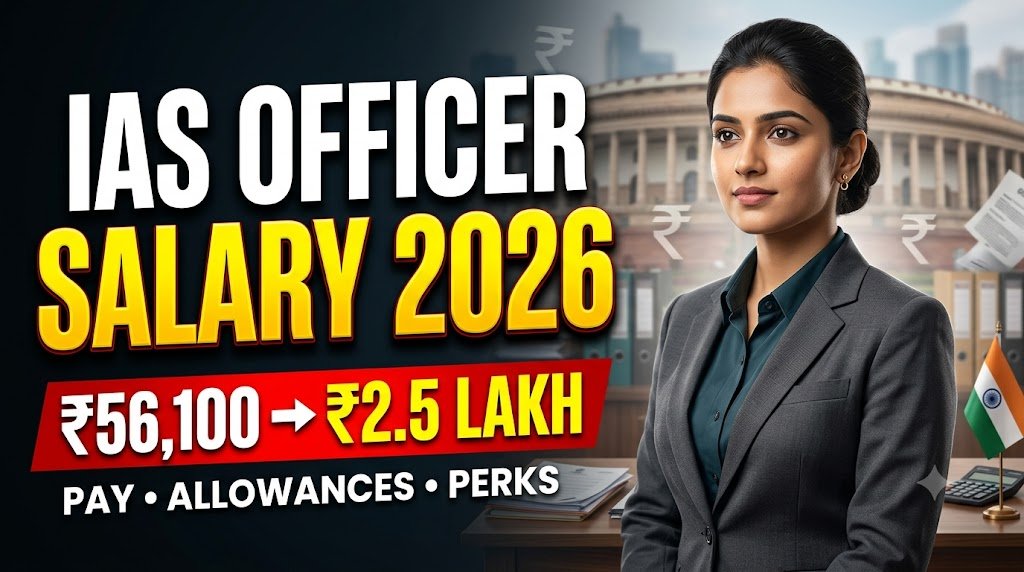
The salary of an IAS officer depends primarily on the pay level, years of service, seniority, and position held. A newly appointed IAS officer starts at a basic pay of ₹56,100 per month under the existing 7th Pay Commission pay matrix.
Apart from basic pay, officers may receive applicable allowances such as Dearness Allowance (DA), House Rent Allowance (HRA), Transport Allowance (TA), and other benefits depending on government rules and the nature of their posting.
Here is a quick overview:
- Starting basic pay: ₹56,100 per month.
- Gross salary: The actual monthly gross amount varies according to the applicable allowances and posting.
- Senior-level salary: Basic pay rises progressively as an officer moves to higher pay levels.
- Maximum basic pay: The Cabinet Secretary’s basic pay is ₹2,50,000 per month under the existing structure.
- Allowances: DA, HRA, TA and other benefits can increase the overall compensation.
It is important to remember that basic pay and gross salary are not the same. The gross amount includes eligible allowances, while the final in-hand salary is affected by deductions such as taxes and other government contributions.
IAS Officer Salary Structure – 7th Pay Commission
The IAS salary structure is organized through the 7th Central Pay Commission pay matrix. Instead of the older grade-pay system, the current structure uses different pay levels.
As an officer gains experience and moves into higher administrative responsibilities, the applicable pay level increases.
Some important stages in the IAS career include:
- Entry Level: Level 10
- Senior Time Scale: Level 11
- Junior Administrative Grade: Level 12
- Selection Grade: Level 13
- Super Time Scale: Level 14
- Higher Administrative Grade: Level 15
- Apex Scale: Level 17
- Cabinet Secretary: Level 18
IAS Officer Pay Level and Basic Salary
| Pay Level | Basic Pay Range | Typical Career Stage/Post |
| Level 10 | ₹56,100 – ₹1,77,500 | Entry-level IAS officer |
| Level 11 | ₹67,700 – ₹2,08,700 | Senior Time Scale |
| Level 12 | ₹78,800 – ₹2,09,200 | Junior Administrative Grade |
| Level 13 | ₹1,18,500 – ₹2,14,100 | Selection Grade |
| Level 14 | ₹1,44,200 – ₹2,18,200 | Super Time Scale |
| Level 15 | ₹1,82,200 – ₹2,24,100 | Higher Administrative Grade |
| Level 17 | ₹2,25,000 | Apex Scale |
| Level 18 | ₹2,50,000 | Cabinet Secretary |
The actual designation associated with a particular pay level can vary according to cadre, posting, vacancies, and government orders. Therefore, the table should be viewed as a broad career and pay-level overview rather than a guaranteed posting schedule.
IAS Salary in India Post-Wise
An IAS officer’s career includes several administrative assignments. The following table provides a simplified overview of how basic pay can progress through different stages of service.
| Approx. Years of Service | Basic Pay (₹) | Possible Administrative Role |
| 1–4 years | 56,100 | Assistant Secretary / SDM |
| 5–8 years | 67,700 | Deputy Secretary / ADM |
| 9–12 years | 78,800 | Joint Secretary / District Magistrate |
| 13–16 years | 1,18,500 | Director / Senior District or Secretariat Assignment |
| 16–24 years | 1,44,200 | Divisional Commissioner / Joint Secretary |
| 25–30 years | 1,82,200 | Principal Secretary / Additional Secretary |
| 30–33 years | 2,05,400 | Senior State or Central Government Assignment |
| 34–36 years | 2,25,000 | Chief Secretary / Senior Apex-Level Role |
| 37+ years | 2,50,000 | Cabinet Secretary, subject to appointment |
The figures in the table represent basic pay and do not include all applicable allowances or benefits.
The actual amount received by an officer can vary depending on the posting location, government accommodation, applicable DA, HRA eligibility, transport benefits, deductions, and other factors.
What Allowances are Given to IAS Officers?
The basic salary is only one component of an IAS officer’s overall compensation. Eligible officers can receive several allowances and facilities according to government rules.
The general formula can be understood as:
Gross Salary = Basic Pay + Applicable Allowances
The major allowances are explained below.
HRA – House Rent Allowance
House Rent Allowance is provided to eligible government employees who do not occupy government-provided accommodation. The amount depends on the applicable rules and classification of the posting location.
HRA generally varies according to the city classification and government regulations.
- Officers staying in eligible rented accommodation may receive HRA.
- The applicable percentage is calculated with reference to basic pay.
- HRA rates can change through government notifications.
- An officer occupying government accommodation generally does not receive HRA for the same accommodation arrangement.
Therefore, the actual HRA received by an IAS officer depends on the officer’s circumstances and the applicable government rules.
DA – Dearness Allowance
Dearness Allowance (DA) is intended to provide relief against inflation. It is linked to changes in the cost of living and is revised periodically by the government.
Important points include:
- DA is calculated as a percentage of basic pay.
- The rate can change following government decisions.
- DA revisions can substantially affect the gross monthly salary.
- The applicable rate should always be checked against the latest government notification.
Because DA changes over time, older salary articles may contain outdated percentages.
TA – Transport Allowance
Transport-related benefits help eligible officers meet expenses associated with official duties and commuting, subject to applicable government rules.
Depending on the posting and official arrangements:
- Transport allowance may be applicable.
- Official vehicles may be provided for designated duties.
- Travel undertaken for official work can be reimbursed according to government rules.
- The exact benefit depends on the officer’s posting and nature of duty.
IAS officers may also receive other benefits related to medical care, official travel, accommodation, communication and other government facilities.
IAS Officer Perks and Other Facilities
One of the biggest advantages of an IAS career is that officers can receive several official facilities in addition to their salary.
Some commonly associated benefits include:
- Government accommodation: Eligible officers may receive official residential accommodation according to availability and government rules.
- Medical facilities: Government medical benefits may be available to officers and eligible family members.
- Official vehicle: Officers in designated positions may receive an official vehicle and driver for government duties.
- Security: Security arrangements may be provided depending on the officer’s post, location and threat assessment.
- Electricity and water facilities: Certain official residences can receive facilities according to applicable government rules.
- Domestic support: Depending on the posting and state rules, support staff may be available at official residences.
- Telephone and communication facilities: Eligible officers may receive official communication facilities for government work.
- Study leave: Eligible officers can apply for study leave under applicable service rules.
- Government guest houses: Officers travelling for official or approved purposes can use eligible government accommodation facilities.
- Travel benefits: Official tours and travel are covered according to government rules.
- Job security: Civil servants enjoy protections under service and constitutional rules, although they remain subject to disciplinary procedures.
- Retirement benefits: Eligible officers receive retirement benefits according to the applicable pension and service rules.
The exact facilities are not identical for every IAS officer. They depend on the post, cadre, location, government rules and availability.
What is the IAS Officer Job Profile 2026-2027?
The IAS job profile is extremely diverse. Officers can work in district administration, state secretariats, central ministries, public sector organizations and other government institutions.
Their responsibilities can include:
- Implementing government policies and welfare schemes.
- Supervising district and departmental administration.
- Managing revenue and land-related administration.
- Maintaining coordination during emergencies.
- Monitoring development projects.
- Addressing public grievances.
- Coordinating with different government departments.
- Supporting policy formulation and implementation.
- Managing resources and government programs.
- Handling disaster and crisis situations.
The exact duties depend heavily on the officer’s current posting.
Functions of an IAS Officer
An IAS officer may be responsible for monitoring the implementation of government programs and ensuring that public services reach citizens effectively.
During emergencies such as floods, earthquakes, major accidents, communal disturbances or other disasters, officers may coordinate relief, rehabilitation and administrative responses.
At senior levels, their work becomes increasingly focused on policy formulation, strategic planning, administration, inter-departmental coordination and governance.
Work Timings of an IAS Officer
IAS officers do not necessarily follow a fixed 9-to-5 schedule throughout their careers.
During normal administrative periods, office work may broadly follow regular government working hours. However, the nature of the job often requires officers to remain available beyond normal hours.
Their work may include:
- Reviewing departmental reports.
- Attending official meetings.
- Visiting project sites.
- Conducting field inspections.
- Meeting citizens.
- Monitoring government schemes.
- Coordinating with police and other departments.
- Responding to emergencies.
During disasters, elections, law-and-order situations or other major events, working hours can become significantly longer.
Career Growth of an IAS Officer
The IAS career provides multiple opportunities to move into increasingly responsible administrative positions.
After selection through the UPSC Civil Services Examination, an IAS officer begins with professional training. The officer then receives field exposure and progressively takes on more responsibilities.
A simplified career progression can look like:
UPSC Selection → Training → Probation → SDM/Equivalent Assignment → Senior Administrative Roles → District Magistrate/Collector → Divisional/Secretariat Roles → Senior State/Central Government Positions
The exact progression varies by cadre, vacancy, performance, service rules and government requirements.
Roles and Responsibilities of an IAS Officer at Each Level
The Indian Administrative Service offers a wide range of assignments. Responsibilities generally become broader and more strategic as an officer gains experience.
1. Probationary IAS Officer
After clearing the UPSC Civil Services Examination, selected candidates undergo extensive training before assuming regular administrative responsibilities.
During this period, trainees learn about:
- Government administration: Understanding the functioning of Union and State Governments.
- Public administration: Developing practical administrative and leadership skills.
- Constitutional framework: Studying the Constitution, laws and regulations relevant to governance.
- Policy implementation: Learning how government policies are translated into programs.
- Decision-making: Developing the ability to assess situations and make administrative decisions.
- Field administration: Understanding the practical challenges faced by citizens and local authorities.
2. Sub-Divisional Magistrate (SDM)
The SDM is responsible for administration within a sub-division of a district.
Major responsibilities can include:
- Law and order: Coordinating with police and other authorities.
- Revenue administration: Supervising revenue and land-related matters.
- Government schemes: Monitoring implementation of welfare and development programs.
- Public grievances: Addressing citizen complaints within the administrative framework.
- Development work: Monitoring local infrastructure and development activities.
- Disaster response: Coordinating relief and administrative action during emergencies.
3. District Magistrate / District Collector / Deputy Commissioner
The District Magistrate, commonly referred to as the District Collector or Deputy Commissioner in different states, plays a central role in district administration.
Key responsibilities may include:
- Law and order coordination: Working with the police and other authorities to maintain public order.
- Government program implementation: Ensuring that government schemes are properly implemented.
- Revenue administration: Supervising land and revenue-related matters.
- District development: Monitoring development programs and public infrastructure.
- Disaster management: Coordinating preparedness, response and relief operations.
- Inter-departmental coordination: Bringing different government departments together for effective administration.
- Election responsibilities: Performing duties assigned under election laws and procedures.
4. Divisional Commissioner
A Divisional Commissioner generally supervises administration across multiple districts within a division, depending on the state’s administrative structure.
Responsibilities can include:
- Inter-district coordination: Ensuring cooperation among district administrations.
- Development monitoring: Reviewing implementation of government schemes.
- Revenue supervision: Monitoring revenue administration.
- Law and order coordination: Working with district authorities on major administrative issues.
- Election duties: Performing responsibilities assigned during elections.
- Review and supervision: Assessing the performance of departments and district administrations.
5. Secretary / Additional Secretary / Joint Secretary in State Government
Senior officers working in the state secretariat contribute to policy formulation and implementation.
Their responsibilities may include:
- Policy development: Preparing and reviewing government policies.
- Departmental coordination: Coordinating with other departments and agencies.
- Administrative supervision: Monitoring the functioning of their department.
- Budget management: Participating in financial planning and expenditure monitoring.
- Government advice: Providing administrative and policy advice to ministers and senior authorities.
- Monitoring programs: Reviewing the progress and effectiveness of government initiatives.
6. Director / Additional Director in State Departments
Directors and Additional Directors manage important responsibilities within government departments and directorates.
Their work can include:
- Supporting senior departmental officers.
- Implementing government policies and programs.
- Preparing reports and performance reviews.
- Managing departmental resources.
- Supervising staff and administrative activities.
- Addressing public grievances.
- Monitoring departmental targets and projects.
7. Principal Secretary / Additional Chief Secretary / Chief Secretary
These are among the most senior administrative positions at the state level.
Their responsibilities may include:
- Administrative coordination: Coordinating the functioning of multiple departments.
- Policy implementation: Ensuring that major government decisions are executed effectively.
- Crisis management: Coordinating the state’s response to major emergencies.
- Inter-government coordination: Working with the Central Government and other states.
- Financial administration: Overseeing important policy and financial matters.
- Leadership: Guiding senior administrative officers across the state.
The Chief Secretary is generally the senior-most civil servant in a state administration.
8. Central Government Positions
IAS officers can also serve in the Central Government in different ministries, departments and organizations.
Their responsibilities may include:
- Developing and reviewing national policies.
- Implementing major Central Government programs.
- Coordinating between ministries.
- Preparing policy documents and reports.
- Managing national-level programs.
- Working on issues involving international organizations.
- Advising senior government authorities.
At the Central level, officers may work in areas such as health, education, finance, infrastructure, transport, environment, social welfare and other sectors.
9. Joint Secretary / Additional Secretary / Secretary in Central Ministries
Senior IAS officers serving in Central ministries have major responsibilities in policy-making and administration.
Their duties may include:
- Policy formulation: Developing government policies and programs.
- Implementation: Monitoring execution of approved policies.
- Coordination: Coordinating different divisions and departments.
- Parliamentary responsibilities: Assisting with parliamentary matters related to the ministry.
- Administrative management: Supervising officials and departmental work.
- Financial responsibilities: Monitoring budgets and expenditure.
- Legal and judicial matters: Handling government responses and cases related to their department.
10. Cabinet Secretary
The Cabinet Secretary is the highest-ranking civil servant in the Government of India.
The position involves extremely significant responsibilities, including:
- Coordination between ministries: Ensuring effective coordination among Central Government departments.
- Cabinet support: Supporting the functioning of the Cabinet system.
- Policy coordination: Helping resolve issues that involve multiple ministries.
- Administrative leadership: Providing leadership to the civil services.
- Crisis coordination: Supporting the government during major national emergencies.
- Senior appointments: Playing an important role in certain high-level administrative processes.
The Cabinet Secretary occupies the top position in the civil services administrative hierarchy.
District Administrative Structure
District administration forms an important part of India’s governance system. It connects state and national policies with local implementation.
A simplified structure is:
District Magistrate / Collector
↓
Additional District Magistrate (ADM)
↓
Sub-Divisional Magistrate (SDM)
↓
Tehsildar / Revenue Officials
↓
Patwari / Village-Level Revenue Staff
Alongside this administrative hierarchy, district officers work with Panchayati Raj Institutions, municipal bodies, police departments and other government agencies.
The District Magistrate coordinates several important areas, including revenue administration, development programs, disaster management and law-and-order responsibilities.
IAS Probation Period: Training, Salary and Rules
After clearing the UPSC Civil Services Examination and receiving an IAS allocation, candidates undergo extensive professional training.
The Lal Bahadur Shastri National Academy of Administration (LBSNAA), Mussoorie, plays a central role in IAS training.
The overall training process includes classroom learning, field exposure and practical administrative experience.
1. Foundation Course
The initial stage introduces officer trainees to the broader functioning of India’s public administration.
Major areas can include:
- Indian Constitution
- Governance
- Public administration
- Indian economy
- History and society
- Law
- Current affairs
- Inter-service coordination
2. Phase I Training
Phase I provides specialized training for IAS officer trainees.
It can include:
- Bharat Darshan: Exposure to different parts of India and institutions.
- Academic training: Subjects related to law, administration, economics, management and governance.
- Language training: Learning the language relevant to the allotted cadre where applicable.
- Sports and extracurricular activities: Activities designed to promote teamwork and leadership.
- Interaction with other services: Building coordination and understanding among civil service trainees.
3. District Training
During district training, officer trainees receive practical exposure to administration.
They may:
- Visit district-level government offices.
- Work with senior district officials.
- Observe revenue administration.
- Study development programs.
- Visit villages and local institutions.
- Prepare field reports.
- Understand the functioning of the Collectorate.
- Gain practical experience in local administration.
4. Phase II Training
After completing field exposure, trainees return for further professional training.
The training can involve:
- Discussions about field experiences.
- Sessions with senior administrators.
- Policy and governance discussions.
- Leadership development.
- Administrative case studies.
- Technology and governance.
- Public management concepts.
5. Assistant Secretary Assignment
IAS officer trainees may also receive exposure to the Central Government through an Assistant Secretary-type assignment.
This provides practical understanding of:
- Central ministries.
- Policy implementation.
- Government decision-making.
- Parliamentary processes.
- Inter-ministerial coordination.
- National-level governance.
Mid-Career Training
IAS officers continue to receive professional development throughout their careers.
Mid-Career Training Programs are designed to improve:
- Leadership skills.
- Policy-making abilities.
- Strategic thinking.
- Decision-making.
- Technology use in governance.
- Administrative innovation.
- Understanding of national and international best practices.
IAS Salary During Probation
An IAS officer receives the applicable basic pay during the probation and training period, subject to deductions and service rules.
The starting basic pay under the existing structure is ₹56,100 per month.
The amount actually credited to the officer’s account can be lower because of deductions and other applicable charges.
During later stages of probation, particularly after field posting, the overall monthly amount can increase because of applicable allowances.
Therefore, it is better to distinguish between:
Basic Pay → Gross Salary → Deductions → Net/In-Hand Salary
The exact in-hand salary during training or probation can vary depending on deductions, accommodation arrangements, applicable allowances and other factors.
Probation Rules You Should Know
The probation period is an important stage of an IAS officer’s career. Officers are evaluated on their training, conduct, performance and ability to handle administrative responsibilities.
During probation, officers are generally expected to:
- Complete prescribed training.
- Follow academy and service rules.
- Successfully complete required assessments.
- Maintain professional discipline.
- Complete assigned fieldwork and reports.
- Demonstrate the required administrative competence.
In exceptional situations, probation can be extended according to applicable service rules.
Failure to meet required standards, serious misconduct or other prescribed grounds can result in action under the relevant rules.
Candidates should always refer to the latest official government/service rules because training schedules, examinations and probation requirements may be updated.
What are the Challenges Faced by IAS Officers?
The IAS career offers authority, respect and an opportunity to serve the public, but it also involves significant pressure and responsibility.
Some major challenges are discussed below.
1. Managing Administrative Gaps
IAS officers may have to work in situations where different government agencies or stakeholders have conflicting priorities.
They need strong coordination and leadership skills to keep administration functioning effectively.
2. Handling Public Complaints and Land Disputes
Citizens frequently approach government authorities regarding land, welfare benefits, public services and administrative delays.
Resolving these issues fairly while following legal procedures can be challenging.
3. Implementing Government Schemes
IAS officers are often responsible for monitoring large welfare and development programs.
Ensuring that benefits reach eligible citizens while reducing delays, leakages and administrative problems requires continuous supervision.
4. Maintaining Law and Order
Major protests, communal tensions, accidents and other emergencies can require immediate administrative action.
Officers must coordinate with police and other departments while making decisions under considerable pressure.
5. Managing Political and Administrative Pressure
Government administration involves interaction with elected representatives and multiple stakeholders.
Civil servants must perform their duties according to the Constitution, laws, rules and established administrative procedures.
6. Fighting Corruption
Preventing corruption and improving transparency are important parts of effective administration.
Officers may need to strengthen monitoring systems, enforce rules and take action against irregularities.
7. Sudden Transfers
Transfers are a normal part of the career of many civil servants.
Frequent changes in posting can require officers and their families to adapt to new locations, responsibilities and working environments.
8. Working in Remote Areas
Officers may be posted in rural, tribal, border or geographically difficult areas where infrastructure and public services may be limited.
Working in such areas can be demanding but also provides valuable administrative experience.
9. Balancing Development and Governance
Development projects must often be balanced with environmental, legal, social and administrative considerations.
An IAS officer may need to coordinate with multiple stakeholders before implementing major decisions.
IAS Salary 2026-2027: Key Takeaways
The IAS position combines a structured government salary with significant administrative responsibility.
The most important points are:
- Starting basic pay: ₹56,100 per month.
- Pay structure: Based on the existing 7th Pay Commission framework.
- Maximum basic pay: ₹2,50,000 per month for the Cabinet Secretary level.
- Major allowances: DA, HRA and transport-related benefits, subject to eligibility.
- Career progression: Officers move through progressively higher pay levels and responsibilities.
- Facilities: Depending on posting and rules, officers may receive government accommodation, vehicle, medical and other official facilities.
- Job profile: Includes district administration, policy implementation, development, revenue, disaster management and senior policy-making.
- Training: Includes academy-based learning and extensive field exposure.
- Challenges: Long working hours during emergencies, transfers, public pressure, complex administrative decisions and challenging postings.
Conclusion
The IAS officer salary 2026-2027 is only one part of what makes the Indian Administrative Service an attractive career. Along with a starting basic pay of ₹56,100, officers can receive applicable allowances, official facilities and opportunities to move into senior administrative positions.
The career begins with intensive training and probation before officers take on field and administrative responsibilities. With experience, an IAS officer can work as an SDM, District Magistrate, Divisional Commissioner, Secretary, senior Central Government official and, for a select few, eventually reach the position of Cabinet Secretary.
At the same time, the profession demands strong decision-making, leadership, integrity, adaptability and a willingness to work under pressure.
For candidates preparing for the UPSC Civil Services Examination, understanding the IAS salary, allowances, career growth and job profile can provide a clearer picture of what lies beyond the examination.
Stay focused, prepare consistently, and keep your goal clear. Success in the UPSC journey requires patience, discipline and long-term dedication.