
The Indian Police Service (IPS) is one of the most prestigious civil services in India. IPS officers play a crucial role in maintaining law and order, preventing crime, managing internal security and leading police forces at the state and central levels. Along with the responsibility and authority associated with the post, IPS officers receive an attractive government salary, allowances, official facilities and several career benefits.
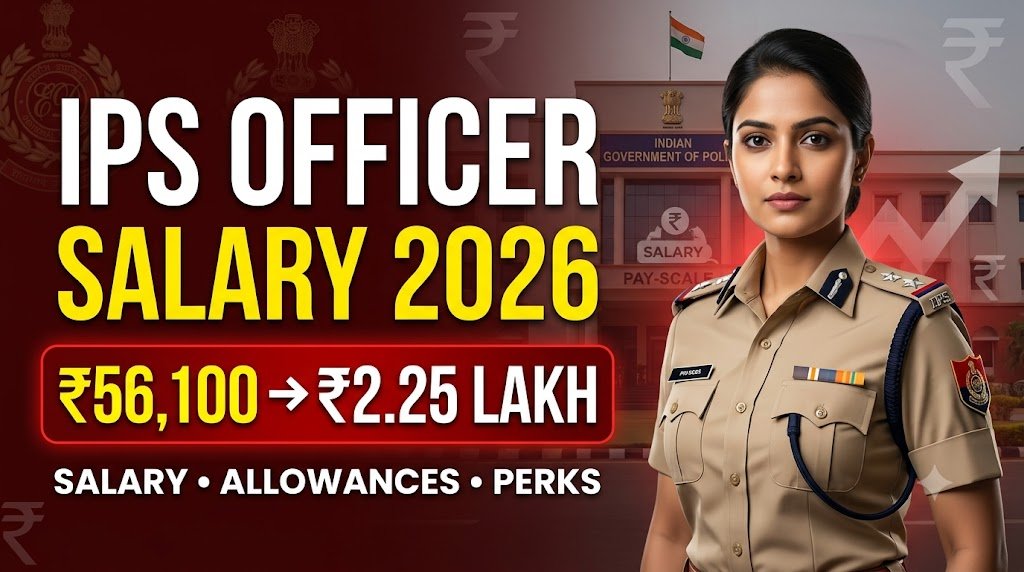
An IPS officer salary in India starts with a basic pay of ₹56,100 per month at the entry level and can rise to ₹2,25,000 per month at the highest level, depending on the officer’s rank and career progression. In addition to basic pay, officers may receive Dearness Allowance (DA), Transport Allowance, government accommodation, medical facilities, official vehicles and other benefits depending on their posting and position.
IPS officers are selected through the UPSC Civil Services Examination (CSE) and can eventually reach senior positions such as SP, DIG, IG, ADG and DGP. Let’s understand the IPS officer salary per month, pay scale, allowances, promotion structure, perks and career path in detail.
What is the Indian Police Service?
The Indian Police Service (IPS) is an All India Service that provides senior leadership to police and security organisations across India. IPS officers are responsible for maintaining public order, preventing and investigating crime, managing police administration and addressing major internal security challenges.
IPS officers can serve in state police departments as well as on deputation with central organisations and security forces. Depending on their experience and assignment, they may work in areas such as law enforcement, intelligence, counter-terrorism, cybercrime, organised crime, border security and police administration.
The IPS was established in 1948 after independence and replaced the colonial-era Indian Imperial Police. Today, it remains one of India’s most sought-after civil services.
How to Become an IPS Officer?
Candidates who want to become an IPS officer have to qualify for the UPSC Civil Services Examination. The examination is conducted in three major stages:
- UPSC Preliminary Examination
- UPSC Main Examination
- Personality Test/Interview
Candidates must satisfy the eligibility conditions specified by UPSC, including nationality, age and educational qualification. A recognised bachelor’s degree is generally required for appearing in the Civil Services Examination.
After clearing all stages, candidates are ranked according to their performance. Service allocation depends on the final rank, category, preferences, vacancies and other applicable conditions. Candidates who are allocated IPS undergo extensive professional training before taking up field responsibilities.
Process of Becoming an IPS Officer
The journey to becoming an IPS officer starts with checking eligibility and completing the UPSC application process. Candidates first appear for the Preliminary Examination. Those who qualify move on to the Main Examination and subsequently the Personality Test.
After the final result, successful candidates are allocated services according to their rank, preferences and available vacancies. Candidates allocated to the IPS then undergo professional training before beginning their careers in the police service.
Basic Process:
Meet Eligibility → Apply for UPSC CSE → Clear Prelims → Appear for Mains → Clear Mains → Personality Test → Final Merit List → IPS Allocation → Training → Field Posting
IPS Officer Training
IPS training is designed to prepare officers for the practical, administrative and leadership responsibilities of policing.
Selected IPS officer trainees undergo foundational and professional training. Training includes subjects such as criminal law, investigation, police administration, leadership, weapons handling, physical fitness, tactics, ethics and public administration.
The Sardar Vallabhbhai Patel National Police Academy (SVPNPA), Hyderabad plays a central role in professional IPS training. Trainees also receive practical exposure through field and district-level training.
The combination of classroom education, physical training and practical field experience helps officers prepare for demanding policing assignments.
IPS Officer Career Path and Promotions
An IPS officer generally begins their career as an Assistant Superintendent of Police (ASP) after completing the required training. With experience, performance and eligibility, an officer can progress through various ranks.
A typical career progression can include:
- Assistant Superintendent of Police (ASP)
- Superintendent of Police (SP)
- Deputy Inspector General of Police (DIG)
- Inspector General of Police (IG)
- Additional Director General of Police (ADG)
- Director General of Police (DGP)
The actual designation and timing of promotion can vary depending on service rules, cadre, vacancies, eligibility, performance and other government conditions.
Rank-Wise Salary Structure of IPS Officers
Under the 7th Central Pay Commission, IPS officers are paid according to different Pay Matrix levels. The entry-level basic pay is ₹56,100, while the highest regular basic pay can reach ₹2,25,000 per month at the apex level.
The following table provides an indicative rank-wise salary structure:
| Career Stage | Designation | Pay Level | Basic Pay | Typical Service Stage |
|---|---|---|---|---|
| Junior Scale | Assistant Superintendent of Police (ASP) | Level 10 | ₹56,100 | Entry level |
| Senior Time Scale | Superintendent of Police | Level 11 | ₹67,700 | Around 4+ years |
| Junior Administrative Grade | Senior Superintendent of Police / SP | Level 12 | ₹78,800 | Around 9+ years |
| Selection Grade | Senior Police Leadership Posts | Level 13 | ₹1,23,100 | Around 13+ years |
| DIG Grade | Deputy Inspector General of Police | Level 13A | ₹1,31,100 | Senior level |
| IG Grade | Inspector General of Police | Level 14 | ₹1,44,200 | Senior leadership |
| ADG Grade | Additional Director General of Police | Level 15 | ₹1,82,200 | Very senior level |
| Apex Scale | Director General of Police | Level 17 | ₹2,25,000 | Highest regular level |
Note: Designations, promotion timelines and postings can differ by cadre and service conditions. Basic pay is different from the total monthly salary because applicable allowances and deductions also affect the final amount.
IPS Officer In-Hand Salary Per Month
The in-hand salary of an IPS officer depends on basic pay, applicable allowances, posting location, government facilities and deductions.
Common components may include:
- Basic Pay
- Dearness Allowance (DA)
- Transport Allowance
- House Rent Allowance (where applicable)
- Other admissible allowances
Deductions can include NPS contributions, income tax and other applicable recoveries.
For an entry-level IPS officer with a basic pay of ₹56,100, the actual monthly amount credited to the bank account can vary considerably depending on the applicable allowances and deductions. Therefore, there is no single fixed in-hand salary for every IPS officer.
| Entry-Level IPS Salary Component | Amount/Status |
| Basic Pay | ₹56,100 |
| Dearness Allowance | As applicable |
| House Rent Allowance | As applicable |
| Transport Allowance | As applicable |
| Other Allowances | As applicable |
| Gross Salary | Varies by posting |
| Deductions | Depends on applicable rules |
| In-Hand Salary | Varies |
What is the Highest Salary of an IPS Officer?
The highest regular basic pay available to an IPS officer under the 7th Pay Commission structure is ₹2,25,000 per month at Pay Level 17.
This is associated with the Apex Scale, generally applicable to the highest-ranking police leadership positions. The actual benefits and facilities available to an officer can vary depending on the position, cadre, posting and government rules.
It is important to distinguish between basic pay and total compensation. Basic pay is the fixed component, while allowances and facilities can increase the overall value of the compensation package.
IPS Officer Grade Pay as Per 7th Pay Commission
The 7th Central Pay Commission replaced the earlier Grade Pay system with the Pay Matrix. Therefore, Grade Pay figures from the 6th Pay Commission should not be treated as a separate salary component under the current 7th CPC structure.
The current salary system is primarily based on Pay Matrix Levels and basic pay.
| IPS Rank/Grade | Pay Level | Starting Basic Pay |
| Assistant Superintendent of Police | Level 10 | ₹56,100 |
| Superintendent of Police | Level 11 | ₹67,700 |
| Senior Police Leadership Grade | Level 12 | ₹78,800 |
| Selection Grade | Level 13 | ₹1,23,100 |
| Deputy Inspector General | Level 13A | ₹1,31,100 |
| Inspector General | Level 14 | ₹1,44,200 |
| Additional Director General | Level 15 | ₹1,82,200 |
| Director General of Police | Level 17 | ₹2,25,000 |
Allowances and Perks of an IPS Officer in India
The salary is only one part of the overall benefits available to IPS officers. Depending on their posting, rank and government rules, officers may receive several allowances and official facilities.
Financial and Residential Benefits
- Government Accommodation: Eligible officers may receive government accommodation according to their rank and posting.
- House Rent Allowance: HRA may be provided where government accommodation is not available or as permitted under applicable rules.
- Dearness Allowance: DA is paid according to government regulations and applicable rates.
- Transport Benefits: Officers may receive transport-related allowances or official vehicles depending on their position and duties.
- Medical Facilities: Government medical facilities and reimbursement benefits may be available for eligible officers and their families.
- Travel Benefits: Officers can receive admissible travel allowances for official journeys.
- Retirement Benefits: IPS officers are covered by applicable government retirement and pension-related rules, including NPS provisions for those appointed under the relevant system.
- Telephone/Communication Facilities: Certain official communication facilities may be provided depending on the assignment.
Professional Perks of IPS Officers
1. Job Security
The IPS is a permanent government civil service. Officers receive the protections and responsibilities associated with government service, subject to applicable service rules and disciplinary procedures.
2. Career Growth
IPS officers have a structured career path that can take them from field-level responsibilities to senior police administration and leadership positions.
3. Central Deputation Opportunities
Experienced IPS officers may get opportunities to work with central government organisations, security agencies and other departments, subject to eligibility and government requirements.
4. Challenging Work
IPS officers can work on important assignments involving crime investigation, public safety, intelligence, law and order, disaster response and internal security.
Additional Perks and Facilities
Depending on rank and posting, IPS officers may also receive access to facilities such as:
- Official vehicle and driver for eligible duties
- Government accommodation
- Supporting staff as permitted by the posting
- Security arrangements based on threat assessment and official requirements
- Government guest-house facilities during eligible official travel
- Training and professional development opportunities
- Opportunities for specialised assignments
- Study or training opportunities under applicable government rules
IPS Officer Salary vs Other Civil Services
The IPS is one of the major All India Services, and its salary structure is governed by the applicable government pay rules. At equivalent Pay Matrix levels, the basic pay structure is broadly aligned with other services covered under the same pay framework.
However, the actual facilities and allowances can differ depending on the nature of duties, location, cadre and posting.
| Feature | IPS Officer |
| Recruitment | UPSC Civil Services Examination |
| Starting Basic Pay | ₹56,100 |
| Highest Regular Basic Pay | ₹2,25,000 |
| Pay Structure | 7th CPC Pay Matrix |
| Entry-Level Field Role | ASP |
| Senior Positions | SP, DIG, IG, ADG, DGP |
| Government Accommodation | Subject to eligibility and availability |
| Official Vehicle | Depending on post/duty |
| Medical Benefits | As per applicable rules |
| Retirement Benefits | As per applicable government rules |
| Promotion | Based on service rules, eligibility, performance and vacancies |
Factors That Affect IPS Officer Salary
The monthly salary received by an IPS officer can change based on several factors:
- Pay Matrix Level
- Years of Service
- Rank and Designation
- Posting Location
- Applicable Allowances
- Government Accommodation
- NPS and Other Deductions
- Income Tax
- Nature of Assignment
- Government Rules and Revisions
Therefore, two IPS officers with the same basic pay may receive different amounts in their monthly salary depending on their posting and applicable benefits.
IPS Officer Salary Growth Over Career
The major attraction of the IPS is not limited to the starting salary. Officers can progress to higher Pay Matrix levels as their career advances.
An officer entering at ₹56,100 basic pay can gradually move into higher levels such as ₹67,700, ₹78,800, ₹1,23,100, ₹1,31,100, ₹1,44,200 and ₹1,82,200. At the apex level, the basic pay can reach ₹2,25,000 per month.
This growth is accompanied by greater administrative responsibility, larger areas of command and more senior leadership roles.
Conclusion
The IPS officer salary in India offers a combination of competitive pay, career growth, responsibility and government benefits. An IPS officer starts with a basic pay of ₹56,100 per month, while the basic pay at the highest regular level can reach ₹2,25,000 per month.
Apart from salary, eligible officers may receive benefits such as government accommodation, transport facilities, medical support, travel allowances and other official facilities depending on their rank and posting.
For aspirants, however, the IPS is much more than a high-paying government career. It offers an opportunity to lead police organisations, maintain public safety, tackle serious crimes and contribute to national security. Candidates who successfully clear the UPSC Civil Services Examination and receive IPS allocation can build a long-term career with significant responsibility and opportunities for professional growth.