We have Provided the NCERT/CBSE Solutions chapter-wise for Class 10 Science Chapter 2 Acids, Bases and Salts with Answers by expert subject teacher for latest syllabus and examination. Students can take a free NCERT Solutions of Acids, Bases and Salts. Each question has right answer Solved by Expert Teacher.
CBSE Solutions Class 10 Science Acids, Bases and Salts
Page No: 18
Q1. You have been provided with three test tubes. One of them contains distilled water and the other two contain an acidic solution and a basic solution, respectively. If you are given only red litmus paper, how will you identify the contents of each test tube?
Answer: Take a small volume of all three liquids in three different test tubes. Dip red litmus paper strips separatelyin all the three test tubes. The tube in which red litmus strip turns blue, contains a basic solution. Now, we use the blue litmus paper as testing paper and dip it into the remaining two solutions. The solution which changes the colour of the blue litmus paper into red is acidic and the other which does not affect it, is neutral, i.e. distilled water.
Page No: 22
Q1. Why should curd and sour substances not be kept in brass and copper vessels?
Answer: Answer: Curd and other sour substances contain acids. Therefore, when they are kept in brass and copper vessels, the metal reacts with the acid to liberate hydrogen gas and harmful products, thereby spoiling the food.
Q2. Which gas is usually liberated when an acid reacts with a metal? Illustrate with an example. How will you test for the presence of this gas?
Answer: (i) Hydrogen (H2) gas is liberated when an acid reacts with a metal.
(ii) Illustration : Set up the apparatus as shown in the given figure. Take some zinc granules in the test tube. Add about 5 mL dilute hydrochloric acid slowly. Soon the reaction between zinc and hydrochloric acid starts and hydrogen gas is evolved.
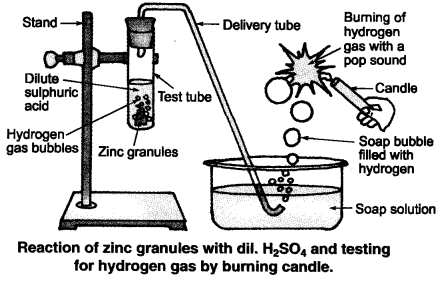
(iii) Test for H2 gas :H2 gas is not soluble in water. When passed through soap solution, it gets trapped into bubbles.
Bring a burning candle near the soap bubble filled with gas. The soap bubble bursts and hydrogen gas burns with a pop sound.
Q3. Metal compound A reacts with dilute hydrochloric acid to produce effervescence. The gas evolved extinguishes a burning candle. Write a balanced chemical equation for the reaction if one of the compounds formed is calcium chloride.
Answer: As metal compound released is Calcium Chloride the gas evolved here is CO2. Hence metal A should be Calcium Carbonate. Hence the reaction between Calcium Carbonate and HCl is
CaCO3 (s) + 2HCl (Aq) → CaCl2( Aq) + CO2 (g) + H2O (l)
Calcium Carbonate + Hydrochloric acid → Calcium Chloride + Carbon dioxide + Water
Page No: 25
Q1. Why do HCl, HNO3, etc., show acidic characters in aqueous solutions while solutions of compounds like alcohol and glucose do not show acidic character?
Answer: When HCl or HNO3 are mixed with water then they dissolve in water to form H+ or H3O+ ions which shows their acidic character. For example just see the following reactions
HCl (aq) → H+ + Cl–
H+ + H2O → H3O+
When alcohols and glucose are mixed with water then they do not dissolve to form ions. Hence they do not show acidic character.
Q2. Why does an aqueous solution of an acid conduct electricity?
Answer: Acids are ionised in their aqueous solution and produce H+ (aq) ions. These ions are responsible for the flow of electricity in the aqueous solutions of acids. H+ ions migrates towards cathode and gain electron to produce hydrogen gas. So when electricity is passed through the aqueous solution of an acid, hydrogen gas is liberated at cathode.
Q3. Why does dry HCl gas not change the colour of the dry litmus paper?
Answer: A dry HCl gas has no H+ so it does not show any acidic character therefore, no change in colour takes place until we moisten the litmus paper.
Q4. While diluting an acid, why is it recommended that the acid should be added to water and not water to the acid?
Answer: Since the process of dissolving an acid in water is exothermic, it is always recommended that acid should be added to water. If it is done the other way, then it is possible that because of the large amount of heat generated, the mixture splashes out and causes burns.
Q5. How is the concentration of hydronium ions (H3O+) affected when a solution of an acid is diluted?
Answer: An acid dissociates into hydronium ions (H3O+) and anions when dissolved in water. Upon dilution, the volume of the solution increases and the number of ions per unit volume decreases. Therefore, the concentration of H3O+ ions per unit volume decreases.
Q6. How is the concentration of hydroxide ions (OH−) affected when excess base is dissolved in a solution of sodium hydroxide?
Answer: When an excess of a base is dissolved in a solution, the solution becomes concentrated. This would result in the increase in the concentration of hydroxide ions (OH−) per unit volume and the strength of the base will increase.
Page No: 28
Q1. You have two solutions, A and B. The pH of solution A is 6 and pH of solution B is 8. Which solution has more hydrogen ion concentration? Which of this is acidic and which one is basic?
Answer: In order to find the hydrogen ion concentration, we can use the rule that states, “The pH of any solution is inversely proportional to the hydrogen ion concentration”. Therefore, it means that the solution that has a lower pH number will have a higher hydrogen ion concentration. Hence, solution A will have a higher hydrogen ion concentration. In addition, solution B will be basic and A will be acidic.
Q2. What effect does the concentration of H+ (aq) ions have on the nature of the solution?
Answer: If the concentration of H+ (aq) ions is increased (>10-7) then the solution become acidic and if the concentration of H+ (aq) ions is decreased (<10-7) then the solution become basic in nature.
Q3. Do basic solutions also have H+ (aq) ions? If yes, then why are these basic?
Answer: Yes, basic solutions also have H+ (aq) ions and similarly acidic solutions have OH– (aq). because acids or bases shows acidic or basic character in water. Distilled water also has 10-7 mol/L, H+ and 10-7 mole/L, OH– ions at 298K.
If an aqueous solution has an equal concentration of hydrogen ions and hydroxide ions in it, it is said to be neutral. Now, if an aqueous solution has more of hydrogen ions and less of hydroxide ions, it will be acidic solution. On the other hand, if an aqueous solution has more of hydroxide ions and less of hydrogen ions it will be basic in nature.
Q4. Under what soil condition do you think a farmer would treat the soil of his fields with quick lime (calcium oxide) or slaked lime (calcium hydroxide) or chalk (calcium carbonate)?
Answer: If the soil is acidic and improper for cultivation, then to increase the basicity of soil, the farmer would treat the soil with quick lime or slaked lime or chalk.
Page No. 33
Q1. What is the common name of the compound CaOCl2 ?
Answer: Bleaching powder.
Q2. Name the substance which on treatment with chlorine yields bleaching powder.
Answer: Dry slaked lime : Ca(OH)2
Chlorine : Cl2
Q3. Name the sodium compound which is used for softening hard water.
Answer: Washing soda or sodium carbonate decahydrate
(Na2CO3.10H2O)
Q4. What will happen if a solution of sodium hydrocarbonate is heated? Give the equation of the reaction involved.
Answer: When sodium hydrogen carbonate is heated then sodium carbonate and water is formed along with the evolution of carbon dioxide gas.

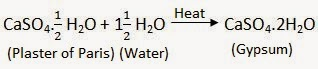
Q5. Write an equation to show the reaction between Plaster of Paris and water
Answer:
Page No: 34
Exercise
Q1. A solution turns red litmus blue, its pH is likely to be
(a) 1
(b) 4
(c) 5
(d) 10
(d) 10
Q2. A solution reacts with crushed egg-shells to give a gas that turns lime-water milky. The solution contains
(a) NaCl
(b) HCl
(c) LiCl
(d) KCl
(b) HCl
Q3. 10 mL of a solution of NaOH is found to be completely neutralised by 8 mL of a given solution of HCl. If we take 20 mL of the same solution of NaOH, the amount of HCl solution (the same solution as before) required to neutralise it will be
(a) 4 mL
(b) 8mL
(c) 12 mL
(d) 16 mL
(d) 16 mL
Q4. Which one of the following types of medicines is used for treating indigestion?
(a) Antibiotic
(b) Analgesic
(c) Antacid
(d) Antiseptic
(c) Antacid
Q5, Write word equations and then balanced equations for the reaction taking place when −
(a) dilute sulphuric acid reacts with zinc granules.
Answer: H2SO4 (aq) + Zn (s) → ZnSO4 (aq) + H2 (g)
(b) dilute hydrochloric acid reacts with magnesium ribbon.
Answer: 2HCl (aq) + Mg (s) → MgCl2 (aq) + H2 (g)
(c) dilute sulphuric acid reacts with aluminium powder.
Answer: 3H2SO4 (aq) + 2Al (s) → Al2(SO4)3 (aq) + 3H2 (g)
(d) dilute hydrochloric acid reacts with iron filings.
Answer: 6HCl (aq) + 2Fe (s) → 2FeCl3 (aq) + 3H2 (g)
Q6. Compounds such as alcohols and glucose also contain hydrogen but are not categorized as acids. Describe an activity to prove it.
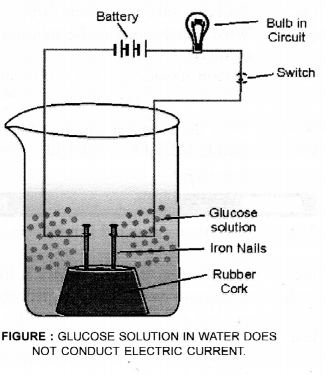
Answer: Two nails are fitted on a cork and are kept it in a 100 mL beaker. The nails are then connected to the two terminals of a 6-volt battery through a bulb and a switch. Some dilute HCl is poured in the beaker and the current is switched on. The same experiment is then performed with glucose solution and alcohol solution.
Observations:
It will be observed that the bulb glows in the HCl solution and does not glow in the glucose solution.
Result:
HCl dissociates into H+and Cl−ions. These ions conduct electricity in the solution resulting in the glowing of the bulb. On the other hand, the glucose solution does not dissociate into ions. Therefore, it does not conduct electricity.
Conclusion:
From this activity, it can be concluded that all acids contain hydrogen but not all compounds containing hydrogen are acids.
That is why, though alcohols and glucose contain hydrogen, they are not categorised as acids.
Q7. Why does distilled water not conduct electricity, whereas rain water does?
Answer: Distilled water does not contain ions (H+ or OH–) or it contains a very poor concentration of H+ or OH– ions ≈ 1 × 10⁻⁷ moles per litre. So it does not conduct electricity, whereas rainwater has some acidic character due to the presence of acids such as H2SO4, HNO3 etc. So rainwater has a sufficient amount or concentration of H+ ions, so it conducts electricity.
Q8. Why do acids not show acidic behaviour in the absence of water?
Answer: The acidic behaviour of a substance is due to the presence of H+(aq) ions. As acids do not dissociate to produce H+(aq) ions in the absence of water so they do not show acidic behaviour.
Q9. Five solutions A,B,C,D and E when tested with universal indicator showed pH as 4,1,11,7 and 9, respectively. Which solution is
(a) neutral?
(b) strongly alkaline?
(c) strongly acidic?
(d) weakly acidic?
(e) weakly alkaline?
Arrange the pH in increasing order of hydrogen–ion concentration.
Answer:
(a) Neutral : D with pH = 7
(b) Strongly alkaline : C with pH = 12
(c) Strongly acidic : B with pH =2
(d) Weakly alkaline : E with pH = 9
(e) Weakly acidic : A with pH = 4
Increasing order of H+ ions concentration :C<E<D<A<B
Q10. Equal lengths of magnesium ribbons are taken in test tubes A and B. Hydrochloric acid (HCl) is added to test tube A, while acetic acid (CH3COOH) is added to test tube B. In which test tube will the fizzing occur more vigorously and why?
Answer: Fizzing will occur more vigorously in test tube A. Hydrochloric acid (HCl) is a strong acid whereas acetic acid (CH3COOH) is a weak acid. Being strong acid, the hydrochloric acid solution contains a much greater amount of hydrogen ions in it due to which the fizzing will occur more vigorously in test tube A (containing hydrochloric acid). The fizzing is due to the evolution of hydrogen gas which is formed by the action of acid on the magnesium metal of magnesium ribbon.
Q11. Fresh milk has a pH of 6. How do you think the pH will change as it turns into curd? Explain your answer.
Answer: Fresh milk is turned to curd due to production of lactic acid. Lactic acid reduces the pH of the milk.
Q12.A milkman adds a very small amount of baking soda to fresh milk.
(a) Why does he shift the pH of the fresh milk from 6 to slightly alkaline?
Answer: The milkman shifts the pH of the fresh milk from 6 to slightly alkaline because in alkaline condition, milk does not set as curd easily.
(b) Why does this milk take a long time to set as curd?
Answer: Since this milk is slightly basic than usual milk, acids produced to set the curd are neutralized by the base. Therefore, it takes a longer time for the curd to set.
Q13. Plaster of Paris should be stored in a moisture-proof container. Explain why?
Answer: In the presence of moisture, Plaster of Paris gets hydrated and changes to gypsum which is a hard mass.
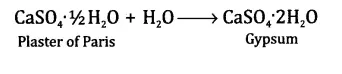
It can no longer be used for making moulds and statues. Therefore, Plaster of Paris is kept in moisture proof containers or bags.
Q14. What is a neutralization reaction? Give two examples.
Answer: Neutralisation reaction is the reaction between acid and base dissolved in aqueous solution to form salt and water.

Q15. Give two important uses of washing soda and baking soda.
Answer: Two important uses of washing soda are:
→ It is used in glass, soap, and paper industries.
→ It is used to remove permanent hardness of water.
Two important uses of baking soda are:
→ It is used as baking powder. Baking powder is a mixture of baking soda and a mild acid known as tartaric acid. When it is heated or mixed in water, it releases CO2 that makes bread or cake fluffy.
→ It is used in soda-acid fire extinguishers.
We Think the given NCERT Solutions for class 10 Science Chapter 2 Acids, Bases and Salts with Answers Pdf free download will assist you. If you’ve got any queries regarding CBSE Class 10 Science Acids, Bases and Salts NCERT Solutions with Answers, drop a comment below and that we will come back to you soons.