
We have Provided the NCERT/CBSE Solutions chapter-wise for Class 10 Science Chapter 9 Heredity and Evolution with Answers by expert subject teacher for latest syllabus and examination. Students can take a free NCERT Solutions of Heredity and Evolution. Each question has right answer Solved by Expert Teacher.
CBSE Solutions Class 10 Science Heredity and Evolution
Page No. 142
QUESTIONS
Q1. If a trait A exists in 10% of a population of an asexually reproducing species and a trait B exists in 60% of the same population, which trait is likely to have arisen earlier?
Answer: Trait B, because it is present in more members of the population. It is likely to have arisen earlier and has now spread to 60% of the population. Trait A is new and has spread to only 10% of the population.
Q2. How does the creation of variations in a species promote survival?
Answer: Variations enable a species to adapt according to the changes and new needs and thus provide survival of species.
Page No. 147
QUESTIONS
Q1. How do Mendel’s experiments show that traits may be dominant or recessive?
Answer: Mendel showed that the traits can either be dominant or recessive through his experiments that focused on mono-hybrid cross. The experiment involved him crossing tall (TT) pea plants with dwarf (tt) pea plants. The resultant plants which formed after fertilization represented the F1 (or filial) generation. All the F1 plants were tall. Mendel then proceeded to self-pollinate the filial generation plants and the result was that 1/4th of the plants obtained in the F2 generation were dwarfs.
From this experiment, Mendel concluded that the F1 tall plants were not true-breeding, instead they carried the traits for both tall and dwarf heights. A portion of the plants were tall due to the fact that the traits for tallness were dominant over the traits for dwarfness. This cements the notion that traits can either be dominant or recessive.
Q2. How do Mendel’s experiments show that traits are inherited independently?
Answer: Mendel carried out dihybrid crosses by crossing two pea plants differing in contrasting traits of two characters. For example, he crossed a pea plant having yellow colour and round seed characters with another pea plant bearing green colour and wrinkled seed characters. In the F2 generation, he obtained pea plants with two parental and two recombinant phenotypes as yellow round and green wrinkled (parental) and yellow wrinkled and green round (recombinant). This indicated that traits separated from their original parental combinations and got inherited independently.
Q3. A man with blood group A marries a woman with blood group O and their daughter has blood group O. Is this information enough to tell you which of the traits – blood group A or O – is dominant? Why or why not?
Answer: No. This information is not sufficient to determine which of the traits – blood group A or O – is dominant. This is because we do not know about the blood group of all the progeny.
Blood group A can be genotypically AA or AO. Hence, the information is incomplete to draw any such conclusion.
Q4. How is the sex of the child determined in human beings?
Answer: Sex determination takes place in human being as follows:
The human male has one x chromosome and oney chromosome. That half the sperms will have x chromosomes and the other half sperms will have y chromosomes. A human female has two x chromosomes (but no y chromosomes) That, is; all the ova (or eggs) will have only x chromosomes. The sex of a child depends on what happens at fertilization.
QUESTIONS
Q1. What are the different ways in which individuals with a particular trait may increase in a population?
Answer: There are three different ways in which individuals with a particular trait can increase in a population.
- Survival Value (Natural Selection): The trait has survival value. It is picked up by natural selection. Through differential reproduction, it increases in population, e.g., green colour in beetles instead of red providing camouflage in bushes against being picked up by crows.
- Genetic Drift: There is seasonal or accidental decline in population. The survivors have certain combination of traits which increase in number with the increase in population. The traits may not give any extra benefit to population.
- Food: Individuals with particular trait may have extra abundance of food in their environment. They will naturally increase in number.
Q2. Why are traits acquired during the life-time of an individual not inherited?
Answer: The traits acquired during the life-time are changes in the non-reproductive cells of the organisms and are not capable of being passed on to the next generation.
Q3. Why are the small numbers of surviving tigers a cause of worry from the point of view of genetics?
Answer: As the number of surviving tigers is small, the sets of genes will be limited. This results in limited variation in characters during sexual reproduction, thereby causing danger for their survival in changing conditions.
Page No. 151
QUESTIONS
Q1. What factors could lead to the rise of a new species?
Answer: Factors that would result in a new species are as follows:
(a) Mutation.
(b) Genetic drift.
(c) Natural selection.
(d) Geographical isolation.
(e) Generative isolation for prolonged periods
(f) Environmental factors on the isolated populations.
(g) Quantum of genetic variant transmissible from one generation to the following generation.
Q2. Will geographical isolation be a major factor in the speciation of a selfpollinating plant species? Why or why not?
Answer: Geographical isolation can prevent the transfer of pollens among different plants. However, since the plants are self-pollinating, which means that the pollens are transferred from the anther of one flower to the stigma of the same flower or of another flower of the same plant, geographical isolation cannot prevent speciation in this case.
Q3. Will geographical isolation be a major factor in the speciation of an organism that reproduces asexually? Why or why not?
Answer: Geographical isolation helps in the prevention of the transfer of genes (gene flow) between populations of a species. In asexual reproduction, A single organism can give rise to new individuals. When there is an error during the copying of DNA, variation occurs in these reproducing organisms. Therefore, the formation of new species cannot be affected by geographical isolation in an asexually reproducing organism.
Page No. 156
QUESTIONS
Q1. Give an example of characteristics being used to determine how close two species are in evolutionary terms.
Answer: Feathers in some ancient reptiles like dinosaurs, as fossils indicate, evolved to provide insulation in cold weather. However, they cannot fly with these feathers later on birds adapted the feathers to flight. This means that birds are very closely related to reptiles, since dinosaurs were reptile.
Q2. Can the wing of a butterfly and the wing of a bat be considered homologous organs? Why or why not?
Answer: Wings of a butterfly and the wings of a bat cannot be considered homologous organs because the origin of these wing are different and the function of these wings are same.
Homologous organs : Those organs which have same origin and different function are called as homologous organs e.g., arm of man of mar and wing of a bird.
Q3. What are fossils? What do they tell us about the process of evolution?
Answer: Fossils are remains or impressions of the past organisms that are found in the rocks of the old ages. They are often called written documents of evolution because they directly indicate the presence of different types of organisms in different ages. The path of evolution is known by arranging the fossils in a proper sequence age-wise. The early fossils are of simple organisms. Later on different complex forms arose, flourished and died down.
They were replaced by newer forms. Study of fossils can also indicate the evolutionary stages of organisms. For example, modern horse (Equus) arose from a fossil animal Eohippus that existed on earth 60 million years back as a 30 cm high small animal. It evolved into 60 cm high goat sized Mesohippus about 40 million years back. Mesohippus gave rise to Merychippus (16-18 million years back) that formed Pliohippus (100-120 cm high, 10 million years ago). The modern horse evolved only 0-5 million years ago from Pliohippus.
Page No. 158
QUESTIONS
Q1. Why are human beings who look so different from each other in terms of size, colour and looks said to belong to the same species?
Answer: This is because although genetic make up of humans may be slightly different in different races of people, there is no reproductive isolation. Reproductive isolation differentiates one species from the other. Human beings different in size, colour and looks can marry among themselves and produce fertile offspring.
Q2. In evolutionary terms, can we say which among bacteria, spiders, fish and chimpanzees have a ‘better’ body design? Why or why not?
Answer: Chimpanzees have more complex body design than fish, followed by spiders and then bacteria. Yet, we cannot say that chimpanzees have a better body design, because evolution does not necessarily mean progress. Evolution simply means the generation of diversity and selection by nature.
It is the adaptability of an organism to the environment that supports its survival, not its complexity. Bacteria which are the simplest life forms still survive today. They are found in varied habitats like hot springs, in ice sheets, etc. only because of their adaptability to the ‘ changing environment. Thus, in evolutionary terms, we cannot say that a particular organism has a better body design.
Page No. 159
EXERCISES
Q1. A Mendelian experiment consisted of breeding tall pea plants bearing violet flowers with short pea plants bearing white flowers. The progeny all bore violet flowers, but almost half of them were short. This suggests that the genetic make-up of the tall parent can be depicted as
(a) TTWW
(b) TTww
(c) TtWW
(d) TtWw
Answer: (c) TtWW
Q2. An example of homologous organs is
(a) Our arm and a dog’s fore-leg.
(b) Our teeth and an elephant’s tusks.
(c) Potato and runners of grass.
(d) All of the above.
Answer: (d) All of the above.
Q3. In evolutionary terms, we have more in common with
(a) A Chinese school-boy.
(b) A chimpanzee.
(c) A spider.
(d) A bacterium.
Answer: (a) A Chinese school-boy.
Q4. A study found that children with light-coloured eyes are likely to have parents with light-coloured eyes. On this basis, can we say anything about whether the light eye colour trait is dominant or recessive? Why or why not?
Answer: This information is not sufficient. For considering a trait as dominant or recessive, we need data of at least three generations. This data is about only two generations.
Q5. How are the areas of study – evolution and classification – interlinked?
Answer: Classification is the process by which scientists group two living organisms based on their similarities. Those species that have more characteristics in common are closely related. And if two species are more closely related, which means they have a more recent ancestor.
For example, in a family, brothers and sisters are more closely related than their cousins. So, we can say that brother and sister have recent common ancestors i.e., their parents. The common ancestors for brother, sister and cousin are their grandparents. Due to sexual reproduction, there is an accumulation of variation over generations which leads to the creation of different phenotypes and genotypes as we move down a family (evolution) tree.
Q6. Explain the terms analogous and homologous organs with examples.
Answer: Homologus organs are those organs which have the same basic structural design and origin but have different functions.
For Example: The forelimbs of humans and the wings of birds look different externally but their skeletal structure is similar.
Analogus organs are those organs which have the different basic structural design and origin but have similar functions.
For Example: The wings of birds and insects.
Q7. Outline a project which aims to find the dominant coat colour in dogs.
Answer: To find the dominant coat colour in dogs the DNA Sequence has to be checked.
Q8. Explain the importance of fossils in deciding evolutionary relationships.
Answer: Fossils are remains or impressions of past organisms that are found in the rocks. Fossils of lower strata belong to early periods while those of upper strata are of later periods. Arranging the fossils stratumwise will indicate the occurrence of different forms of life at different times. It is found that the early fossils generally belong to simple organisms. Complexity and elaboration increased gradually with evolution. Evolution has never been linear or straight. A number of variants or branches appeared, some of which were more complex while others were less complex.
- Fossils indicate the path of evolution of different groups.
- They can indicate the phylogeny of some organisms, e.g, Horse, Elephant.
- Some fossils have characteristics intermediate between two groups,
Q9. What evidence do we have for the origin of life from inanimate matter?
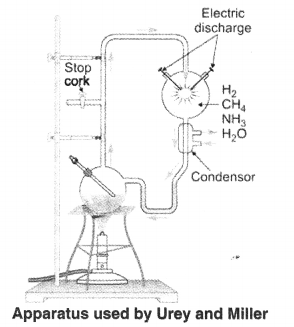
Answer: A British scientist J.B.S. Haldane at first in 1929 suggested that life is originated from inanimate matter. According to him life must have developed from the simple inorganic molecules which were present at that time. Later, Miller and Urey in 1953 presented its evidences. They assembled an apparatus to create an early earth atmosphere which was supposed to consist of gases like methane, ammonia and hydrogen sulphide, etc. over water.
This was maintained at a temperature just below 100°C and electric sparks were then passed through the mixture of gases to stimulate lightning for about one week. At the end of one week, it was found that about 15 per cent of carbon (from methane) had been converted into simple compounds and amino acids which make up protein molecules formed in living organisms. This experiment provides the evidence that the life originated from inanimate matter (or lifeless matter) like inorganic molecules.
Q10. Explain how sexual reproduction gives rise to more viable variations than asexual reproduction. How does this affect the evolution of those organisms that reproduce sexually?
Answer: In sexual reproduction, the DNA comes from two parents. Therefore, the variations are more
obvious. When the next generation reproduces, it passes on the characteristics inherited from the parents as well as its own individual traits. This results in similarities and variations.
Q11. How is the equal genetic contribution of male and female parents ensured in the progeny?
Answer: Equal genetic contribution of male and female parents is ensured in progeny through the inheritance of equal numbers of chromosomes from both parents. There are 23 pairs of chromosomes but not all is paired. The 22 pairs are called autosomes while the remaining 1 pair is called the sex chromosomes (represented as X and Y.)
Females have two sets of X-chromosomes while males have 1 X-chromosome and 1 Y-chromosome.
During the process of reproduction, fertilization takes place, where the male gamete fuses with the female gamete and it results in the formation of a diploid zygote. Furthermore, the zygote receives an equal contribution of genetic material from both parents. The male contributes 22 autosomes plus, 1 X or Y chromosomes. The female contributes 22 autosomes, plus 1 X-chromosome.
Q12. Only variations that confer an advantage to an individual organism will survive in a population. Do you agree with this statement? Why or why not?
Answer: We agree with the statement that Only variations that confer an advantage to an individual organism will survive in a population. All the variations do not have an equal chance of surviving in the environment in which they find themselves. The chances of surviving depend on the nature of variations. Different individual would have different kind of advantages. A bacteria that can withstand heat will survive better in a heat wave. Selection of variants by environmental factors forms the basis for revolutionary process.
We Think the given NCERT Solutions for class 10 Science Chapter 9 Heredity and Evolution with Answers Pdf free download will assist you. If you’ve got any queries regarding CBSE Class 10 Science Heredity and Evolution NCERT Solutions with Answers, drop a comment below and that we will come back to you soons.