
We have Provided the NCERT/CBSE Solutions chapter-wise for Class 10 Science Chapter 8 How do Organisms Reproduce? with Answers by expert subject teacher for latest syllabus and examination. Students can take a free NCERT Solutions of How do Organisms Reproduce?. Each question has right answer Solved by Expert Teacher.
CBSE Solutions Class 10 Science How do Organisms Reproduce?
Page No. 128
QUESTIONS
Q1. What is the importance of DNA copying in reproduction?
Answer: DNA is the genetic material present in the cells of all organisms. The genetic information from generation to generation is carried by DNA. It is therefore possible for the organism to produce organism of its own type due to DNA copying only For the inheritance of traits of the parent, DNA copying is a must. DNA copying also brings about variation ,which forms the basis for the origin of new species.
Q2. Why is variation beneficial to the species but not necessarily for the individual?
Answer: If some variation were to be present in a few individuals in these populations, there would be some chance for them to survive. If there were a population of bacteria living in temperate waters and if the water temperature were to be increased by global warming most of these bacteria would die, but the few variants resistant to heat would survive and grow further. Variation is thus useful for the survival of species over time.
Page No. 133
QUESTIONS
Q1. How does binary fission differ from multiple fission?
Answer:
| Binary Fission | Multiple Fission |
| 1. Products. It gives rise to two individuals. 2. Conditions. Binary fission occurs under favourable conditions. 3. Nucleus. Nucleus of the parent cell divides only once to form two daughters. 4. Cytoplasm. Cytoplasm undergoes cleavage after each nuclear division. 5. Residue. No part of the parent body is left unused. Examples. Amoeba, Paramecium. | 1. It forms several (more than two) individuals. 2. Multiple fission occurs both under favourable and unfavourable conditions. 3. Nucleus of the parent undergoes repeated divisions to form a number of daughter nuclei. 4. Cytoplasm does not divide after every nuclear division. 5. A part of the body, covering and residual cytoplasm, is left behind. Examples. Plasmodium, Amoeba (encysted). |
Q2. How will an organism be benefited if it reproduces through spores?
Answer: An organism is benefited by reproducing through the spores because spores are surrounded by a thick layer which protects them in adverse conditions. When the favourable conditions occur, these spores start to grow again. In this way they are successfully live in unfavourable conditions.
Q3. Can you think of reasons why more complex organisms cannot give
rise to new individuals through regeneration?
Answer: (a) The body of complex organisms consist of several organ systems which perform
specific functions.
(b) Regeneration is carried out by specialised cells which are not present in complex organisms.
Q4. Why is vegetative propagation practised for growing some types of
plants?
Answer: Following are the advantages of practising vegetative propagation for growing some types of plants:
- Crops like orange, banana, pineapple do not have viable seeds, so vegetative propagation can be used.
- It is a rapid, cheap and easier method to grow crops.
- It can be used in places where seed germination fails.
- A good quality of variety can be preserved.
Q5. Why is DNA copying an essential part of the process of reproduction?
Answer: DNA copying is an essential part of reproduction as it passes genetic information from parents to offspring. It determines the body design of an individual. The reproducing cells produce a copy of their DNA through some chemical reactions and result in two copies of DNA. The copying of DNA always takes place along with the creation of additional cellular structure. This process is then followed by division of a cell to form two cells.
Page No. 140
QUESTIONS
Q1. How is the process of pollination different from fertilisation?
Answer: Pollination is the process of transfer of pollens from anther to stigma. It occurs with the help of certain pollinators such as air, water, birds, or some insects.
Fertilization, is the fusion of the male and female gametes. It occurs inside the ovule and leads to the formation of zygote.
Q2. What is the role of the seminal vesicles and the prostate gland?
Answer:
- Seminal Vesicles: There is one pair of seminal vesicle. They lie at the base of urinary bladder above prostate gland. They secrate a viscous fluid for nourishment of sperms.
- Prostate Gland : There is one prostate gland. It surrounds first part of urethra. It secretes alkaline fluid which is discharged into urettra.
Q3. What are the changes seen in girls at the time of puberty?
Answer:
- Breast size begins to increase. There is darkening of skin of nipples below the tips of breasts.
- Menarche or beginning of menstruation.
- Broadening of pelvis,
- Deposition of fat in face, buttocks and thighs,
- Increased vasculature of skin and hence increased warmth of skin,
- Rounding of body ccthtours.
- High pitched voice,
- Slow growth of ovaries, fallopian tubes, uterus, vagina, enlargement of labia, etc.
Q4. How does the embryo get nourishment inside the mother’s body?
Answer: In mother’s body, the embryo gets nutrition from the mother’s blood. For this, there is a special structure, called placenta. Placenta contains villi. There are empty spaces in mother’s tissues that cover the villi. It provides a large surface area for the transfer of glucose, oxygen and other substances from the mother to the embryo.
Q5. If a woman is using a copper -T, will it help in protecting her from sexually transmitted diseases?
Answer: No, because the copper-T just hampers the process of implantation of embryo in the uterine wall but not provides protection against sexually transmitted diseases.
Page No. 141
EXERCISES
Q1. Asexual reproduction takes place through budding in
(a) amoeba.
(b) yeast.
(c) plasmodium.
(d) leishmania.
Answer: (b) yeast.
Q2. Which of the following is not a part of the female reproductive system in human beings?
(a) Ovary
(b) Uterus
(c) Vas deferens
(d) Fallopian tube
Answer: (c) Vas deferens
Q3. The anther contains
(a) sepals.
(b) ovules.
(c) carpel.
(d) pollen grains.
Answer: (d) pollen grains.
Q4. What are the advantages of sexual reproduction over asexual reproduction?
Answer: Following are the advantages of sexual reproduction:
- The offspring has the characters of both the parents.
- The survival of the species is ensured as there are more variations.
- The offspring can easily adapt to environmental changes.
- It also improves the health of humans.
Q5. What are the functions performed by the testis in human beings?
Answer: Two functions performed by the testis in human beings are as follows:-
- It secretes the hormone testosterone, which is responsible for the secondary sexual changes in males.
- It produces sperms, which participate in fertilisation.
Q6. Why does menstruation occur?
Answer: Menstruation is a process in which blood and mucous flows out every month through the vagina. This process occurs every month because one egg is released from the ovary every month and at the same time, the uterus (womb) prepares itself to receive the fertilized egg. Thus, the inner lining of the uterus gets thickened and is supplied with blood to nourish the embryo. If the egg does not get fertilised, then the lining of the uterus breaks down slowly and gets released in the form of blood and mucous from the vagina.
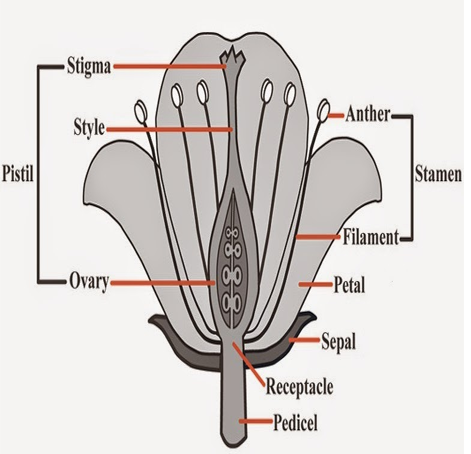
Q7. Draw a labelled diagram of the longitudinal section of a flower.
Answer:
Q8. What are the different methods of contraception?
Answer: The contraceptive method fall in a number of categories one category is the creation of mechanical barrier so that the sperm does not reach the egg Condom on the penis or similar coverings worn in the vagina can serve this purpose. Another category of contraceptives acts by changing the hormonal balance of the body so that eggs are not released and fertilization cannot occur. As orally pills taken to be commonly drugs can change hormonal balances, they can case side effects too. Other contraceptive devices such as the loop or the copper T are placed in the uterus to prevent pregnancy.
Q9. How are the modes for reproduction different in unicellular and multicellular organisms?
Answer: The different modes of reproduction in unicellular organisms are fission, budding, etc. Here, the cell divides into two daughter cells and this process of cell division continues.
Whereas, in multicellular organisms there is a different organ system for reproduction. The different modes of reproduction in multicellular organisms are vegetative propagation, spore formation, etc.
In more complex organisms like humans and animals, the reproduction is through sexual reproduction.
Q10. How does reproduction help in providing stability to populations of species?
Answer:
- Replication of DNA.
- Growth and differentiation of cellular machinery.
- Cell division. It is mode of reproduction in single celled organisms,
- Development of special reproductive structures and formation of new individuals.
- Continued replication of DNA, growth and cell division, formation of tissues, organs, etc. and maturation into a multicellular organism.
Q11. What could be the reasons for adopting contraceptive methods?
Answer: The reasons for adopting contraceptive devices are as follow:
(i) To control the birth rate and prevent the increase in population.
(ii) To reduce the adverse effects on mother’s body due to frequent pregnancy
(iii) To provide safety from sexually transmitted diseases.
We Think the given NCERT Solutions for class 10 Science Chapter 8 How do Organisms Reproduce? with Answers Pdf free download will assist you. If you’ve got any queries regarding CBSE Class 10 Science How do Organisms Reproduce? NCERT Solutions with Answers, drop a comment below and that we will come back to you soons.