
We have Provided the NCERT/CBSE Solutions chapter-wise for Class 10 Social Science GEography Chapter 4 Agriculture with Answers by expert subject teacher for latest syllabus and examination. Students can take a free NCERT Solutions of Agriculture. Each question has right answer Solved by Expert Teacher.
CBSE Solutions Class 10 Social Science Geography Agriculture
Page No 46
Q1. Multiple choice questions.
(i) Which one of the following describes a system of agriculture where a single crop is grown on a large area?
(a) Shifting Agriculture
(b) Plantation Agriculture
(c) Horticulture
(d) Intensive Agriculture
Answer: Plantation agriculture
(ii) Which one of the following is a rabi crop?
(a) Rice
(b) Gram
(c) Millets
(d) Cotton
Answer: (b) Gram
(iii) Which one of the following is a leguminous crop?
(a) Pulses
(b) Jawar
(c) Millets
(d) Sesamum
Answer: (a) Pulses
(iv) Which one of the following is announced by the government in support of a crop?
(a) Maximum support price
(b) Minimum support price
(c) Moderate support price
(d) Influential support price
Answer: (b) Minimum support price
Q2. Answer the following questions in 30 words.
(i) Name one important beverage crop and specify the geographical conditions required for its growth.
Answer: The important beverage crop is Tea.
The geographical conditions required for growth of Tea:
(a)The tea plant grows well in tropical and sub-tropical climates endowed with deep and fertile well-drained soil, rich in humus and organic matter.
(b)Tea bushes require warm and moist frost-free climate all through the year.
(c)Frequent showers evenly distributed over the year ensure continuous growth of tender leaves.
(d)Tea is processed within the tea garden to restore its freshness.
(ii) Name one staple crop of India and the regions where it is produced.
Answer: Rice is a staple food crop of India. It grows in the plains of north and north-east India, coastal areas and the deltaic regions.
(iii) Enlist the various institutional reform programmes introduced by the government in the interest of farmers.
Answer: The various institutional reform programmes introduced by the government for the benefit of farmers are:
- Provision for crop insurance against drought, flood, cyclone, fire, disease etc.
- Establishment of Grameen banks, cooperative societies and bank for providing loan facilities to the farmers at a lower rate of interest. Government also announces Minimum Support Price.
- Subsidy on agricultural inputs and resources such as power and fertilisers.
- Facilities of Kissan Credit Card and Personal Accident Insurance Scheme.
- Special weather bulletins and agricultural programmes for farmers were introduced on radio and television.
(iv) The land under cultivation has got reduced day by day. Can you imagine its consequences?
Answer: It has many serious consequences-
- Shortage of foodgrains
- Rise in price of foodgrains
- Food insecurity
- Bad quality of foodgrains due to use of more and more chemicals in the limited land
- Degradation in the quality of land.
Q3. Answer the following questions in about 120 words.
(i) Suggest the initiative taken by the government to ensure the increase in agricultural production.
Answer: Government has taken following steps to ensure the increase in agricultural production since 1951.
(a) Abolished zamindari system and consolidated small land holdings
(b) Introduced large scale use of HYV seeds, chemical fertilisers, pesticides, etc.
(c) Opened rural banks and cooperative societies to provide agricultural loans to farmers
(d) Introduced crop insurance against drought, flood, cyclone, fire and disease
(e) Introduced special weather bulletins on radio and television
(f) Announced minimum support price for crops to check the exploitation of farmers
(ii) Describe the impact of globalisation on Indian agriculture.
Answer: The impact of globalisation on Indian agriculture has been felt since colonial times. Raw cotton and spices were important export items from India. In 1917, Indian farmers revolted in Champaran against being forced to grow indigo in place of foodgrains, in order to supply dye to Britain’s flourishing textile industry. Thus, globalisation has had its boons and banes for Indian agriculture.
Post liberalisation, Indian farmers face new challenges in the form of competition from highly subsidised agriculture of developed nations. This prompts the need for making Indian agriculture successful and profitable by improving the conditions of small and marginal farmers, countering the negative effects of Green Revolution, developing and promoting organic farming, and diversifying cropping pattern from cereals to high-value crops.
(iii) Describe the geographical conditions required for the growth of rice.
Answer:
- It is a Kharif crop which requires high temperature, (above 25 °C) and high humidity with annual rainfall above 100 cm.
- In the areas of less rainfall, it grows with the help of irrigation. For example, the development of dense network of canal irrigation and tubewells have made it possible to grow rice in Punjab, Haryana, western Uttar Pradesh and parts of Rajasthan.
Project Work
Q1. Group discussion on the necessity of literacy among farmers.
Answer: Agriculture is the backbone of Indian economy. The responsibility of agriculture lies upon Indian farmers. They are not only poor economically but also illiterate too. So, the farmers must be given proper education. If they are properly educated, then they will be able to know about the quality of their land, higher varieties of seeds, fertilisers, pesticides and so on. Till time, a lot of farmers still cultivate their land in the old fashioned way. It not only takes more time but lot of efforts too. This is the reason that the farmers are still lagging behind. So they must be made acquainted with the latest technologies and equipment.
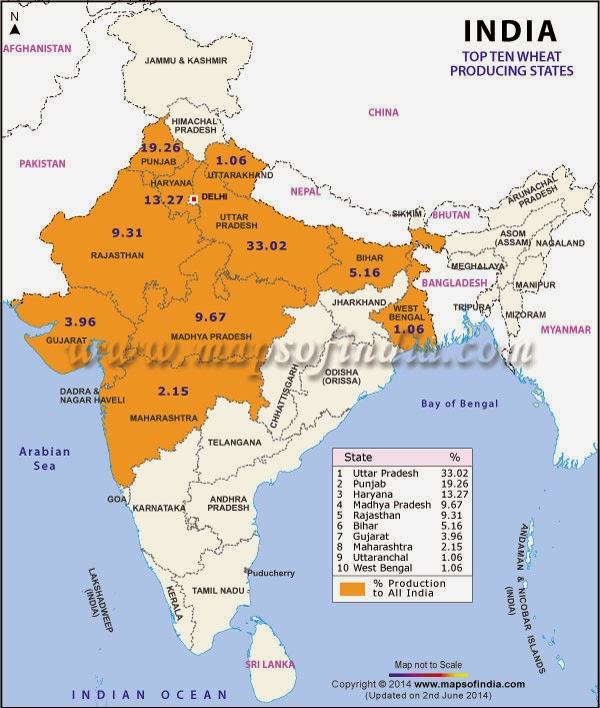
Q2. On an outline map of India show wheat producing areas.
Answer:
ACTIVITY
Solve the puzzle by following your search horizontally and vertically to find the hidden answers.

1) The two staple food crops of India.
2) This is the summer cropping season of India.
3) Pulses like arhar, moong, gram, urad contain…
4) It is a coarse grain.
5) The two important beverages in India are…
6) One of the four major fibers grown on black soils.
Answer:

1) Rice and Wheat
2) Kharif
3) Protein
4) Jowar
5) Coffee, Tea
6) Cotton
We Think the given NCERT Solutions for class 10 Geography Social Science Chapter 4 Agriculture with Answers Pdf free download will assist you. If you’ve got any queries regarding CBSE Class 10 Social Science Agriculture NCERT Solutions with Answers, drop a comment below and that we will come back to you soons.