
We have Provided the NCERT/CBSE Solutions chapter-wise for Class 10 Science Chapter 6 Life Processesy with Answers by expert subject teacher for latest syllabus and examination. Students can take a free NCERT Solutions of Life Processesy. Each question has right answer Solved by Expert Teacher.
CBSE Solutions Class 10 Science Life Processesy
Page No. 95
QUESTIONS
Q1. Why is diffusion insufficient to meet the oxygen requirements of multicellular organisms like humans?
Answer: In multicellular organisms like humans, all the body cells are not in direct contact with the surrounding environment. Therefore, every cell of the body will not get oxygen as per need by the process of diffusion from the environment. Therefore diffusion is insufficient to meet the oxygen requirements of multicellular organisms.
Q2. What criteria do we use to decide whether something is alive?
Answer: Growth, movement or locomotion, response to, stimuli and ability to reproduce are the criteria that we use to decide whether something is alive.
Q3. What are outside raw materials used for by an organism?
Answer: Outside raw material is used by organism for food and oxygen. Raw materials requirement varies on the complexity of the organism and the environment it is living.
Q4. What processes would you consider essential for maintaining life?
Answer: Life processes such as nutrition, respiration, transportation, excretion, etc. are essential for maintaining life.
Page No. 101
QUESTIONS
Q1. What are the differences between autotrophic nutrition and heterotrophic nutrition?
Answer:
| Autotrophic Nutrition | Heterotrophic Nutrition |
| 1. The organisms synthesize their own food from simple organic raw materials. 2. For eg. all green plant are autotrophs. | 1. The organisms cannot synthesize their own food from simple inorganic, raw materials. 2. For eg. all animals, human beings and non-green plants like bacteria and fungi. |
Q2. Where do plants get each of the raw materials required for photosynthesis?
Answer:
- Carbon Dioxide: At through stomata.
- Water: Soil through roots.
- Minerals: Soil through roots. ,
Q3. What is the role of the acid in our stomach?
Answer: Role of acid in our stomach is :
(i) To make acidic medium which is necessary for the activation of the enzyme pepsin.
(ii) To kill bacteria which the food may contain.
Q4. What is the function of digestive enzymes?
Answer: The function of digestive enzymes is to hasten the process of digestion in which complex
molecules break down into simpler molecules which are then easily absorbed by the body.
Q5. How is the small intestine designed to absorb digested food?
Answer: Small intestine has small projections called as micro villi which increases the surface volume which make absorption more effective. Within the villi there are numerous blood vessels that absorb digested food and carry it to blood stream. Blood transports food to each part of our body.
QUESTIONS
Page No. 105
Q1. What advantage over an aquatic organism does a terrestrial organism have with regard to obtaining oxygen for respiration?
Answer: Terrestrial organisms take up oxygen from the atmosphere whereas aquatic animals obtain oxygen from water. Air contains more O2 as compared to water. Since the content of O2 in air is high, the terrestrial animals do not have to breathe faster to get more oxygen. Therefore, unlike aquatic animals, terrestrial animals do not need adaptations for gaseous exchange.
Q2. What are the different ways in which glucose is oxidized to provide energy in various organisms?
Answer: A biochemical process of stepwise oxidation or breaking down of organic compounds (simple carbohydrate like glucose) to release energy inside the hying cell at body temperature. The energy released in respiration sets stored in Adenosine Triphosphate [ATP] molecules.

Q3. How is oxygen and carbon dioxide transported in human beings?
Answer: Oxygen:
- 97% in combined state with haemoglobin called oxyhaemoglobin.
- 3% dissolved in plasma.
Carbon Dioxide:
- 5-7% as dissolved in plasma.
- 70% as sodium bicarbonate in plasma.
- 23% in combined state with haemoglobin called carbaminohaemoglobin.
Q4. How are the lungs designed in human beings to maximize the area for exchange of gases?
Answer: Within the lungs, the air passage divides into smaller and smaller tubes, called bronchi which in turn form bronchioles. The bronchioles terminate in balloon-like structures, called alveoli. The alveoli present in the lungs provide maximum surface for exchange of gases. The alveoli have vary thin walls and contain an extensive network of blood vessels to facilitate exchange of gases.
QUESTIONS
Page No. 110
Q1. What are the components of the transport system in human beings? What are the functions of these components?
Answer: The components along with functions of transport system in human beings are as:
Heart: It is a muscular pumping organ that helps to pump blood around the body.
Blood: The blood is a fluid connective tissue. It consists of a watery fluid called plasma, and three types of cells: red blood cells, white blood cells and platelets. Plasma helps in transporting food, carbon dioxide, salts and nitrogenous wastes in dissolved form. Red blood cells carry oxygen. White blood cells engulf bacteria and produce antibodies, which provide immunity against various disease-causing pathogens. Platelets help to clot the blood at the site of injury.
Blood vessels: There are three types of blood vessels. They are: arteries, veins and capillaries. These vessels help in transporting the blood in the body.
Lymph: It carries digested and absorbed fats from intestine and transports them to the blood. It also drains excess fluid from extra-cellular space back into the blood.
Q2. Why is it necessary to separate oxygenated and deoxygenated blood in mammals and birds?
Answer: Mammals and birds are warm blooded animals which keep their body temperature constant irrespective of the environment they leave. This process require lot of oxygen for more cellular respiration so that warm blooded animals produce more energy to balance their body temperature. Hence it is very important for warm blooded animals to separate oxygenated and deoxygenated blood to keep their circulatory system efficient.
Q3. What are the components of the transport system in highly organised plants?
Answer: In highly organised plants, there are two different types of conducting tissues – xylem and phloem. Xylem conducts water and minerals obtained from the soil (via roots) to the rest of the plant. Phloem transports food materials from the leaves to different parts of the plant body.
Q4. How are water and minerals transported in plants?
Answer: Water and minerals are transported in plants through Xylem components.
Q5. How is food transported in plants?
Answer: Unlike animals, some materials pass in and out of plants through diffusion. For rapid gaseous diffusion to occur, the plants possess stomata and lenticels. During the daytime the photosynthetic organs obtain carbon dioxide from outside by diffusion. The same is used for synthesis of food. Oxygen is released as a by-product. It passes out of the plant by diffusion. Simultaneously, a lot of water vapours pass out.
Other materials required for building plant body are obtained from soil, e.g., nitrogen, phosphorus, other minerals, water .They are sent to chlorophyll containing organs where food is manufactured. The manufactured food is passed to all parts for utilisation and storage. If the distance between the two is small, the materials reach there by diffusion. If the distance is large, as in most plants, they have to be transported through a proper system of transportation. However, plants have a large proportion of dead cells. They do not move. Therefore, they have low energy needs.
QUESTIONS
Page No. 112
Q1. Describe the structure and functioning of nephrons.
Answer: Structure of nephron : Each nephron is composed of two parts. First one is a cup-shaped bag at its upper end which is called Bowman’s capsule.
The Bowman’s capsule contains a bundle of blood capillaries which is called glomerulus. One end of the glomerulus is attached to the renal artery which brings the impure blood containing the urea waste into it. These impurities are filtered. The other part of the nephron is coiled. In this part, the substances like sugar (glucose), amino acid, ions and excess water which are required by the body, are reabsorbed. The substance remained in the nephron is mainly urine containing dissolved urea in water which is expelled from the body through urethra from time to time.
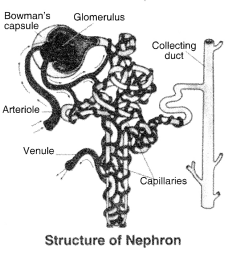
Functions of nephron : Filtration of blood takes place in Bowman’s capsule from the capillaries of glomerulus. The filtrate passes into the tubular part of the nephron. This filtrate contains glucose, amino acids, urea, uric acid, salts and water.
Reabsorption : As the filtrate flows along the tubule, useful substances such as glucose, amino acids, salts and water are selectively reabsorbed into the blood by capillaries surrounding the nephron tubule.
Urine : The filtrate which remained after reabsorption is called urine. Urine contains dissolved nitrogenous waste like urea and uric acid, excess salts and water. Urine is collected from nephrons to carry it to the ureter from where it passes into urinary bladder.
Q2. What are the methods used by plants to get rid of excretory products?
Answer:
- Plants get rid of the oxygen produced during photosynthesis by its diffusion through stomata and lenticels.
- They get rid of excess water by transpiration.
- Many waste products are stored in cell vacuoles.
- Some wastes are removed in the falling leaves.
- Other, wastes are stored as resins and gums, especially in old xylem.
- Plants also get rid of some waste products by excreting into the surrounding soil.
Q3. How is the amount of urine produced regulated?
Answer: Amount of urine produced depends on the amount of excess water and dissolved waste present in the body. Other factors may be environment and ADH hormone which regulates the production of urine.
Page No. 113
Exercise
Q1. The kidneys in human beings are a part of the system for
(a) nutrition.
(b) respiration.
(c) excretion.
(d) transportation.
(c) excretion.
Q2. The xylem in plants are responsible for
(a) transport of water.
(b) transport of food.
(c) transport of amino acids.
(d) transport of oxygen.
(a) transport of water.
Q3. The autotrophic mode of nutrition requires
(a) carbon dioxide and water.
(b) chlorophyll.
(c) sunlight.
(d) all of the above.
(d) all of the above.
Q4. The breakdown of pyruvate to give carbon dioxide, water and energy takes place in
(a) cytoplasm.
(b) mitochondria.
(c) chloroplast.
(d) nucleus.
(b) mitochondria.
Q5. How are fats digested in our bodies? Where does this process take place?
Answer: Fats are digested in our body in the liver, which is the largest gland in the human body. It secrets bile juice, which is stored in gall bladder before it is poured into duodenum through a common bile duct. Bile is alkaline due to the presence of bile salts and bile pigments. Bile helps in
- Emulsification of fat (emulsification means breaking the fat into small globules)
- Activates the pancreatic and intestinal enzymes by making the food alkaline.
Q6. What is the role of saliva in the digestion of food?
Answer: Saliva is the secretion of salivary glands that is poured in the buccal cavity for :
- Moistening and softening of food for easy crushing by the teeth.
- Action of enzyme ptyalin or salivary amylase which converts starch and glycogen of cooked food into sweet sugar maltose.
- Conversion of semisolid food into slippery bolus for easy swallowing.
Q7. What are the necessary conditions for autotrophic nutrition and what are its by-products?
Answer: Necessary conditions for autotrophic nutrition :
(i) Presence of chlorophyll in the living cells.
(if) Provision of supply of water to green plants or cells of the plant.
(iii) Sufficient sunlight.
(iv) Sufficient supply of carbon dioxide.
By-product of auto tropic nutrition is oxygen.
Q8. What are the differences between aerobic and anaerobic respiration? Name some organisms that use the anaerobic mode of respiration.
Answer:
| Aerobic respiration | Anaerobic respiration |
| 1. This process takes place in the presence of oxygen. 2. It involves complete oxidation of glucose. 3. The end products of this process are carbon dioxide and water. 4. Large amount of energy is released during this process. 5. This process takes place in the cytoplasm as well as in mitochondria of the cell. | 1. This process takes place in the absence of oxygen. 2. It involves incomplete oxidation of glucose. 3. The end products of this process are ethanol and cabondioxide, or lactic acid.. 4. comparatively less amount of energy is released during this process. 5. This process takes place in the cytoplasm of the cell. |
- Anaerobic mode of respiration is used by yeasts and some bacteria.
Q9. How are the alveoli designed to maximise the exchange of gases?
Answer:
- The lung is an important part of the body. The passage inside the lungs divides into smaller and smaller tubes, which finally terminate in balloon-like structures, called as alveoli.
- The alveoli provide a surface where the exchange of gases can take place. The walls of the alveoli usually contains an extensive network of blood vessels. We know that, when we breathe in, we lift our ribs, flatten our diaphragm and chest cavity becomes larger.
- Because of this action, air is sucked into the lungs and fills the expanded alveoli.
- The blood brings the essential carbon dioxide from rest of the body and supply it to alveoli; the oxygen in the alveolar air is taken up by the blood in the alveolar blood vessels to be transported to the all other cells of the body. During normal breathing cycle, when air is taken in and let out, the lungs always contain a residual volume of air so that there is sufficient time for oxygen to be absorbed and carbon dioxide to be released.
Q10. What would be the consequences of a deficiency of haemoglobin in our bodies?
Answer: Haemoglobin is the respiratory pigment that transports oxygen to the body cells for cellular respiration. Therefore, deficiency of haemoglobin in blood can affect the oxygen supplying capacity of blood. This can lead to deficiency of oxygen in the body cells. It can also lead to a disease called anaemia.
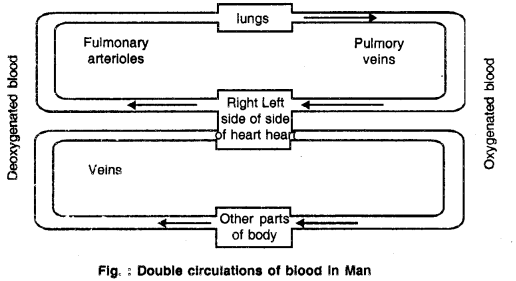
Q11. Describe double circulation in human beings. Why is it necessary?
Answer: Double circulation: “The flow of blood twice through the heart before it is pumped throughout the body is known as double circulation.”
Q12. What are the differences between the transport of materials in xylem and phloem?
Answer:
| Transport in Xylem | Transport in Phloem |
| 1. Components. It consists of water and minerals. 2. Direction. The movement is generally unidirectional. 3. Force. It operates through creation of negative tension. 4. Active Component. An active component is absent. 5. Metabolic Inhibitors. Metabolic inhibitors have no effect on xylem transport. 6. Channels. Tracheary elements are non-living. | 1. It consists of organic nutrients. 2. The movement is multidirectional. 3. It operates through creation of positive turgor. 4. An active component is present in the region of loading and unloading. 5. Metabolic inhibitors inhibit phloem transport. 6. Phloem channels are made of living cells. |
Q13. Compare the functioning of alveoli in the lungs and nephrons in the kidneys with respect to their structure and functioning.
Answer:
| Alveoli | Nephron |
| 1. Alveoli are functional unit of lungs. 2. A mature lung has about 30 crore alveoli. 3. Alveoli provide a wide surface for gaseous exchange. 4. The exchange of O2 and CO2 takes place through the network of capillaries in alveoli. | 1. Nephrons are functional unit of kidney. 2. A kidney has about 10 lakh nephrons. 3. The surface area of a nephron is not much more. 4. The Bowman’s capsule in nephron regulates the concentration of water and salts. |
We Think the given NCERT Solutions for class 10 Science Chapter 6 Life Processesy with Answers Pdf free download will assist you. If you’ve got any queries regarding CBSE Class 10 Science Life Processesy NCERT Solutions with Answers, drop a comment below and that we will come back to you soons.