
We have Provided the NCERT/CBSE Solutions chapter-wise for Class 10 Science Chapter 7 Control and Coordination with Answers by expert subject teacher for latest syllabus and examination. Students can take a free NCERT Solutions of Control and Coordination. Each question has right answer Solved by Expert Teacher.
CBSE Solutions Class 10 Science Control and Coordination
Page No 119
QUESTIONS
Q1. What is the difference between a reflex action and walking?
Answer: Reflex action is involuntary action which means it is not under control of brain only involves spinal cord, it is rapid, thus gives instant response to the stimulus and not affected by our thinking.
But walking is a voluntary action controlled by brain involves central nervous system and spinal cord both and affected by our thinking.
Q2. What happens at the synapse between two neurons?
Answer: Both axon and dendrites arise from cell body. The functional junction between neurons is called synapse. The synapse is a gap between a pair of adjacent neurons. The functional unit of nervous system is neurons. Cyton contains a nucleus within the cytoplasm and Nissl granules formed of ribo nucleic acid (RNA) and thread like fibres called neurofibrils of cytons within brain and spinal cord called a nucleus.
Q3. Which part of the brain maintains posture and equilibrium of the body?
Answer: Cerebellum.
Q4. How do we detect the smell of an agarbatti (incense stick)?
Answer: The smell of agarbatti (incense stick) diffuses in the air. It is detected by olfactory receptors present in the nose. This information is sent to olfactory lobe by sensory nerves located in the forebrain. It responds to the information.
Q5. What is the role of the brain in reflex action?
Answer: Brain does not play any direct role in reflex action. Reflex action is mainly controlled by the spinal cord. The brain function as a relay centre for transferring impulses from sensory to motor neurons in the form of cerebral reflexes Control and Coordination such as closure of eyes on exposure to flash of light and salivation in the mouth at the good smell of food. In spinal reflexes, it acts as a collection centre of information without any direct involvement in reflex action.
Page No. 122
QUESTIONS
Q1. What are plant hormones?
Answer: Plant hormones are the organic substances produces at certain sites of the plant and are translocated to other parts based on the requirement. Plant hormones help to coordinate growth, development and responses to the environment. Ex: Auxin’s Gibberlin’s, cytokines, abscisic acid and ethylene.
Q2. How is the movement of leaves of the sensitive plant different from the movement of a shoot towards light?
Answer: The movement of leaves of the sensitive plant, Mimosa pudica or “touch me not”, occurs in response to touch or contact stimuli. This is done by plant cells by changing the amount of water in leaves. This movement is independent of growth. The movement of shoot towards light is known as phototropism. This type of movement is directional and is growth dependent.
Q3. Give an example of a plant hormone that promotes growth.
Answer: Auxin is an example of a plant hormone that promotes growth.
Q4. How do auxins promote the growth of a tendril around a support?
Answer: Auxin is a plant growth hormone. When the tip of the tendril touches a support, then the auxins present on its tip moves to the side of tip which is away from the support, so, due to more auxins in its tendrils away from the support grows faster.
Q5. Design an experiment to demonstrate hydrotropism.
Answer: Hydro’ means water. Thus, hydrotropism is response of plants towards water.
To design the experiment–Self doing
Page No. 125
QUESTIONS
Q1. How does chemical coordination take place in animals?
Answer: In animals, chemical coordination is achieved through the agency of hormones which function as chemical messengers or informational molecules. Hormones are secreted by ductless glands in response to specific conditions or nervous stimulation. Timing and amount of a hormone released are regulated by feed-back mechanism. After a meal, sugar level of blood rises.
It is detected by pancreas. Pancreas responds by producing hormone insulin from (3-cells of islets of Langerhans. Insulin causes glucose to be absorbed by all cells as well as get stored in liver and muscles in the form of glycogen. As the level of glucose falls in blood, insulin secretion is reduced.
Q2. Why is the use of iodised salt advisable?
Answer: It is advised to use iodised salt because thyroid gland needs iodine to produce thyroxin hormone. Thyroxin hormone controls all the metabolic activities of our body like metabolism of carbohydrates, fats and protein etc. Due to the deficiency of thyroxin a disease called goitre is caused.
Q3. How does our body respond when adrenaline is secreted into the blood?
Answer: Adrenaline is commonly known as ‘fight or flight’ hormone. This is because, the hormone prepares the body for any emergency situation. If there is an increased secretion of this hormone in the blood, it causes increased blood supply to limbs and face. It also increases the heart rate and breathing rate. All of these responses enable the body to deal with any situation-be it a fight or; if need be; a flight from the scene.
Q4. Why are some patients of diabetes treated by giving injections of insulin?
Answer: Diabetes is a condition where insulin hormone is produced less or stopped by pancreatic cells of a person. Insulin regulates blood glucose by converting extra glucose to glycogen. When insulin is not produced adequately person blood glucose level which leads to adverse effects. In order to maintain the insulin and blood glucose level diabetes patients are treated with injections of insulin.
Page No. 125
EXERCISES
Q1. Which of the following is a plant hormone?
(a) Insulin
(b) Thyroxin
(c) Oestrogen
(d) Cytokinin
Answer: (d) Cytokinin
Q2. The gap between two neurons is called a
(a) dendrite.
(b) synapse.
(c) axon.
(d) impulse.
Answer: (b) synapse.
Q3. The brain is responsible for
(a) thinking.
(b) regulating the heart beat.
(c) balancing the body.
(d) all of the above.
Answer: (d) all of the above.
Q4. What is the function of receptors in our body? Think of situations where receptors do not work properly. What problems are likely to arise?
Answer: All information from our environment is detected by the specialised tips of some nerve cells. These receptors are usually located in our sense organs, such as the inner ear, the nose, the tongue, and so on. So gustatory receptors will detect taste while olfactory receptors will detect smell. We detect that we are touching a hot object by the action of receptors present on various organs or tissues.
If olfactory receptor not works properly then we are not able to smell things like aggarbatti, perfumes, flavour of food.
- Q5. Draw the structure of a neuron and explain its function.
Answer: Structure of Neuron: It is the structural and functional unit of nervous system.
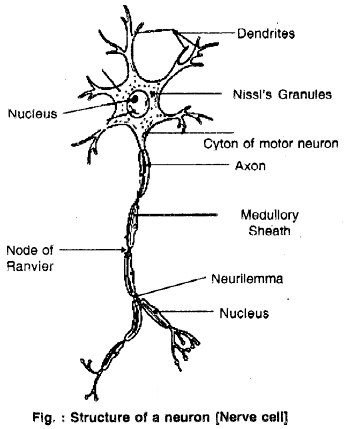
A neuron consists of three parts
(i) Cell body (ii) Dendrites (iii) Axon
(i) Cell body: The cell body of a neuron is also called cyton/ soma. It has cytoplasm called neuroplasm, it has mitochondria, Golgiapparatus, neurofibrils, neurotubules, special granules called nissl’s gramules. It concerns with metabolic maintenance and growth.
(ii) Dendrites (Singular dendron): These are several short, tapering much branched protoplasmic processes stretching out from the cell body of a neuron. The conduct nerve impulses towards the cell body.
(iii) Axon: It is a single, very long, cylindrical protoplasmic process (nerve fibre) of uniform diameter arising from the cell body The cell membrane of the axon is called axotemma and its cytoplasm is termed axoplasm. Neurons transmit messages in the form of nerve impulses.
Special properties of Neurons.
- They do not divide.
- From shortly after birth, new neurons do not develop
- They are not repaired when injured
- They are only glucose as a respiratory substrate
- They die of deprived of oxygen for over five minutes
Q6. How does phototropism occur in plants?
Answer: It is directional growth movement of curvature which occurs in response to unidirectional exposure to light. The region of photoperception is sho.ot apex while the region of response is in the area of elongation. The light effective in phototropic response is blue light. The photoreceptor is a flavoprotein called phototropin. Leaves are essential for producing the response.
Stems generally bend towards the direction of light. They are positively phototropic. Leaves generally come to lie at right angles to light. They are diaphototropic. Roots are either neutral (non-phototropic) or negatively phototropic. Positively phototropic heads of Sunflower perform solar tracking as they move from east to west along the direction of sun.
Phototropic movement is generally caused by increased auxin on the dark side and lesser auxin on the illuminated side. It causes more growth on the dark side of stem causing it to bend towards the source of light. The opposite happens in root where less auxin stimulates growth while higher auxin inhibits growth.
In the plant growing in the open, sunlight is received from above. Auxin diffuses equally on all sides so that the stem does not bend but grows straight vertically.
Q7. Which signals will get disrupted in case of a spinal cord injury?
Answer: (i) All the involuntary actions will get disturbed.
(ii) Reflex actions will be disturbed because reflexes are located in the spinal cord. Therefore, the quick responses required to safe guard the body will not take place.
Q8. How does chemical coordination occur in plants?
Answer: Plant hormones play a very important role in chemical coordination. Most of the plant hormones stimulate growth in certain parts of the plant. For example, hormones auxin and gibberellins stimulate growth. However, hormone abscisic acid inhibits the growth of the plant.
Q9. What is the need for a system of control and coordination in an organism?
Answer: There are various organs in an organism. These organs must be carefully controlled and coordinated for the survival of an organisms. In the body of an organism various fluids are secreted from the glands of the endocrine system. These hormones are responsible for the overall growth and development of an organism. All others daily decision that includes voluntary and involuntary action are controlled by central nervous system (CNS).
Coordination is needed for all human activities we perform. Our nervous system receives information from surroundings which is processed and response is ilicited. The endocrine system (hormonal system) helps in integrating various metabolic activities like reproduction, development, and all reflex actions (cope up with various give up situations).
The hormonal system in plants helps in process of photosynthesis; they need carbon dioxide, water and sunlight. The stomatal opening in leaves opens up to allow in carbon dioxide gas, the roots bend towards water and the stem grows towards sunlight, the tendrils in climbing pants are supported by the hormonal system of the plant body.
Thus, we need of control and coordination system in an organisms.
Q10. How are involuntary actions and reflex actions different from each other?
Answer: Involuntary actions are beyond our ability to control. We can’t control the movement of food in the alimentary canal, for example. These actions, on the other hand, are directly controlled by the brain. On the other hand, reflex behaviours such as pulling back the hand when it comes into contact with a hot object are instantaneous and do not require any thought.
This implies that, unlike involuntary activities, reflex actions are not controlled by the brain. Involuntary actions like heartbeat and peristalsis cannot be conditioned, whereas reflex actions may. It’s feasible to conclude that involuntary acts are all reflex actions, however not all involuntary actions are reflex actions.
Q11. Compare and contrast nervous and hormonal mechanisms for control and coordination in animals.
Answer: Difference between nervous and hormonal mechanism:
| Nervous system | Hormonal system |
| 1. Made up of neurons (nerve cell). 2. Messages transmitted in the form of electrical impulses. 3. Messages transmitted along nerve fibre. 4. Effect of message usually lasts for a very short while. 5. Messages travel very quickly. | 1. Made of secretory cells (glands). 2. Messages transmitted in the form of chemicals called hormones. 3. Messages transmitted along blood stream. 4. Effect of message usually lasts longer. 5. Messages travel more slowly. |
Q12. What is the difference between the manner in which movement takes place in a sensitive plant and the movement in our legs?
Answer: Seismonastic movements : Such movement occur in response to touch (shock). Seismonastic movement are best see in ‘touch me not’ plant (Mimosa-pundica). It is also called ‘lajwanti’ or Chhuimui plant. It we touch the leaves of mimosa plant with our finger, we find that all its leaves fold up and droop. After sometimes the leaves will remian their original status.
Relflexs travels in the following sequence:
Stimulus → Receptor organs → Sensory nerve → Spinal cord → Motor nerve → effector organ → Response to stimulus
We Think the given NCERT Solutions for class 10 Science Chapter 7 Control and Coordination with Answers Pdf free download will assist you. If you’ve got any queries regarding CBSE Class 10 Science Control and Coordination NCERT Solutions with Answers, drop a comment below and that we will come back to you soons.