
We have Provided the NCERT/CBSE Solutions chapter-wise for Class 10 Science Chapter 13 Magnetic Effects of Electric Current with Answers by expert subject teacher for latest syllabus and examination. Students can take a free NCERT Solutions of Magnetic Effects of Electric Current. Each question has right answer Solved by Expert Teacher.
CBSE Solutions Class 10 Science Magnetic Effects of Electric Current
Page No. 224
QUESTION
Q1. Why does a compass needle get deflected when brought neara bar magnet?
Answer: The needle of a compass is a small magnet. That’s why when a compass needle is brought near a bar magnet, its magnetic field lines interact with that of the bar magnet. Hence, a compass needle gets deflected
Page No. 227
QUESTIONS
Q1. Draw magnetic field lines around a bar magnet.
Answer:
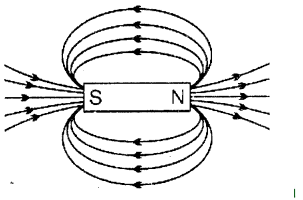
Q2. List the properties of magnetic field lines.
Answer:
- Magnetic field lines are closed continuous curves.
- The tangent at any point on the magnetic field line gives the direction of the magnetic field at that point.
- No two magnetic field lines can cross each other.
- Magnetic field lines are crowded in a region of strong magnetic field and magnetic field lines diverge in a region of weak magnetic field.
Q3. Why don’t two magnetic field lines intersect each other?
Answer: This is due to the fact that the resultant force on a north pole at any point can be only in one direction. But if the two magnetic field lines intersect one another, then the resultant force on north pole placed at the point of intersection will be along two directions, which is not possible.
Page No. 229
QUESTIONS
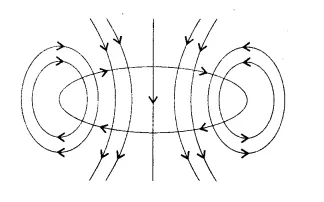
Q1. Consider a circular loop of wire lying in the plane of the table. Let the current pass through the loop clockwise. Apply the right-hand rule to find out the direction of the magnetic field inside and outside the loop.
Answer: (a) Direction of magnetic field inside the loop is perpendicular to the plane of the paper inward (anticlockwise).
(b) Direction of magnetic field outside the loop is perpendicular to the plane of the paper outward (clockwise).
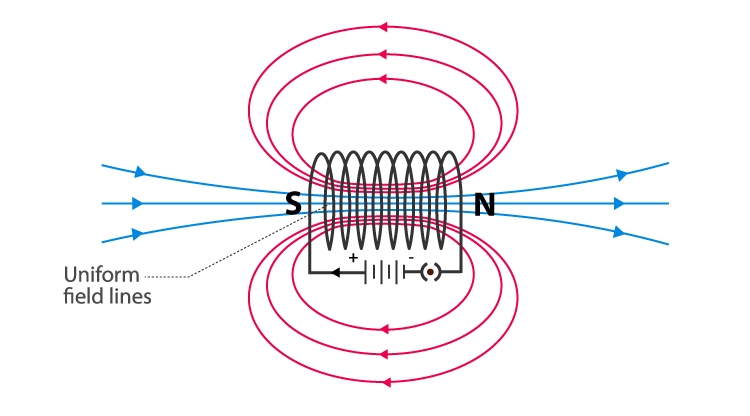
Q2. The magnetic field in a given region is uniform. Draw a diagram to represent it.
Answer:
Q3. Choose the correct option.
The magnetic field inside a long straight solenoid-carrying current
(a) is zero
(b) decreases as we move towards its end
(c) increases as we move towards its end
(d) is the same at all points
Answer: (d) is the same at all points
Page No. 231
Q1. Which of the following property of a proton can change while it moves freely in a magnetic field? (There may be more than one correct answer.)
(a) mass
(b) speed
(c) velocity
(d) momentum
Answer: (c) velocity and (d) momentum
Q2. In Activity 13.7 (page: 230), how do we think the displacement of rod AB will be affected if (i) current in rod AB is increased: (ii) a stronger horse-shoe magnet is used: and (iii) length of the rod AB is increased?
Answer: We know that in a magnetic field, a current-carrying conductor would experience a force. The magnitude of this force would increase with the amount of current, the magnetic field strength and the length of the conductor. So, the magnetic force exerted on rod AB and its deflection would increase if:
(i) current in rod AB is increased
(ii) a stronger horse-shoe magnet is used
(iii) length of rod AB is increased
Q3. A positively-charged particle (alpha-particle) projected towards west is deflected towards north by a magnetic field. The direction of magnetic field is
(a) towards south
(b) towards east
(c) downward
(d) upward
Answer: (d) upward
Page No. 223
QUESTIONS
Q1. State Fleming’s left-hand rule.
Answer: Fleming’s left hand rule states that if we arrange the thumb, the centre finger, and the forefinger of the left hand at right angles to each other, then the thumb points towards the direction of the magnetic force, the centre finger gives the direction of current, and the forefinger points in the direction of magnetic field.
Q2. What is the principle of an electric motor?
Answer: It is based on the principle that when a rectangular coil is placed in a magnetic field and a current is passed through it, a torque acts on the coil which rotates it continuously.
Q3. What is the role of the split ring in an electric motor?
Answer: The split-ring in an electric motor reverses the direction of current in the armature coil of the motor. Therefore, the direction of the force acting on the two arms of the coil is also reversed. As a result of this, the coil of d.c. motor continues to rotate in the same direction.
Page No. 236
Q1. Explain different ways to induce current in a coil
Answer: Different ways to induce current in a coil are :
- moving a magnet towards or away from the coil or vice-versa, and
- changing current in the neighbouring coil.
Page No. 237
QUESTIONS
Q1. State the principle of an electric generator.
Answer: It is based on the principle of electromagnetic induction in which a changing magnetic field in a conductor induces a current in it.
Q2. Name some sources of direct current.
Answer: DC generator and cell are some sources of direct current.
Q3. Which sources produce alternating current?
Answer: Power plants and AC generators are some of the sources that produce alternating current
Q4. Choose the correct option.
A rectangular coil of copper wires is rotated in a magnetic field. The direction of the induced current changes once in each
(a) two revolutions
(b) one revolution
(c) half revolution
(d) one-fourth revolution
Answer: (c) half revolution
Page No. 238
Q1. Name two safety measures commonly used in electric circuits and appliances.
Answer:Following safety measures should be followed while using electricity :
- Wires carrying electricity should not be touched bare footed.
- While working with electricity, one must wear gloves made up of insulated material and rubber sole shoes.
- The insulation of the wire must be checked periodically.
- The electrical appliances must be earthed.
- The electric circuits should be switched off during lighting.
- An electric fuse is a very safety device. Electric fuse of proper rating should be used to stop the flow of excess electric current and to solve save the electrical appliances.
- For avoiding overloading, many appliances should not be connected at a time in the circuit.
Q2. An electric oven of 2 kW is operated in a domestic electric circuit (220 V) that has a current rating of 5 A. What result do you expect? Explain.
Answer: Current drawn by the electric oven can be obtained by the expression,
P = VI
Where,
Current = I
Power of the oven, P = 2 kW = 2000 W
Voltage supplied, V = 220 V
I = 2000/220 V = 9.09 A
Hence, the current drawn by the electric oven is 9.09 A, which exceeds the safe limit of the circuit. Fuse element of the electric fuse will melt and break the circuit.
Q3. What precaution should be taken to avoid the overloading of domestic electric circuits?
Answer: A fuse in a circuit is used to avoid overloading. Overloading can occur when the live wire and neutral wire come into direct contact. In such a situation, the current in the circuit abruptly increases. The use of an electric fuse prevents the electric circuit and the appliance from a possible damage by stopping the flow of unduly high electric current.
Page No. 240
Exercise
Q1. Which of the following correctly describes the magnetic field near a long straight wire?
(a) The field consists of straight lines perpendicular to the wire
(b) The field consists of straight lines parallel to the wire
(c) The field consists of radial lines originating from the wire
(d) The field consists of concentric circles centred on the wire
(d) The field consists of concentric circles centred on the wire
Q2. The phenomenon of electromagnetic induction is
(a) the process of charging a body
(b) the process of generating magnetic field due to a current passing through a coil
(c) producing induced current in a coil due to relative motion between a magnet and the coil
(d) the process of rotating a coil of an electric motor
(c) producing induced current in a coil due to relative motion between a magnet and the coil
Q3. The device used for producing electric current is called a
(a) generator
(b) galvanometer
(c) ammeter
(d) motor
(a) generator
Q4. The essential difference between an AC generator and a DC generator is that
(a) AC generator has an electromagnet while a DC generator has permanent magnet.
(b) DC generator will generate a higher voltage.
(c) AC generator will generate a higher voltage.
(d) AC generator has slip rings while the DC generator has a commutator.
(d) AC generator has slip rings while the DC generator has a commutator.
Q5. At the time of short circuit, the current in the circuit
(a) reduces substantially
(b) does not change
(c) increases heavily
(d) vary continuously
(c) increases heavily
Q6. State whether the following statements are true or false.
(a) An electric motor converts mechanical energy into electrical energy.
(b) An electric generator works on the principle of electromagnetic induction.
(c) The field at the centre of a long circular coil carrying current will be parallel straight lines.
(d) A wire with a green insulation is usually the live wire of an electric supply.
Answer:
(a) False
(b) True
(c) True
(d) False
Q7. List three sources of magnetic fields.
Answer:
- a permanent magnet
- a current carrying conductor
- a current carrying solenoid.
Q8. How does a solenoid behave like a magnet? Can you determine the north and south poles of a current-carrying solenoid with the help of a bar magnet? Explain.
Answer: A solenoid behaves like a magnet in the following ways
- The magnetic field produced by a current carrying solenoid is very much similar to that of a bar magnet.
- Like a bar magnet, one end of the solenoid has N-polarity while the other end has S-polarity.
To determine the north and south poles, we bring N-pole of the bar magnet near one end of the solenoid. If there is an attraction, then that end of the solenoid has south polarity and the other has north polarity. If there is a repulsion, then that end of the solenoid has north polarity and the other end has south polarity because similar poles repel each other.
Q9. When is the force experienced by a current-carrying conductor placed in a magnetic field largest?
Answer: When the current-carrying conductor and magnetic field both are perpendicular to each other, the force experienced is largest.
Q10. Imagine that you are sitting in a chamber with your back to one wall. An electron beam, moving horizontally from back wall towards the front wall, is deflected by a strong magnetic field to your right side. What is the direction of magnetic field?
Answer: The direction of the magnetic field can be determined using the Fleming’s Left hand rule. The direction of the magnetic field will be perpendicular to the direction of current and the direction of deflection, i.e., either upward or downward. The direction of the current is from the front wall to the back wall because negatively charged electrons move from the back wall to the front wall. The directed of the magnetic force is rightward. Hence, using Fleming’s left hand rule it can be concluded that the direction of the magnetic field inside the chamber is downward.
Q11. Draw a labelled diagram of an electric motor. Explain its principle and working. What is the function of a split ring in an electric motor?
Answer:
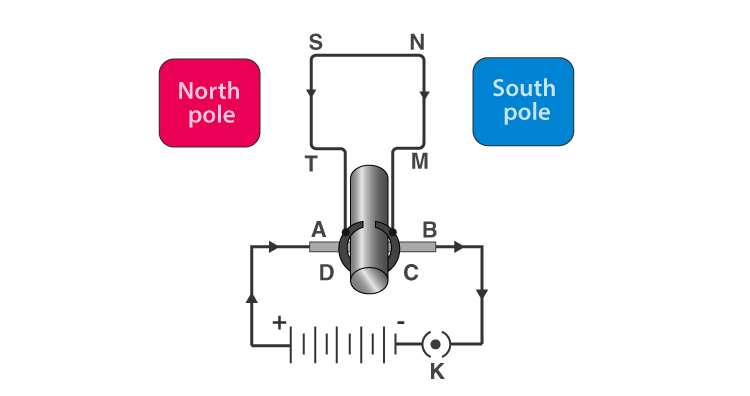
When current is made to flow through the coil MNST by closing the switch, the coil starts to rotate in the anticlockwise direction. This is due to the downward force acting on the length MN and simultaneously an upward force acting along the length ST. As a result of which the coil rotates in the anticlockwise direction. Current in the length MN flows from M to N and the magnetic fields act from left to right normal to the length MN. According to Fleming’s Left Hand rule, a downward force acts along the length MN.
Similarly the current along the length ST flows from S to T and the magnetic field acts from left to right. Therefore, an upward force acts along the length ST. These two forces together cause the coil to rotate anti-clockwise. After half a rotation, the position of MN and ST interchange. The half ring C come in contact with brush B and the half ring D comes in contact with rush C. Hence the direction of current in the coil MNST gets reversed.
Q12. Name some devices in which electric motors are used?
Answer: Some devices in which electric motors are Water pumps, Electric fans, Electric mixers and Washing machines.
Q13. A coil of insulated copper wire is connected to a galvanometer. What will happen if a bar magnet is (i) pushed into the coil, (ii) withdrawn from inside the coil, (iii) held stationary inside the coil?
Answer: (i) We will see a deflection in the galvanometer.
(ii) The needle of galvanometer again shows deflection, but in The opposite direction.
(iii) No deflection in the galvanometer.
Q14. Two circular coils A and B are placed closed to each other. If the current in the coil A is changed, will some current be induced in the coil B? Give reason.
Answer: When current in coil A is changed, a changing magnetic field is set up around it. This changing magnetic field also links with coil B and hence some current will be induced in coil B due to electromagnetic induction.
Q15. State the rule to determine the direction of a (i) magnetic field produced around a straight conductor-carrying current, (ii) force experienced by a current-carrying straight conductor placed in a magnetic field which is perpendicular to it, and (iii) current induced in a coil due to its rotation in a magnetic field.
Answer: (i) Right hand thumb rule : If the current carrying conductor is held in the right hand such that the thumb points in the direction of the current, then the direction of the curl of the fingers will give the direction of the magnetic field.
(ii) Fleming’s left hand rule : NCERT Solutions for Class 10 Science Chapter 13 Magnetic Effects of Electric Current Stretch the forefinger, the central finger and the thumb of the left hand mutually perpendicular to each other. If the forefinger points in the direction of the magnetic field, the middle finger in the direction of current, then the thumb points in the direction of force in the conductor.
(iii) Fleming’s right hand rule : Stretch the thumb, forefinger and the central finger of the right hand mutually perpendicular to each other. If the forefinger points in the direction of magnetic field, thumb in the direction of motion of the conductor, then the middle finger points in the direction of current induced in the conductor.
Q16. Explain the underlying principle and working of an electric generator by drawing a labelled diagram. What is the function of brushes?
Answer: Earth wire is used as a safety measure to prevent electric shocks in case of leakage of current to the metallic body of appliances. Earthing is essential because the person touching defective appliance (where the live wire comes in contact with the metal body due to break of Insulation or otherwise) does not get a fatal shock and the appliance is saved from being damaged.
Q17. When does an electric short circuit occur?
Answer: Listed below are two instances of when a short-circuit can occur:
1) When too many appliances are connected to a single socket or when high power rating appliances are connected to a light circuit, the resistance of the circuit becomes low as a result the current flowing through the circuit becomes very high. This condition results in a short-circuit.
2) When live wires whose insulation have worn off come in contact with each other, the current flowing in the circuit increases abruptly which results in a short circuit.
Q18. What is the function of an earth wire? Why is it necessary to earth metallic appliances?
Answer: sing an earth wire, the metallic body of electric appliances could be connected to the earth so that any electric current leakage is transferred to the ground. This would prevent any electric shock to the user. Therefore, earthing of electrical appliances is very necessary.
We Think the given NCERT Solutions for class 10 Science Chapter 13 Magnetic Effects of Electric Current with Answers Pdf free download will assist you. If you’ve got any queries regarding CBSE Class 10 Science Magnetic Effects of Electric Current NCERT Solutions with Answers, drop a comment below and that we will come back to you soons.