
We have completed the NCERT/CBSE Solutions chapter-wise for Class 12 Sociology Chapter 3 Social Institutions: Continuity and Change with Answers by expert subject teacher for latest syllabus and examination. Prepare effectively for the exam taking the help of the Class 12 Sociology NCERT Solutions PDF free of cost from here. Students also can take a free NCERT Solutions of Social Institutions: Continuity and Change. Each question has right answer Solved by Expert Teacher. Download the Sociology NCERT Solutions with Answers for Class 12 Sociology Pdf and prepare to help students understand the concept very well.
NCERT Solutions for Class 12 Sociology Chapter wise
Q1. What is the role of the ideas of separation and hierarchy in the caste system?
Answer: Theoretically, the caste system can be understood as the combination of two sets of principles, one based on difference and separation and the other on wholism and hierarchy.
Each caste is different and strictly separated from every other caste on the basis of restrictions. These restrictions are related to marriage, food sharing and social interaction to occupation.
Different and separated castes do not have an individual existence. They exist in relation to a larger whole. This societal whole or system is a hierarchical rather than egalitarian system. Each individual caste follows an ordered rank-a particular position in a ladder like arrangement going from highest to lowest.
The hierarchical ordering of castes is based on the distinction between purity and pollution. Castes that are considered ritually pure have high status, while those considered less pure or impure have low status.
This idea of separation and hierarchy has inculcated discrimination, inequality and prejudices in Indian society.
Q2. What are some of the rules that the caste system imposes?
Answer: The most commonly cited rules that the caste system has imposed are as follows:
- Caste is determined by birth-a child inherits the “bom information” the caste of its parents. One can never change one’s caste, leave it, or choose not to join it. Caste is never a matter of choice.
- Membership in a caste involves strict rules about marriage. Caste groups are “endogamous” i.e. marriage is restricted to members of the group.
- Members of a particular caste have to follow rules about food and food sharing.
- An individual bom into a caste could only practice the occupation associated with that caste, so that occupations were hereditary.
- Caste involves hierarchy of rank and status. Every person has a caste. Every caste has a caste. Every caste has a specified place in the hierarchy of all castes.
- Castes involve sub-division within themselves. Sometimes sub-castes may also have sub-caste i.e. segmental organisation
Q3. What changes did colonialism bring about in the caste system?
Answer: Caste system worked with full strength in Indian society till the arrival of the British or even after sometime of establishment of the British empire. But once the British strengthened their position in India, they started to bring certain changes in Indian society and caste system was greatly affected by this. In this way colonisation brought the following changes in the caste system.
(i) Changes came due to western education. The British started establishing western education system in India by which all the children were given same and equal education without any discrimination. With western education, people came to know about their rights which led to the decline of caste system. Education was made open for women and lower castes because of which the main feature of caste system, of not giving education to them, came to an end.
(ii) Doing surveys. The colonial rulers brought many changes in India and all these changes were brought down deliberately. Firstly, they tried to understand the complex system of castes so that adminstration could be run smoothly. That is why they carried out detailed surveys about customs and traditions of different castes and tribes. Reports were made and on the basis of these reports, they started to bring changes in society. It again led to changes in caste system.
(iii) Social welfare. Modern educated Indians started to bring reforms in Indian society and their main objective was to eliminate the evils from the society. All the social reformers took certain steps against caste system. Welfare works were done for lower castes, inter-caste marriages were encouraged, widow marriage and elimination of child marriage got legal sanction. It reduced the complexity of caste system.
Q4. In what sense has caste become relatively ‘invisible’ for the urban upper castes?
Answer:
- In the contemporary period, caste has tended to become ‘invisible’ for the upper caste, urban middle and upper classes.
- For these groups, who have benefited the most from the developmental policies of the post-colonial era, caste has appeared to decline in significance precisely because it has done its job so well.
- Their caste status had been crucial in ensuring that these groups had the necessary economic and educational resources to take full advantage of the opportunities offered by rapid development.
- In particular, the upper caste elite were able to benefit from subsidised public education, specially professional education in science, technology, medicine and management.
- They were also able to take advantage of the expansion of state sector jobs in the early decades after independence. In this initial period, their lead over the rest of society (in terms of education) ensured that they did not face any serious competition.
- As their privileged status got consolidated in the second and third generations, these groups began to believe that their advancement had little to do with caste. Certainly for the third generations from these groups their economic and educational capital alone is quite sufficient to ensure that they will continue to get the best in terms of life chances.
- However, a further complication is introduced by the fact that this is a differentiated group. Although the privileged as a group are overwhelmingly upper caste, not all upper caste people are privileged, some being poor.
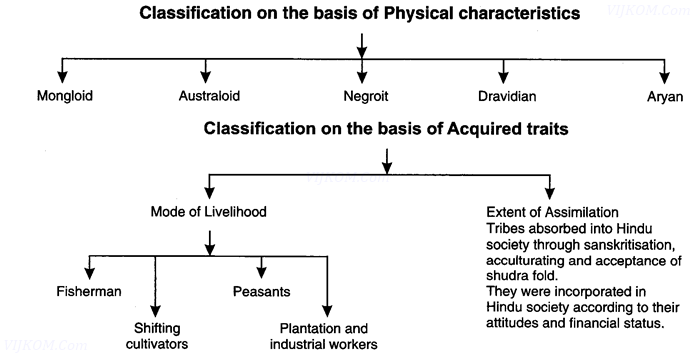
Q5. How have tribes been classified in India?
Answer: Tribes have been classified in terms of their their permanent and acquired traits.
Permanent traits
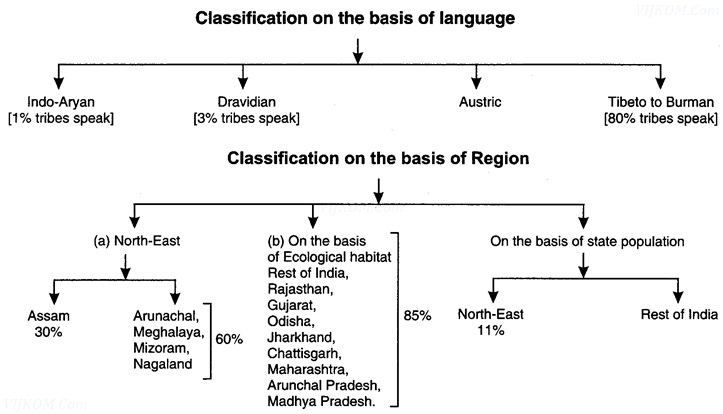
Classification on the basis of size:
In terms of size, tribals range between seven million to less than 100 person (In Andaman Nicobar Islands). The biggest tribes are the Gonds, Bhils, Santhals, Oraons, Minas, Bodos, and Mundas each at least a million people. The tribals in India shared 8.2% of total population i.e. 85 million people according to 2001 cen
Q6. What evidence would you offer against the view that ‘tribes are primitive communities living isolated lives untouched by civilisation?’
Answer: There is no reason to believe that tribes are out of contact with the rest of world or have always been the oppressed section of the society. This can be said because of the following reasons:
- Gond Kingdoms in central India such as that of Garha Mandla or Chanda.
- Many of the Rajput Kingdoms of central and western India emerged through a process of stratification among adivasi communities themselves.
- Adivasi often exercised dominance over the plains people through their capacity to raid them and through their services as local militias.
- They also occupied a special trade niche, trading forest produce, salts and elephants.
Evidences substantiating tribes as primitive communities:
- Tribes have not a state or political form of the normal kind.
- They have no written rules on religion.
- They are neither Hindus nor peasants.
- Primarily they are engaged in activities like food gathering, fishing, hunting, agriculture etc.
- The habitat of tribes is in dense forests and mountainous regions.
Q7. What are the factors behind the assertion of tribal identities today?
Answer: These days the request of maintaining the concept of tribal identity is increasing day-by-day. One of its reasons may be the gradual emergence of an educated middle class among tribal communities. Most visible in the North-eastern states, this is now a segment beginning to be seen in the rest of the country as well, particularly among members of the larger tribal communities. In conjunction with policies of reservation, education is creating an urbanised professional class. As tribal societies get more differentiated i.e. develop class and other divisions within themselves, different bases are growing for the assertion of tribal indentity.
Q8. What are some of the different forms that the family can take?
Answer: Family is a very important social institution. In either form i.e. nuclear or extended, it has post to perform. Lately, a lot of changes have come about in the structure for example, those people employed in the software industry have odd working to this, grandparents have shifted in as caregivers to young. A family could be headed by a male or female; descent could be traced from the mother or the father. This structure and composition of the family is based on various factors such as economy, polity, culture and education.
The changes in the structure of family that we see today could be
(i) Same sex marriage
(ii) Love marriage
But history and contemporary times suggest that such changes are met with violent reactions.
Nuclear Family: It consists of one set of parents and their children.
Extended Family: It consisted of more than one couple and, often, more than two generations live together. The extended family is symptomatic of India.
Diverse forms of family
(i) Matrilocal-patrilocal (based on residence)
(ii) Matrilineal and patrilineal (based on rules of inheritance)
(iii) Matriarchal and patriarchal (based on authority)
Q9. In what ways can changes in social structure lead to changes in the family structure?
Answer: The structure of family can be seen as social institution and also in its relationship to other social institution of society.
- The internal structure of the family is usually related to other structure of society i.e. political, economic, cultural, etc. Therefore any significant change in behaviour pattern of members of family may change the nature of society for example working schedules of young parents in the software industry in India may lead to increasing number of grandparents moving in as caregivers to the young grand children.
- The composition of the family and its structure thereby changes. And these changes can be understood in relation to other changes in society.
- The family (the private sphere) is linked to the economic, political, cultural and educational (the public) spheres.
- Sometimes the changes in the families and corresponding changes in the society occur accidently e.g. due to war or riots people migrate in search of work or for security reasons.
- Sometimes these changes are purposefully brought about, e.g. due to independence and openness of ideas, people choosing their jobs, life partner and life style and such changes are very frequent in the Indian society.
Q10. Explain the difference between matriliny and matriarchy.
Answer: Studies have shown that different types of families are found in different societies. From the point of view of residence, some societies are matrilocal and some are patrilocal. In matrilocal family, the newly married couple lives with the woman’s parents whereas in patrilocal family, the couple stays with the man’s parents.
From the point of view of inheritance, in matrilineal society, property passes on from the mother to daughter and in patrilineal society, property passes on from father to son. In patriarchal family, the men exercise authority and dominance and in matriarchal family, women play a similar dominant role. But matriarchy unlike patriarchy has been a theoretical instead of an empirical concept.
No historical or anthropological evidence of matriarchy has been found where women exercise dominance. But, there do exist matrilineal societies where women inherit property from their mothers but do not exercise control over it, nor are they decision makers in public affairs.
We Think the given NCERT Solutions for class 12 Sociology book Chapter 3 Social Institutions: Continuity and Change with Answers Pdf free download will assist you. If you’ve got any queries regarding CBSE Class 12 Sociology Social Institutions: Continuity and Change NCERT Solutions with Answers, drop a comment below and that we will come back to you soons.