
We have completed the NCERT/CBSE Solutions chapter-wise for Class 12 Sociology Chapter 2 The Demographic Structure of the Indian Society with Answers by expert subject teacher for latest syllabus and examination. Prepare effectively for the exam taking the help of the Class 12 Sociology NCERT Solutions PDF free of cost from here. Students also can take a free NCERT Solutions of The Demographic Structure of the Indian Society. Each question has right answer Solved by Expert Teacher. Download the Sociology NCERT Solutions with Answers for Class 12 Sociology Pdf and prepare to help students understand the concept very well.
NCERT Solutions for Class 12 Sociology Chapter wise
Q1. Explain the basic argument of the theory of the demographic transition. Why is the transition period associated with a ‘population explosion’?
Answer: Theory of demographic transition suggests that population growth in linked to overall levels of economic development and that every society follows a typical pattern of development related population growth.
There are three basic phases of population growth:
Stage I: Primitive Stage [Underdeveloped countries]
- Low population growth in a society that is underdeveloped and technologically backward.
- In such societies like Africa birth rate is high since people are unaware of the advantages of having small families, they are not educated.
- Death rate is also high since health and medical facilities are not available, therefore population is low.
Stage II: [Developing countries]. The birth rate and death rate rank very high, the net growth rate remains low.
Birth rate is high as in this society people live in a patriarchal society in which men decide how many children must be bom and male child is preferred. People are illiterate and ignorant.
Death rate is also high since health and medical facilities are not available.
Stage III: [Developed countries]. Birth rate in low because people are educated and aware and use contraceptives, birth control is popularised. Death rate is also low because of availability of health and medical facilities, therefore population is low.
Transitional Stage: The stage between backwardness and skilled people]: In this stage growth rate of population is very high whereas death rates are brought down due to better medical facilities, nutrition and better medical and technological advancement therefore this transition period is associated with a population explosion.
Q2. Why did Malthus believe that catastrophic events like famines and epidemics that cause mass deaths were inevitable?
Answer: Malthus believes that agricultural production increases in directly proportional while population rises in inversely proportional or geometric progressive pace hence, population control is only measure to attain prosperity.
Human Beings are generally find them unable to are positive checks or natural procces of population control that maintain the balance between availability of food and its consumers. In brief, he refers positive checks as famines and diseases. These checks increase the death rate and thus, remove imbalance between food supply and increasing population.
Q3. What is meant by ‘birth rate’ and ‘death rate’? Explain why the birth rate in relatively slow to fall while the death rate declines much faster.
Answer: Birth rate and death rate are fundamental concepts in Demography.
Birth rate: The birth rate is the total number of live births in a particular area (an entire country, a state, a district or other territorial unit) during a specified period (usually a year) divided by the total population of that area in thousands.
Death rate: It is the number of deaths per thousands persons in a year in a particular area, which can be the entire country, a state or any other territorial unit during a specified period.
Causes of slow birth rate:
Birth rate is relatively slow while the death rate can be brought down at much faster rate because the birth rate is a socio-cultural phenomenon that is relatively slow to change. By and large, increased levels of prosperity exert a strong downward pull on the birthrate.
On the other hand, death rate has been controlled by public health measures and medical advancement can control the death rate immediately.
Q4. Which states in India have reached or are very near the ‘replacement levels’ of population growth? Which ones still have very high rates of population growth? In your opinion, what could be some of the reasons for these regional differences?
Answer: States at the replacement levels of population growth in India are—Kerala, Tamil Nadu, Tripura, Manipur, Nagaland, Jammu and Kashmir, Punjab and Goa.
The states still have very high rates of population growth are—Rajasthan, Uttar Pradesh, Bihar and Madhya Pradesh.
By Replacement level, we mean giving birth to two children that replace the couple viz. Husband and wife. Kerala’s total fertility rate is actually below the replacement level, i.e. 1.8 children per couple. It means that the population is going to decline in future.
The states very near the replacement levels of population growth are Himachal Pradesh, Uttaranchal, Maharashtra, Karnataka, Andhra Pradesh, west Bengal, Arunachal Pradesh and Mizoram.
Reasons for regional differences
(i) Socio-cultural formation and literacy are different in each state of India. There are people who still lay emphasis on reproduction of more children so that they might jump in the row of majority and secure more political interests in democracy.
(ii) Prejudices and stereotypes are also responsible for regional differences in population growth.
(iii) Lack of understanding national interest and giving preference to individual interests over national interests.
(iv) Lack of sensitivity and intelligence.
(v) Variations in the landforms. For instance, Assam, Arunachal Pradesh etc. being hilly regions, there is seen lower population growth as compared to Uttar Pradesh and Madhya Pradesh.
Q5. What is meant by ‘the age structure’ of the population? Why is it relevant for economic development and growth?
Answer: India has a very young population. The average age of an Indian is less than that for most other countries. Majority of Indians are between the age group of 15 and 64 years.
- Age structure of the population refers to the proportions of persons in different age groups relative to the total population.
- Population under the age of 15 has decreased from 42% in 1971 to 31% in 2011. During this period the ratio of age group 15 to 64 was gone up from 53% to 63.7%.
- Age structure in a country changes with development poor medical facilities, prevalence of disease reduce the life expectancy.
- Age structure of population can be put in following age groups:
0-14 years. [Children]
15-59 years. [Working population]
60 + Years. [Old people]
This age structure of the Indian population can be understood by following table.
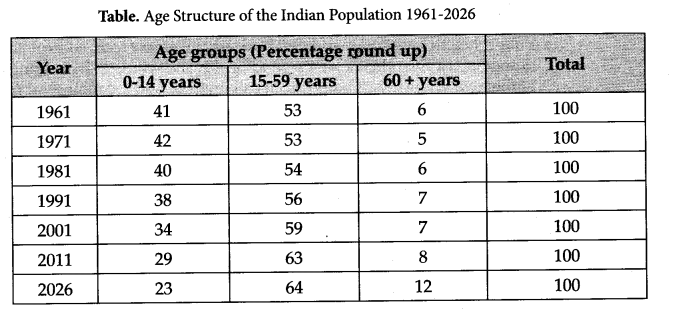
This table indicates that the share of the under 15 age group in the total population has come down from higher level of 42% in 1971 to 34% in 2001 and it is perfected to be reduced to 23% in 2026. It means birth rate in India is gradually decreasing.
Relevance for economic development and growth:
- Due to the advancement in medical sciences, public health measures and nutrition the life expectancy is at rise. This is due to economic development and growth.
- Need of family planning in being understood. Decrease in 0-14 years age group reveals that National population policy is implemented properly.
- Because of socio-cultural changes in Indian society and economic growth Age structure of population is moving towards positive young India.
- Dependency ratio is decreasing and increase in working population is causing positive growth in Indian economy.
- Economic development and improvement in quality of life improve life expectancy and changes the structures of the population.
- High infant mortality rate and material mortality rate due to poor economic growth hence an adverse effect of age structure on the population.
Q6. What is meant by the ‘sex ratio’? What are some of the implications of a declining sex ratio? Do you feel that parents still prefer to have sons rather than daughters? What, in your opinion, could be some of the reasons for this preference?
Answer: Sex ratio refers to the number of females per thousand males in a given area at a specified period of time.
- The sex ratio ratio is an important indicator of gender balance in population.
- Historically there were more females than males in most countries of the world.
This phenomena occurred due to two reasons:
(i) Girl babies enjoy better immune system and resistant to diseases in comparison of male child during the early years of infancy.
(ii) Females live longer than males in most of the societies. - The ratio between female babies and male babies is roughly 1050 female to 1000 male.
- In India sex ratio is declining significantly and continuously for more than a century. From 972 female per thousand males at the turn of 20th century the sex ratio declined to 933 at the turn of 21st century.
- The state level child sex ratio is alarming. As many as 6 states and union territories have a child sex ratio as low child sex ratio of 793. The highest child sex ratio of 986 is found in Sikkim.
Sex ratio seems to be declining in countries like India, China and South Korea.
In India, parents still prefer male child. This is basically due to social and cultural reasons. Being agricultural society the village population preferred male child to look after the land. The reason of preference of male child is definitely not linked with economic reasons. The states like Punjab, Haryana, Delhi, Chandigarh and Maharashtra are most prosperous states of India and should have highest child sex ratio, but things are just different.
The census of 2001 reveals that these are states with the lowest sex ratios i.e., 950 female babies per 1000 male babies. This data is a reliable evidence that selective abortion in these states is not due to poverty, ignorance or lack of resource. Predisposing factors for low child sex ratio in India: - Religious or Cultural Beliefs: Belief that only son is entitled to perform funeral and related rituals of his parents. Only son is the warish of family. In the absence of male child the vansh will not continue.
- Economic Reasons: The main occupation of Indian society is agriculture. Villagers have a thinking that landed property cannot be given to girls because after marriage they will go to another village, town or city. Neither girl child can get her share of load nor she can take care of the land.
- Lack of Awareness: People in Indian society having ignorant conservation attitude are still not ready to give equal status to daughter because they think that during old age they will be dependent on the son. Only he will share food, house, customs and responsibilities.
- Implications of child sex ratio: Low child sex ratio, if continues, will have serious implications on our social network, particularly the Institution of marriage. It will also cause severe law and order problem related to women.
We Think the given NCERT Solutions for class 12 Sociology book Chapter 2 The Demographic Structure of the Indian Society with Answers Pdf free download will assist you. If you’ve got any queries regarding CBSE Class 12 Sociology The Demographic Structure of the Indian Society NCERT Solutions with Answers, drop a comment below and that we will come back to you soons.