
We have completed the NCERT/CBSE Solutions chapter-wise for Class 9 Science Chapter 12 Sound with Answers by expert subject teacher for latest syllabus and examination. Prepare effectively for the exam taking the help of the Class 9 Science NCERT Solutions PDF free of cost from here. Students also can take a free NCERT Solutions of Sound. Each question has right answer Solved by Expert Teacher. Download the Science NCERT Solutions with Answers for Class 9 Science Pdf and prepare to help students understand the concept very well.
NCERT Solutions for Class 9 Science Chapter wise
Page No. 162
Questions
Q1. How does the sound produced by a vibrating object in a medium reach your ear?
Answer: When an object vibrates, it sets the particles of the medium around it vibrating. The particles in the medium in contact with the vibrating object displace from its equilibrium position. It then exerts force on the adjacent particles. After displacing the adjacent particle the first particle of medium comes back in its original position. This process continues in the medium till the sound reaches your ear.
Page No. 163
Q1. Explain how sound is produced by your school bell.
Answer: When the school bell is hit with a hammer, it moves forward and backwards producing compression and rarefaction due to vibrations. This is how sound is produced by the school bell.
Q2. Why are sound waves called mechanical waves?
Answer: Sound waves are characterised by the motion of particles of a medium. Hence sound waves are called mechanical waves.
Q3. Suppose you and your friend are on the moon. Will you be able to hear any sound produced by your friend?
Answer: Sound waves are mechanical waves and hence need a medium to propagate. As the moon is devoid of any atmosphere, we cannot hear any sound on the moon.
Questions
Q1. Which wave property determines (a) loudness, (b) pitch?
Answer: (a) The loudness of a sound depends on its amplitude. If the amplitude of a sound is large, then the sound produced will also be loud.
(b) The pitch of a sound depends on its frequency. A sound will be considered a high pitched sound, if its frequency is high.
Q2. Guess which sound has a higher pitch: guitar or car horn?
Answer: A guitar has a higher pitch than a car horn, provided the guitar is properly tuned.
Questions
Q1. What are wavelength, frequency, time period and amplitude of a sound wave?
Answer: Wavelength: The distance between two consecutive compressions or two consecutive rarefactions is known as the wavelength. Its SI unit is metre (m).
Frequency: The number of complete oscillations per second is known as the frequency of a sound wave. It is measured in hertz (Hz).
Amplitude: The maximum height reached by the crest or trough of a sound wave is called its amplitude.
Q2. How are the wavelength and frequency of a sound wave related to its speed?
Answer: Wavelength, speed, and frequency are related in the following way:
Speed = Wavelength x Frequency
v = λ ν
Q3. Calculate the wavelength of a sound wave whose frequency is 220 Hz and speed is 440 m/s in a given medium.
Answer: Given that,
Frequency of sound wave = 220 Hz.
Speed of sound wave = 440 m/s.
Calculate wavelength.
We know that,
Speed = Wavelength × Frequency
v = λ ν
440 = Wavelength × 220
Wavelength = 440/220
Wavelength = 2
Q4. A person is listening to a tone of 500 Hz sitting at a distance of 450 m from the source of the sound. What is the time interval between successive compressions from the source?
Answer: The time interval between two successive compressions is equal to the time period of the wave. This time period is reciprocal of the frequency of the wave and is given by the relation:T= 1 / Frequency = 1/ 500 = 0.002 s
Questions
Q1. Distinguish between loudness and intensity of sound.
Answer: Intensity of a sound wave is defined as the amount of sound energy passing through a unit area per second. Loudness is a measure of the response of the ear to the sound. The loudness of a sound is defined by its amplitude. The amplitude of a sound decides its intensity, which in turn is perceived by the ear as loudness.
Questions
Q1. In which of the three media, air, water or iron, does sound travel the fastest at a particular temperature?
Answer: Sound travels faster in solids when compared to any other medium. Therefore, at a particular temperature, sound travels fastest in iron and slowest in gas.
Questions
Q1. An echo returned in 3 s. What is the distance of the reflecting surface from the source, given that the speed of sound is 342 m s−1?
Answer: Time taken by sound to travel from the source to the reflecting surface, t = 3/2 = 1.5 s
Speed, v = 342 m s
Distance of reflecting surface from the source, S = vt = 342 x 1.5 = 513 m.
Questions
Q1. Why are the ceilings of concert halls curved?
Answer: Ceilings of concert halls are curved so that the sound waves can spread uniformly in all directions after reflection.
Questions
Q1. What is the audible range of the average human ear?
Answer: The audible range of an average human ear lies between 20 Hz to 20,000 Hz. Humans cannot hear sounds having frequency less than 20 Hz and greater than 20,000 Hz.
Q2. What is the range of frequencies associated with
(a) Infrasound?
(b) Ultrasound?
Answer: (a) Frequencies associated with infra sound : < 20 Hz.
(b) Frequencies associated with ultrasound : > 2 × 10⁴ Hz.
Questions
Q1. A submarine emits a sonar pulse, which returns from an underwater cliff in 1.02 s. If the speed of sound in salt water is 1531 m/s, how far away is the cliff?
Answer: Time taken by the sonar pulse to return, t = 1.02 s
Speed of sound in salt water, v = 1531 m s – 1
Distance of the cliff from the submarine = Speed of sound x Time taken
Distance of the cliff from the submarine = 1.02 x 1531 = 1561.62 m
Distance travelled by the sonar pulse during its transmission and reception in water = 2 x Actual distance = 2d
Actual Distance, d= Distance of the cliff from the submarine/2
= 1561/2
= 780.31 m
Exercise
Q1. What is sound and how is it produced?
Answer: Sound is produced due to vibrations. When a body vibrates, it forces the adjacent particles of the medium to vibrate. This results in a disturbance in the medium, which travels as waves and reaches the ear. Hence, sound is produced.
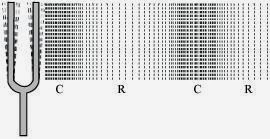
Q2. Describe with the help of a diagram, how compressions and rarefactions are produced in air near a source of sound.
Answer: When a vibrating body moves forward, it createsa region of high pressure in its vicinity. This region of high pressure is known as compressions. When it moves backward, it creates a region of low pressure in its vicinity. This region is known as a rarefaction. As the body continues to move forward and backwards, it produces a series of compressions and rarefactions. This is shown in below figure.
Q3. Cite an experiment to show that sound needs a material medium for its propagation.
Answer: Take an electric bell and hang it inside an empty bell-jar which is fitted with a vacuum pump (as shown in the figure below).
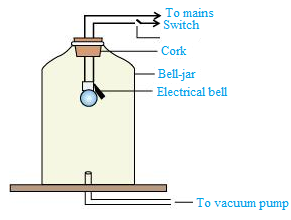
Initially, one can hear the sound of the ringing bell. Now, pump out some air from the bell-jar using the vacuum pump. You will realize that the sound of the ringing bell decreases. If you keep on pumping the air out of the bell-jar, then glass-jar will be devoid of any air after some time. Now try to ring the bell. No sound is heard but you can see bell prong is still vibrating. When there is no air present in the bell jar, a vacuum is produced. Sound cannot travel through vacuum. Therefore, this experiment shows that sound needs a material medium for its propagation.
Q4. Why is sound wave called a longitudinal wave?
Answer: When sound waves travel in medium, the particles of the medium vibrate about their equilibrium positions along the direction of the propagation of the waves.
Q5. Which characteristics of the sound helps you to identify your friend by his voice while sitting with others in a dark room?
Answer: The characteristic of the sound which helps you to identify your friend by his voice while sitting with others in a dark room is the quality or timber of sound which enables us to distinguish one sound from another having the same pitch and loudness.
Q6. Flash and thunder are produced simultaneously. But thunder is heard a few seconds after the flash is seen, why?
Answer: The speed of sound (344 m/s) is less than the speed of light (3 x 10⁸ m/s). Sound of thunder takes more time to reach the Earth as compared to light. Hence, a flash is seen before we hear a thunder.
Q7. A person has a hearing range from 20 Hz to 20 kHz. What are the typical wavelengths of sound waves in air corresponding to these two frequencies? Take the speed of sound in air as 344 m s−1.
Answer: For a sound wave,
Speed = Wavelength x Frequencyv = λ x ν
Speed of sound in air = 344 m/s (Given)
(i) For, ν= 20 Hz
λ1= v/ν = 344/20 = 17.2 m
(ii) For, ν= 20000 Hz
λ2= v/ν = 344/20000 = 0.172 m
Hence, for humans, the wavelength range for hearing is 0.0172 m to 17.2 m.
Q8. Two children are at opposite ends of an aluminium rod. One strikes the end of the rod with a stone. Find the ratio of times taken by the sound wave in air and in aluminium to reach the second child.
Answer: Consider the length of aluminum rod = d
Speed of sound wave at 25° C, V Al = 6420 ms-1
Time taken to reach other end
T Al = d/ (V Al) = d/6420
Speed of sound in air, V air = 346 ms-1
Time taken by sound to each other end,
T air = d/ (V air) = d/346
Therefore, the ratio of time taken by sound in aluminum and air,
T air / t Al = 6420 / 346 = 18.55
Q9. The frequency of a source of sound is 100 Hz. How many times does it vibrate in a minute?
Answer: Frequency of source = 100 Hz.
∴ Number of times the source of sound vibrates in 1 s = 100
∴ Number of times the source vibrates in a minute or 60 s = 100 x 60 = 6000.
Q10. Does sound follow the same laws of reflection as light does? Explain.
Answer: The incident and the reflected sound wave create the same angle at the point of incidence with the normal to the surface. In addition, the sound wave incident, the sound wave reflected, and the normal sound wave to the point of incidence are all in the same plane. Hence, sound follows the same laws of reflection as light does.
Q11. When a sound is reflected from a distant object, an echo is produced. Let the distance between the reflecting surface and the source of sound production remains the same. Do you hear echo sound on a hotter day?
Answer: An echo is heard when the time interval between the original sound and the reflected sound is at least 0.1 s. The speed of sound in a medium increases with an increase in temperature. Hence, on a hotter day, the time interval between the original sound and the reflected sound will decrease. Therefore, an echo can be heard only if the time interval between the original sound and the reflected sound is greater than 0.1 s.
Q12. Give two practical applications of reflection of sound waves.
Answer: Ear Trumpet : It is a sort of machine used by persons who are hard of hearing. The sound energy received by the wide end of the trumpet is connected into a much smaller area at the narrow end by multiple reflections. The narrow end of the trumpet which is inserted in the ear delivers the entire amount of energy falling on the wide end which makes the inaudible sound audible to the user. Stethoscope : It is a medical instrument used frequently by doctors for making a rough diagnosis of the diseases existing inside the body at places which are either inaccessible or accessible only through major operations.
Q13. A stone is dropped from the top of a tower 500 m high into a pond of water at the base of the tower. When is the splash heard at the top? Given, g = 10 m s−2 and speed of sound = 340 m s−1.
Answer: Height of the tower, s = 500 m
Velocity of sound, v = 340 m s−1
Acceleration due to gravity, g = 10 m s−2
Initial velocity of the stone, u = 0 (since the stone is initially at rest)
Time taken by the stone to fall to the base of the tower, t1
According to the second equation of motion:
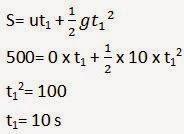
Now, time taken by the sound to reach the top from the base of the tower, t2= 500 / 340 = 1.47 s
Therefore, the splash is heard at the top after time, t
Where, t= t1 + t2 = 10 + 1.47 = 11.47 s.
Q14. A sound wave travels at a speed of 339 m s−1. If its wavelength is 1.5 cm, what is the frequency of the wave? Will it be audible?
Answer: Speed (v) of sound = 339 m s−1
Wavelength (λ) of sound = 1.5 cm = 0.015 m
Speed of sound = Wavelength × Frequency
v = v = λ X v
v = v / λ = 339 / 0.015 = 22600 Hz.
The frequency of audible sound for human beings lies between the ranges of 20 Hz to 20,000 Hz. The frequency of the given sound is more than 20,000 Hz, therefore, it is not audible.
Q15. What is reverberation? How can it be reduced?
Answer: The phenomenon of prolongation of original sound due to the multiple reflection of sound waves even after the source of sound stops producing sound is called reverberation.
Reverberation can be reduced by covering the roof and walls of a hall by sound absorbing materials.
Q16. What is loudness of sound? What factors does it depend on?
Answer: The measure of the response of the ear to the sound is defined as the loudness of sound. The loudness or softness of sound is determined basically by its amplitude which depends upon the force with which an object is made to vibrate. A loud sound has high energy. Loudness depends on the amplitude of vibrations such that loudness is proportional to the square of the amplitude of vibrations.
Q17. Explain how bats use ultrasound to catch a prey.
Answer: Bats produce high-pitched ultrasonic squeaks. These high-pitched squeaks are reflected by objects such as preys and returned to the bat’s ear. This allows a bat to know the distance of his prey.
Q18. How is ultrasound used for cleaning?
Answer: Ultrasound is used to clean parts located in hard-to-reach places, i.e., spiral tube, odd shaped parts, electronic components etc. Objects to be cleaned are placed in a cleaning solution and ultrasonic waves are sent into the solutions. Due to the high frequency, the dust particles, grease get detached and drop out. The objects thus get thoroughly cleaned.
Q19. Explain the working and application of a sonar.
Answer: SONAR is an acronym for Sound Navigation And Ranging. It is an acoustic device used to measure the depth, direction, and speed of under-water objects such as submarines and ship wrecks with the help of ultrasounds. It is also used to measure the depth of seas and oceans.
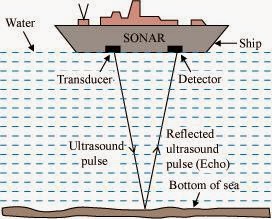
A beam of ultrasonic sound is produced and transmitted by the transducer (it is a device that produces ultrasonic sound) of the SONAR, which travels through sea water. The echo produced by the reflection of this ultrasonic sound is detected and recorded by the detector, which is converted into electrical signals. The distance (d) of the under-water object is calculated from the time (t) taken by the echo to return with speed (v) is given by 2d = v × t. This method of measuring distance is also known as ‘echo-ranging’.
Q20. A sonar device on a submarine sends out a signal and receives an echo 5 s later. Calculate the speed of sound in water if the distance of the object from the submarine is 3625 m.
Answer: Time (t) taken to hear the echo = 5 s
Distance (d) of object from submarine = 3625 m
Total distance travelled by SONAR during reception and transmission in water = 2d
Velocity (v) of sound in water = 2d/t = (2 × 3625) / 5
= 1450 ms-1
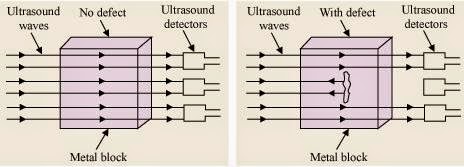
Q21. Explain how defects in a metal block can be detected using ultrasound.
Answer: Metallic components are generally used in construction of big structures like buildings, bridges, machines and also scientific equipment. Ultrasounds are used to detect cracks and flaws in metal blocks.
The cracks or holes inside the metal blocks that are invisible from outside reduce the strength of the structure. Ultrasonic waves are allowed to pass through the metal block and detectors are used to detect the transmitted waves.
If there is even a small defect, the ultrasound gets reflected back. This indicates the presence of the flaw or any defect.
Finding defects using Ultrasound:
Q22. Explain how the human ear works.
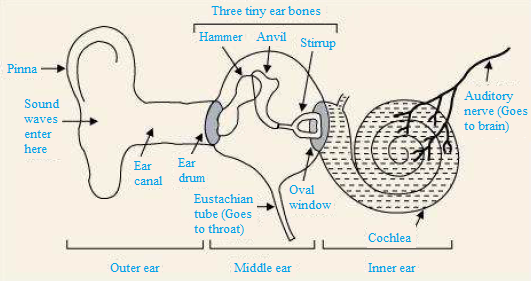
Answer:
Various sounds produced by particles in our surroundings are collected by pinna that transfers these sounds to the ear drum through the ear canal. The eardrum begins to vibrate back and forth briskly as soon as the sound waves fall on it. The vibrating eardrum initiates the small bone hammer to vibrate. These vibrations are passed from the hammer to the third bone stirrup via the second bone anvil. The stirrup strikes the membrane of the oval window to pass its vibration to the cochlea. The liquid in the cochlea produces electrical impulses in the nerve cells. These electrical impulses are carried to the brain by the auditory nerve. They are interpreted by the brain as sound and hence we get a sensation of hearing.
We Think the given NCERT Solutions for class 9 Science book Chapter 12 Sound with Answers Pdf free download will assist you. If you’ve got any queries regarding CBSE Class 9 Science Sound NCERT Solutions with Answers, drop a comment below and that we will come back to you soons.