
We have completed the NCERT/CBSE Solutions chapter-wise for Class 9 Social Science Chapter 4 Climate with Answers by expert subject teacher for latest syllabus and examination. Prepare effectively for the exam taking the help of the Class 9 Social Science NCERT Solutions PDF free of cost from here. Students also can take a free NCERT Solutions of Climate. Each question has right answer Solved by Expert Teacher. Download the Social Science NCERT Solutions with Answers for Class 9 Social Science Pdf and prepare to help students understand the concept very well.
NCERT Solutions for Class 9 Social Science Chapter wise
Page No. 39
Excercise
Q1. Choose the right answer from the four alternatives given below :
(i) Which of the following places receives the highest rainfall ?
(a) Guwahati
(b) Mawsynram
(c) Kolkata
(d) None of these
Answer: (b) Mawsynram
(ii) The wind blowing in the northern plains in summers is known as:
(a) Kaalbaisakhi
(b) Loo
(c) Trade winds
(d) None of the above
Answer: (b) Loo
(iii) Which one of the following causes rainfall during winters in northwestern part of India?
(a) Cyclonic depression
(b) Retreating monsoon
(c) Western disturbances
(d) Southwest monsoon
Answer: (a) Cyclonic depression
(iv) Monsoon arrives in India approximately in:
(a) Early May
(b) Early July
(c) Early June
(d) Early August
Answer: (c) Early June
(v) Which one of the following characterises the cold weather in India?
(a) Warm days and warm nights
(b) Warm days and cold nights
(c) Cool days and cold nights
(d) Cold days and warm nights
Answer: (b) Warm days and cold nights
Q2. Answer the following questions briefly.
(i) What are the factors affecting the climate of India?
Answer: The factors affecting the climate of India are
- Latitude
- Altitude
- Pressure and Winds
(ii) Why does India have a monsoon type of climate?
Answer: India comes in the Inter Tropical Convergence Zone (ITCZ) and together with factors such as El Nino, Coriolis Force and Jet Streams, India gets a unique type of climate which is called the Monsoon type of climate in India.
(iii) Which part of India does experience the highest diurnal range of temperature and why?
Answer:
(iv) Which winds account for rainfall along the Malabar coast?
Answer: The Thar desert experiences the highest diurnal range of temperature. This is because during the day the temperature rises to over 50°C, and at night due to the absence of the sun and lack vegetation the temperature drops to below 15°C the same night.
(v) What are Jet streams and how do they affect the climate of India?
Answer: Jet streams are a narrow belt of high-altitude winds in the troposphere. The sub-tropical westerly jet stream blowing south of the Himalayas are responsible for the western cyclonic disturbances experienced in the north and north-western parts of the country during the winter months. The sub-tropical easterly jet stream blowing over peninsular India is responsible for the tropical cyclones that affect the eastern coastal regions of India during the monsoon as well as during the October to November period.
(vi) Define monsoons. What do you understand by “break” in monsoon?
Answer: Monsoon refers to the seasonal reversal in the wind direction. Monsoon ‘break’ refers to the happening of wet and dry spells during the rainy season. The monsoon rains take place only for a few days at a time.
(vii) Why is the monsoon considered a unifying bond?
Answer: The unifying influence of the monsoon on the Indian subcontinent is quite perceptible. The seasonal alteration of the wind systems and the associated weather conditions provide a rhythmic cycle of seasons. Even the uncertainties of rain and uneven distribution are very much typical of the monsoons. The Indian landscape, it’s animal and plants life, its entire agricultural calendar and the life of the people (including their festivities) revolve around this phenomenon. Year after year, people of India from north to south and from east to west, eagerly await the arrival of the monsoon. These monsoon winds bind the whole country by providing water to set the agricultural activities in motion. The river valleys which carry this water also unite as a single river valley unit.
Q3. Why does the rainfall decrease from the east to the west in Northern India.
Answer: The rainfall in the eastern part of India occurs due to the Bay of Bengal branch of southwest monsoons. As the winds move from Bengal to the Gangetic plains, their moisture content decreases and by the time they reach Punjab region, they are almost dry. So, a decrease is seen in the amount of rainfall from east to west.
Q4. Give reasons as to why :
(i) Seasonal reversal of wind direction takes place over the Indian subcontinent.
Answer: Land and water are of different densities, so the rate of heating and cooling varies. The Indian subcontinent is surrounded by water on three sides. In summer the land mass of India is warmer than the surrounding sea, therefore there is low pressure. The sea is cooler, thereby having higher pressure. So the winds blow from sea to land.
In winter the land has high pressure while the sea has low pressure. Therefore, the winds blow towards the sea. Thus a seasonal reversal of wind direction takes place.
(ii) The bulk of rainfall in India is concentrated over a few months.
Answer: The rainfall received by India is largely due to the south-west monsoon winds. The duration of the monsoon is between 100 to 120 days. Hence, the bulk of rainfall received by the country is concentrated over a few months.
(iii) The Tamil Nadu coast receives winter rainfall.
Answer: The Tami Nadu coast receives winter rainfall because of movement of low-pressure conditions to the Bay of Bengal.
(iv) The delta region of the eastern coast is frequently struck by cyclones.
Answer: The Bay of Bengal is the centre of various pressure changes and hence there is always a chance of development of cyclone. Due to this, the delta region of the eastern coast is frequently struck by cyclones.
(v) Parts of Rajasthan, Gujarat and the leeward side of the Western Ghats are drought-prone.
Answer: Because they fall in the rain shadow region of Aravali Mountains.
Q5. Describe the regional variations in the climatic conditions of India with the help of suitable examples.
Answer: There is a huge regional variation in the climatic conditions of India. The Temperature and Precipitation vary not only from place to place but also from season to season.
- In summers, the temperature goes up to 50°C in certain parts of Rajasthan but it barely crosses 20°C in Pahalgam in Kashmir region.
- In winters, the night temperature in Dras sector of Kashmir is below freezing point around -45°C but in Thiruvananthapuram, Kerala it hardly goes below 20°C.
- In the Andaman and Nicobar Islands, the difference between day and night temperature is barely 7° – 8°C.
- The coastal areas experience less contrast in the temperature, whereas the seasonal contrasts are more in the interior of the country.
- There is a decrease in rainfall generally from east to west in the northern plains.
- Most parts of India get rainfall from June to August – September, whereas the Coromandel Coast gets rainfall in the winter season. Odisha gets rainfall from cyclones too.
Q6. Discuss the mechanism of monsoons.
Answer: The following facts are important to understand the mechanism of the monsoons.
- The difference in the heating and cooling rate of land and water bodies. In summer there is low pressure on the land and high pressure in the sea.
- The shift of the position of the Inter-Tropical Convergence Zone in summer over the Northern Plains (its normal position is about 5°N of the Equator).
- The presence of the high-pressure area, east of Madagascar, affects the Indian Monsoons.
- The intense heating of the Tibetan plateau in summer causing low pressure.
- The movement of the westerly and easterly jet stream over the Indian peninsular during summer.
Q7. Give an account of weather conditions and characteristics of the cold season.
Answer: The Cold Weather Season
Beginning from mid-November, the winter season lasts till February. The weather is usually marked by clear sky, low temperatures and low humidity, and feeble and variable winds. The temperature decreases from the south to the north, with the peninsular region not showing any noticeable seasonal change in temperature pattern due to the moderating influence of the sea. The coldest months are December and January. The days are generally warm and the nights are cold. Frost is common in the north and the higher slopes of the Himalayas experience snowfall.
During this season, the sub-tropical westerly jet streams blowing south of the Himalayas bring in cyclonic disturbances from the Mediterranean region. These cause winter rains over the plains and snowfall in the mountains. The Tamil Nadu coast also receives winter rainfall due to the blowing of the north-east trade winds from sea to land.
Q8. Give the characteristics and effects of the monsoon rainfall in India.
Answer: The characteristics of monsoon rainfall are following:
(i) Most of the rain is received from South West summer monsoons during the period mid-June to mid-September. It is seasonal rainfall.
(ii) Summer rainfall is quite uncertain. Some times monsoons start early resulting in floods. Often the on-set of monsoons is delayed resulting in drought. The early or late retreat of monsoons also result in serious droughts.
(iii) The rainfall is unevenly distributed over the country. About 10% of the country gets more than 200 cms. of rain while 25% of the country gets less than 75 cms. of rain. Summer rain is characterised by breaks or dry spells.
(iv) Indian rainfall is heavy and downpouring type. It is often said, “It pours, it never rains in India.” Most of the areas have variable rainfall, as much as 30 cms. plus or minus. Due to variability in areas of low rain, famines result.
(v) The amount of rainfall is determined by the presence of mountains. High mountains force monsoons to rise and give rain.
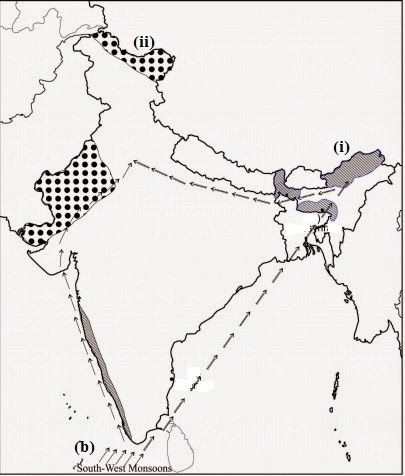
Map Skills
On an outline map of India, show the following.
(i) Areas receiving rainfall over 400 cm.
(ii) Areas receiving less than 20 cm of rainfall.
(iii) The direction of the south-west monsoon over India.
Answer:
We Think the given NCERT Solutions for class 9 Social Science book Chapter 4 Climate with Answers Pdf free download will assist you. If you’ve got any queries regarding CBSE Class 9 Social Science Climate NCERT Solutions with Answers, drop a comment below and that we will come back to you soons.