
We have completed the NCERT/CBSE Solutions chapter-wise for Class 9 Social Science Chapter 5 Natural Vegetation and Wildlife with Answers by expert subject teacher for latest syllabus and examination. Prepare effectively for the exam taking the help of the Class 9 Social Science NCERT Solutions PDF free of cost from here. Students also can take a free NCERT Solutions of Natural Vegetation and Wildlife. Each question has right answer Solved by Expert Teacher. Download the Social Science NCERT Solutions with Answers for Class 9 Social Science Pdf and prepare to help students understand the concept very well.
NCERT Solutions for Class 9 Social Science Chapter wise
Page No. 51
Exercise
Q1. Choose the right answer from the four alternatives given below:
(i) To which one of the following types of vegetation does rubber belong to?
(a) Tundra
(b) Tidal
(c) Himalayan
(d) Tropical Evergreen
Answer: (d) Tropical Evergreen
(ii) Cinchona trees are found in the areas of rainfall more than:
(a) 100 cm
(b) 50 cm
(c) 70 cm
(d) Less than 50 cm
Answer: (a) 100 cm
(iii) In which of the following states is the Simplipal bioreserve located?
(a) Punjab
(b) Delhi
(c) Odisha
(d) West Bengal
Answer: (c) Odisha
(iv) Which one of the following bio-reserves of India is not included in the world network of bioreserve?
(a) Manas
(b) Nilgiri
(c) Gulf of Mannar
(d) Nanda Devi
Answer: (a) Manas
Q2. Answer the following questions briefly.
(i) Define an ecosystem.
Answer: One cannot separate the biotic elements from the abiotic elements from the environment. The interrelationship between these living and non-living components of the environment at any given place at a given time create a system that is known as an ecosystem.
(ii) What factors are responsible for the distribution of plants and animals in India?
Answer: Factors responsible for the distribution of plants and animals in India are:
(a) Relief: Land and soil
(b) Climate: Temperature, Humidity, Photoperiod and Precipitation.
(iii) What is a bio-reserve? Give two examples.
Answer: Bio-reserves are protected areas. This is done to protect natural vegetation, wildlife and the environment.
2 examples: Sunderbans, Gulf of Mannar
(iv) Name two animals having habitat in different types of vegetation.
Answer: The Tibetan antelope and the Kashmir stag have their habitat in the Montane vegetation. In the Tropical Evergreen Forests bats and sloths are found and in the Tropical Deciduous Forests, snakes and tortoises exist.
Q3. Distinguish between
(i) Flora and Fauna
Answer: Flora: This term denotes the species of plants of a particular region or period
Fauna: This term denotes the species of animals of a particular region or period.
(ii) Tropical Evergreen and Deciduous forests
Answer:
Tropical Evergreen Forests
1) These are also called Rain Forest
2) Examples: ebony, mahogany, rubber, rosewood
3) Common animals found in these forests are elephants and monkeys.
4) Present in areas receiving more than 200 cm of rainfall
Deciduous forests
1) These are also called Monsoon Forest.
2) Examples: teak, bamboo, sandalwood, peepal, neem
3) Common animals found in these forests are lions and tigers
4) Present in areas receiving rainfall between 200 cm and 70 cm
Q4. Name different types of vegetation found in India and describe the vegetation of high altitudes.
Answer:
- Tropical evergreen forests
- Tropical deciduous forests
- Tropical Thorn forests and scrubs
- Montane forests
- Mangrove forests
Vegetation in high altitudes
- Alpine vegetation found in altitudes above 3600 m.
- Trees in these areas are junipers, birches and pines.
Q5. Quite a few species of plants and animals are endangered in India. Why?
Answer: The reasons behind different plants and animals being endangered in India are given below.
- Loss of habitat due to urbanisation and formation of industries.
- Deforestation in large areas to expand agricultural lands and residential areas.
- Pollution of soil, water and air.
- Illegal hunting and poaching in forests.
Q6. Why has India a rich heritage of flora and fauna?
Answer: India has a rich heritage of flora and fauna due to a large variety in relief features, soil, temperature, rainfall and the length of the day which determines the hours of sunlight. Moreover, India is a very vast country
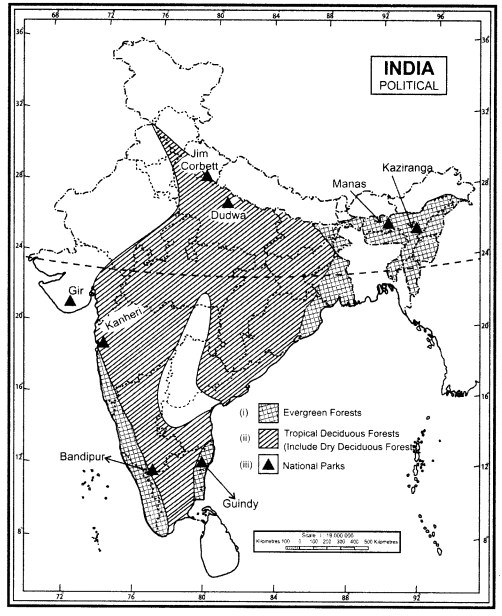
Map Skills
On an outline map of India, label the following.
(i) Areas of Evergreen Forests
(ii) Areas of Dry Deciduous Forests
(iii)Two national parks each in Northern, Southern, Eastern and Western parts of the Country
Answer:
We Think the given NCERT Solutions for class 9 Social Science book Chapter 5 Natural Vegetation and Wildlife with Answers Pdf free download will assist you. If you’ve got any queries regarding CBSE Class 9 Social Science Natural Vegetation and Wildlife NCERT Solutions with Answers, drop a comment below and that we will come back to you soons.