
We have Provided the NCERT/CBSE Solutions chapter-wise for Class 10 Science Chapter 11 Human Eye and Colourful World with Answers by expert subject teacher for latest syllabus and examination. Students can take a free NCERT Solutions of Human Eye and Colourful World. Each question has right answer Solved by Expert Teacher.
CBSE Solutions Class 10 Science Human Eye and Colourful World
Page No. 190
QUESTIONS
Q1. What is meant by power of accommodation of the eye?
Answer: The ability of the eye lens to adjust its focal length, so as to clearly focus rays coming from distant as well a near objects on the retina, is called the power of accommodation of the eye.
Q2. A person with a myopic eye cannot see objects beyond 1.2 m distinctly. What should be the type of the corrective lens used to restore proper vision?
Answer:
Given v = -1.2 m
u = ∞
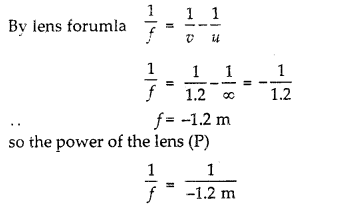
So, if the far point of myopic eye is 1.2 m, focal length of corrective lens is -1.2 m. And it will be concave.
Q3. What is the far point and near point of the human eye with normal vision?
Answer: The farthest position of an object from the human eye so that its sharp image is formed on the retina is at infinite distance from the eye.
The nearest position of an object from a human eye so that its sharp image is formed on the retina is at 25 cm from the eye.
Q4. A student has difficulty reading the blackboard while sitting in the last row. What could be the defect the child is suffering from? How can it be corrected?
Answer: The child is suffering from myopia. The child should use concave lens of suitable focal length.
Page No. 197
EXERCISES
Q1. The human eye can focus objects at different distances by adjusting the focal length of the eye lens. This is due to
(a) presbyopia
(b) accommodation
(c) near-sightedness
(d) far-sightedness
Answer: (b) accommodation
Q2. The human eye forms an image of an object at its
(a) cornea
(b) iris
(c) pupil
(d) retina
Answer: (d) retina
Q3. The least distance of distinct vision for a young adult with normal vision is about
(a) 25 m
(b) 2.5 cm
(c) 25 cm
(d) 2.5 m
Answer: (c) 25 cm
Q4. The change in focal length of an eye lens is caused by the action of the
(a) pupil
(b) retina
(c) ciliary muscles
(d) iris
Answer: (c) ciliary muscles
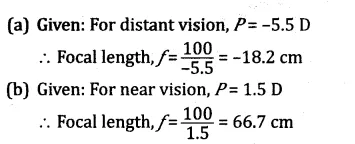
Q5. A person needs a lens of power –5.5 dioptres for correcting his distant vision. For correcting his near vision he needs a lens of power +1.5 dioptre. What is the focal length of the lens required for correcting (i) distant vision, and (ii) near vision?
Answer:
Q6. The far point of a myopic person is 80 cm in front of the eye. What is the nature and power of the lens required to correct the problem?
Answer: The person is suffering from an eye defect called myopia. In this defect, the image is formed in front of the retina. Hence, a concave lens is used to correct this defect of vision.
Object distance, u = infinity = ∞
Image distance, v = – 80 cm
Focal length = f
According to the lens formula,
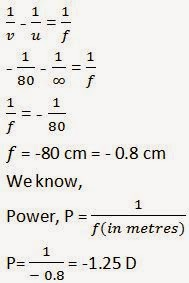
A concave lens of power – 1.25 D is required by the person to correct his defect.
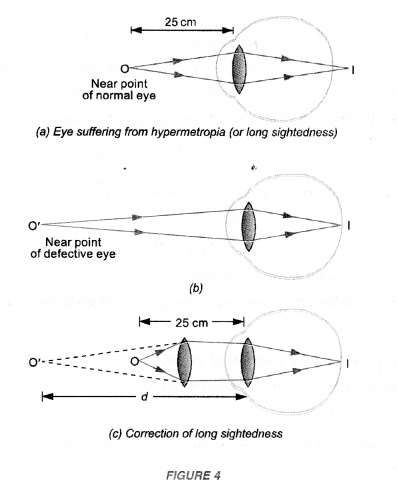
Q7. Make a diagram to show how hypermetropia is corrected. The near point of a hypermetropic eye is 1 m. What is the power of the lens required to correct this defect? Assume that the near point of the normal eye is 25 cm.
Answer:

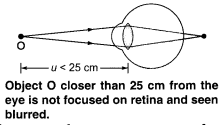
Q8. Why is a normal eye not able to see clearly the objects placed closer than 25 cm?
Answer: At distance less than 25 cm, the ciliary muscles cannot bulge the eye lens any more, the object cannot be focused on the retina and it appears blurred to the eye, as shown in the given figure.
Q9. What happens to the image distance in the eye when we increase the distance of an object from the eye?
Answer: In order to focus the eye on objects situated at varying distances, the focal length of the eye lens is changed by the action of ciliary muscles.
Q10. Why do stars twinkle?
Answer: The twinkling of a star is due to atmospheric refraction of starlight. The starlight, on entering the earth’s atmosphere, undergoes refraction continuously before it reaches the earth. The atmospheric refraction occurs in a medium of gradually changing refractive index.
Q11. Explain why the planets do not twinkle.
Answer: Planets are much closer to the earth and are seen as extended sources. So, a planet may be considered as a collection of a large number of point-sized light sources. Although light coming from individual point-sized sources flickers but the total amount of light entering our eye from all the individual point-sized sources average out to be constant. Thereby, planets appear equally bright and there is no twinkling of planets.
Q12. Why does the Sun appear reddish early in the morning?
Answer: Light of lower frequencies such as yellow, orange, red is scattered the least by oxygen and nitrogen molecules of the atmosphere. Thus, the red, orange and yellow lights are transmitted through the atmosphere much more than violet and blue. Red which is scattered the least due to long wavelength, passes through more atmosphere than other colours.
Therefore, most of the light with high frequencies, violet, indigo, blue, green are scattered away in the atmosphere at sunrise. Only red and a little orange light which are least scattered enter our eyes, and appear reddish early in the morning.
Q13. Why does the sky appear dark instead of blue to an astronaut?
Answer: The blue colour of sky is due to the scattering of sunlight. The scattering of sunlight in the atmosphere is due to the presence of atoms and molecules of gases, droplets and dust particles. When the astronaut is in space, then there is no atmosphere (or atoms and molecules of gases, droplets and dust particles) around him. Therefore, sunlight does not scatter and hence sky appears dark.
We Think the given NCERT Solutions for class 10 Science Chapter 11 Human Eye and Colourful World with Answers Pdf free download will assist you. If you’ve got any queries regarding CBSE Class 10 Science Human Eye and Colourful World NCERT Solutions with Answers, drop a comment below and that we will come back to you soons.