
ncertcourse.com offers you best answers for NCERT Solutions for Class 12 Political Science Part B Chapter 8 Regional Aspirations. This chapter designed by expert’s subject teachers to prepare students to score well. Here you find question wise complete detailed chapter questions and answers.
Class 12th Political Science NCERT Solutions Part B Politics in India Since Independence
Q1. Match the following:
A BNature of Regional aspirations States
(a) Socio-religious identity – (i) Nagaland/Mizoram, leading to statehood.
(b) Linguistic identity and Chhattisgarh. – (ii) Jharkhand/tensions with centre.
(c) Regional imbalance – (iii) Punjab, leading to demand for statehood.
(d) Secessionist demands – (iv) Tamil Nadu,on account of tribal identity.
Answer:-
(a)—–> (iii)
(b)—–> (iv)
(c)—–> (ii)
(d)—–> (i)
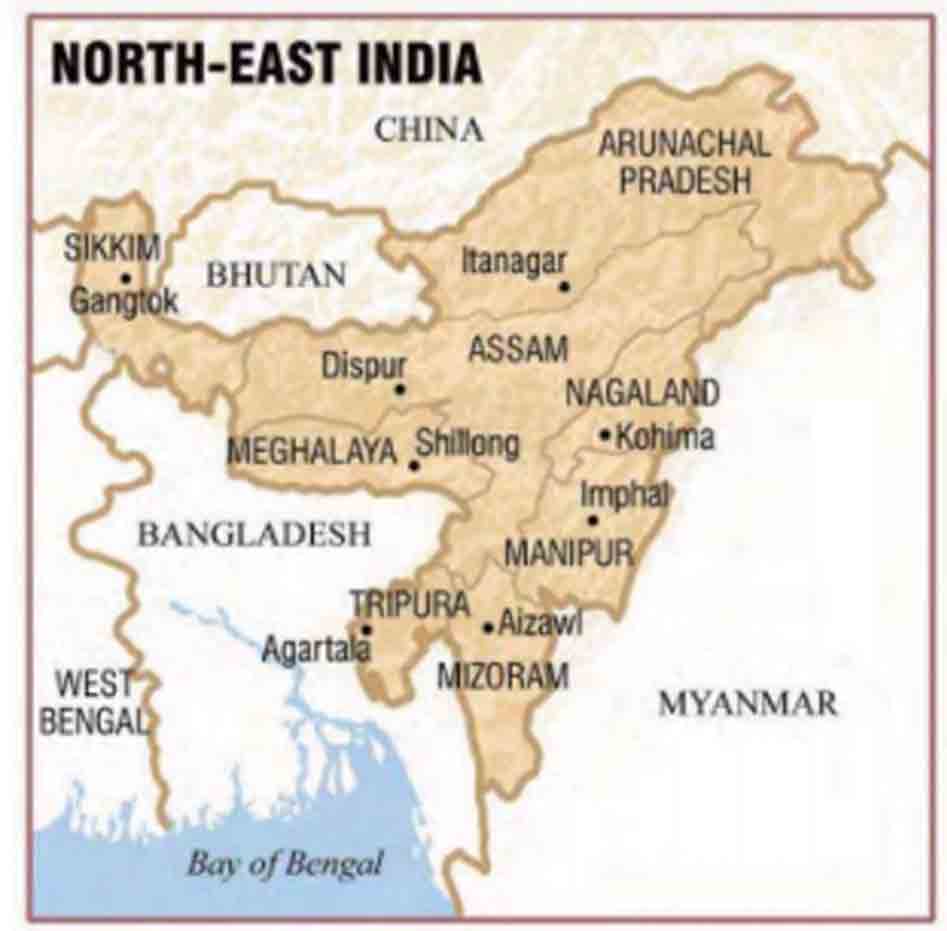
Q2. Regional aspirations of the people of North-East get expressed in different ways. These include movements against outsiders, movement for greater autonomy and movement for separate national existence. On the map of the North-East, using different shades for these three, show the states where these expressions are prominently found.
Answer:- Tripura, Mizoram and Arunachal Pradesh
Q3. What were the main provisions of the Punjab accord? In what way can they be the basis for further tensions between the Punjab and its neighbouring States?
Answer:- The main provisions of Punjab accord are :
(a) The accord was signed between Rajiv Gandhi and the president of the Akali Dal in 1985.
(b) The main provisions of punjab accord were that the Chandigarh was to become an official part of punjab.
(c) The commission was to be set up for the friendly dialogue between haryana and punjab over their conflictual issues.
(d) The tribunal was also to be set up for the sharing of Ravi/Beas river water with three major states_Punjab, Haryana and Rajasthan.
(e) For the integration of punjabi community with the rest of India ,Rajiv Gandhi government also removed AFSPA (armed forces special powers act) from the state of Punjab
Q4. Why did the Anandpur Sahib Resolution become controversial?
Answer:- Anandpur Sahib Resolution of 1973 became quite controversial because:
(a) it was mainly inclined towards the demanding of more regional autonomy for punjab.
(b) Soon, it changed into a militant movement where the separatist leaders wanted the establishment of ‘Khalistan’.
(c) The nature, consequences and membership of Anandpur Resolution were major factors that led to its controversial position.
Q5. Explain the internal divisions in the state Jammu and Kashmir and describe how these lead
to multiple regional aspirations in that state.
Answer:- Jammu and Kashmir comprised of three regions:
- Kashmir region is Kashmir valley consisting Kashmiri speaking and mostly Muslim with a Kashmiri speaking Hindu minority.
- Jammu region consists of Hindus, Muslims, Sikhs and speakers of various languages, in the areas of foothills and plains.
- Ladakh region is equally divided between Buddhists and Muslims and maintains an little population area.
These internal divisions led to multiple regional aspirations:
- One strand of separatist to demand a separate Kashmiri nation independent of India and Pakistan.
- Some other groups want Kashmir to be merged with Pakistan.
- Third strand wants a greater autonomy for people of state within Indian Union.
- The demand for intra-state autonomy is as strong as the demand for the state autonomy. In present scenario, most of the separatist in dialogue are trying to re-negotiate a relationship of state with India.
Q6. What are the various positions on the issue of regional autonomy for Kashmir? Which of these do you think are justifiable? Give reasons for your answer.
Answer:- There are three major notions towards the regional autonomy of state of Jammu and Kashmir.
(a) The nationalistic or pro Indian group is inclined towards the removal of special status or regional autonomy from this particular state. The revoking of article 370 and 35A claimed to be proponents of this notion but the critics say otherwise.
(b) The second division is inclined towards the integration of Kashmir with Pakistan.
(c) The third and the most prominent division in the valley is in favour of ‘AZAD KASHMIR’ or Independent kashmir
Among all three :
The third division of separatism is justifiable for the valley of Kashmir as it upholds the idea of territorial integrity,sovereignty and right to self determination of the people who believe in the establishment of their own nation based upon principles of equality, liberty and justice
Q7. The Assam movement was a movement was a combination of cultural pride and economic backwardness. Explain.
Answer:- The north-eastern area of india consists of seven sisters which have different regional,political and cultural aspirations. After the partition of India in 1947, the integrated policies were implemented all over India while as the North-Eastern territories including Assam witnessed alienation and isolation from the Indian union. This gave rise to the indigenous cultures and the individuals pertaining to Assam began looking at every outsider with a wedge of cultural and social invasion. This alienation also led to the economic backwardness of these regional territories as the Central Government funded economic development of major four cities – Delhi, Kolkata, Chennai and Mumbai.
Q8. All regional movements need not lead to separatist demands. Explain by giving examples from this chapter.
Answer:-
- Regional aspirations are part of democratic politics.
- Expression of regional issues is not an abnormal phenomenon.
- Scotland, Wales, Northern Ireland have regional aspirations in United Kingdom.
- Regional movements are responded
through democratic negotiations rather than suppression. –
- Its examples are in eighties, military erupted in Punjab, problems persisted in the NorthEast, students agitated in Assam and Kashmir valley was on the boil.
- The government of India settled down some negotiations with these regional aspirations to reduce tensions in many regions.
- Mizoram is an example of political settlement to resolve the problem of separation effectively.
Q9. Regional demands from different parts of India exemplify the principle of unity with diversity. Do you agree? Give reasons.
Answer:- Yes, I do agree as:
(a) India has been the crucible of ethnic groups where different cultures mixed up so inextricably cannot be demarcated into clear cut boundaries.
(b) The maximum and integrated development of India can only be achieved by the recognition and the fulfillment of regional aspirations.
(c) The diversity of opinions and demands are the main reasons that secure the argumentational value of democracy which underlines the principles of participation and representation.
Q10. Read the passage and answer the questions below:
One of Hazarika’s songs…..dwells on the unity theme; the seven states of North-Eastern India become seven sisters born of the same mother…..’ Meghalaya went own way…..Arunachal too separated and Mizoram appeared in Assam’s gateway as a groom to marry another daughter. ‘…….The song ends with the determination to keep the unity of the Assamese with other smaller nationalities that are left in the present -day Assam- ‘the Karbis and the Musing brothers and sisters are our dear ones.’_ SANJIB BARUAH.
(a) Which unity is the poet talking about.
(b) Why were some states of North-East created separately out of the erstwhile State of Assam?
(c) Do you think that the same theme of unity could apply to all the regions of India? Why?
Answer:- (a) The poet is talking about the unity of seven sisters of North-Eastern area.
(b) These states were carved out of Assam due to the clash between regional and cultural aspiration.
(c) Yes, the same theme of unity could apply to all states of India because the Indian Union believes in the establishment of indestructible union with destructible states to protect the territorial integration of country but to also fulfill the regional aspirations.
Extra Questions of Class 12 Political Science Chapter 8 Regional Aspirations
Q1. Why were the seven small states created in North-East India?
Answer:- Seven small states were created in North-East India because of demands for
(i) autonomy (ii) movements for secession and (iii) opposition to outsiders.
Q2. Which students group led the anti foreigner movement in Assam?
Answer:- All Assam Students’ Union in 1979 (AASU).
Q3. Jammu and Kashmir state comprised of which three social and political regions?
Answer:- Kashmir, Jammu and Laddakh regions.
Q4. How did India meet with the challenge of diversity?
Answer:- By redrawing the internal boundaries of the country, i.e. created Chhattisgarh Jharkhand and Uttarakhand etc
Q5. When was first normal election held in Punjab after violence?
Answer:- In 1997 in the post militancy era and alliance of Akali Dal and BJP scored victory.
Q6. What do you mean by Seven Sisters?
Answer:- The ‘North-East region’ consisting of seven states is referred to as seven sisters.
Q7. Assess the role of democratic negotiations in responding to regional aspirations.
Answer:- Democratic negotiations are very much helpful in solving the regional aspirations, for example, terrorism in Punjab, problems of north-east of India, Mizoram problem, etc all regional problems can only be solved through democratic and peaceful ways only.
Q8. How was the reorganization of North-East India completed and by when?
Answer:- The reorganization of the North-East was completed by 1972. Instead of one tribal state, several states got carved out of Assam. Central Government had to create Meghalaya, Mizoram, and Arunachal Pradesh out of Assam, Tripura, and Manipur were upgraded into a state too.
Q9. What was ‘operation Blue Star’? Why did it hurt the sentiments of the Sikh Community?
Answer:- On 5th June 1984, a military operation took place in the Golden Temple of Amritsar, the most important and pious place of the Sikh Community. This operation the Golden Temple, is known as the ‘Blue Star Operation’ Due to the sanctity of the Golden Temple, the operation ‘Blue Star’ hurt the sentiments of the Sikh Community.
Q10. Why is violence between two communities considered a threat to democracy?
Answer:- It is true that violence between two communities is considered a threat to democracy. India’s democratic politics is based on the premise that all religious communities enjoy the freedom that they may join any party. It is also accepted that there will not be community-based political parties. Even then the democratic atmosphere of the country faced many challenges during the anti-Sikh riots of 1984, violence in Gujrat in 2002, demolition of Babri Masjid in 1992, etc. Thus communal riots are against democratic norms.
Q11. State one similarity and one difference between the crisis in Punjab and Assam during 1980s.
Answer:– Similarity- It was regional aspirations given to prior importance and solving the crisis through democratic negotiations. Differences- In Punjab, Akali Dal started the movement for formation of ‘Punjabi Sabha’ wide areas in Assam, the crisis was against the people who were seen as outsiders or migrants who were considered to be competitors to employment opportunities.
Q12. In what ways the issue of outsiders continues to be a live issue in Assam?
Answer:- Assam Accord could not solve the problem of immigration:
- The issue of‘outsiders’ continues to be alive issue.
- In Tripura, the original inhabitants have been reduced to being a minority in North-East.
- The same feelings formed the hostility of local population to Chakma refugees in Mizoram and Arunachal Pradesh.
Q13. Describe the outcome of the Anandpur Sahib Resolution of 1973.
Answer:-
- The Anandpur Sahib Resolution wanted to redefine centre-state relationship in the country.
- The resolution also spoke of the aspirations of the Sikh qaum (community or nation) and declared its goal as attaining the bolbala (dominance or hegemony) of the Sikhs.
- The Resolution was a plea for strengthening federalism, but it could also be interpreted as a plea for a separate Sikh nation.
- The Resolution had a limited appeal among the Sikh masses.
Part B Politics in India Since Independence
- Lesson 1 Challenges of Nation Building
- Lesson 2 Era of One Party Dominance
- Lesson 3 Politics of Planned Development
- Lesson 4 India’s External Relations
- Lesson 5 Challenges to and Restoration of Congress System
- Lesson 6 The Crisis of Democratic Order
- Lesson 7 Rise of Popular Movements
- Lesson 8 Regional Aspirations
- Lesson 9 Recent Developments in Indian Politics