
We have completed the NCERT/CBSE Solutions chapter-wise for Class 12 Business Studies Chapter 10 Financial Markets with Answers by expert subject teacher for latest syllabus and examination. Prepare effectively for the exam taking the help of the Class 12 Business Studies NCERT Solutions PDF free of cost from here. Students also can take a free NCERT Solutions of Financial Markets. Each question has right answer Solved by Expert Teacher. Download the Business Studies NCERT Solutions with Answers for Class 12 Business Studies Pdf and prepare to help students understand the concept very well.
NCERT Solutions for Class 12 Business Studies Chapter wise
EXERCISES
Very Short Answer Type:
Q1. What is a Treasury Bill?
Answer: Treasury bill is the short term instrument which the Central Government issues to the financial institutions or the general public in order to meet its short term financial needs. Its maturity period cannot be more than a year. It is issued by the RBI on behalf of the government.
Q2. Explain the various segments of the NSE.
Answer: National Stock Exchange of India (NSE) : The National Stock Exchange is the latest, most modern and technology driven exchange. It was incorporated in 1992 and was recognized as a stock exchange in April 1993. It started operations in
1994, was trading on the wholesale debt market segment.
Subsequently, it launched the capital market segment in November 1994 as a trading platform for equities and the futures and options segment in June 2000 for various dervative instruments. NSE has set up a nationwide fully automated screen based trading system.
The NSE was set up by leading financial institutions, bank, insurance companies and Other financial intermediaries, it is managed by professionals, who do not directly or indirectly trade on the exchange.
The trading rights are with the trading members who offer their services to the investors. The board of NSE comprises of senior executives from promotor institutions and eminent professional, without having any representation from trading members.
Market Segments of NSE
The exchange provides trading in the following three segments
Whole Sale Debt Market Segment: This segment provides a trading platform for a wide range of fixed income securities that include central government securities, treasury bills, state development loans, bonds issued by public sector undertakings, floating rate bonds, zero coupon bonds, index bonds, commercial paper, certificate of deposit corporate debentures and mutual funds.
Capital Market Segment: The capital-market segment of NSE provides an efficient and transparent platform for trading in equity, preference, debentures, exchange traded funds as well as retail government securities. O Futures and options segment.
Q3. State any two reasons why investing public can expect a safe and fair deal in the stock market. (Point w.r.t safety of Transactions – Functions of the Stock Exchange).
Answer: Investing public can expect safe and fair deal in stock market due to these two reasons:
i. The function of the stock exchange is to protect the rights and interests of the investors. It should be guiding individual investors and educating them on the ways to deal in stock exchange.
ii. The function is to develop fair practices and codes of conduct by the intermediaries involved like merchant bankers, brokers.
Q4. What is the common name for Beneficiary Owner Account, which is to be opened by the investors for trading in securities?
Answer: Beneficial owner is the type of person who enjoys the ownership benefits even when the property title is in name of someone else. In other words, any individual or individuals who have the power to vote or influence any transaction decisions such as company shares either directly or indirectly.
Q5. Name any two details that need to be provided by the investor to the broker while filling a client registration form
Answer: The investor needs to provide following details to the broker at the time of filling a client registration form
i. Date of birth and address
ii. PAN Number
Short Answer Type:
Q1. What are the functions of a financial market?
Answer: Functions of financial markets are:
- Mobilisation of Savings: It gives savers the choice of different investments and thus helps to channelise surplus funds into the most productive use.
- Facilitate Price Discovery: In the financial market, the households are suppliers of funds and business firms represent the demand. The interaction between them helps to establish a price for the financial asset which is being traded in that particular market.
- Provide Liquidity to Financial Assets: Financial markets facilitate easy purchase and sale of financial assets. In doing so they provide liquidity to financial assets, so that they can be easily converted into cash whenever required.
- Reduce the Cost of Transaction: Financial markets provide valuable information about securities helps to save time, effort and money.
Q2. “Money Market is essentially a Market for short term funds.” Discuss.
Answer: The money market is a market for short term funds which deals in monetary assets whose period of maturity is upto one year. These assets are close substitutes for money. It is a market where low risk, unsecured and short term debt instruments that are highly liquid are issued and actively traded everyday. It enables the raising of short term funds for earning returns. The major participants in the market are the Reserve Bank of India, Commercial Bank, Non-Banking Finance Companies, State Governments, Large Corporate Houses and Mutual Funds.
Q3. Distinguish between Capital Market and Money Market.
Answer:
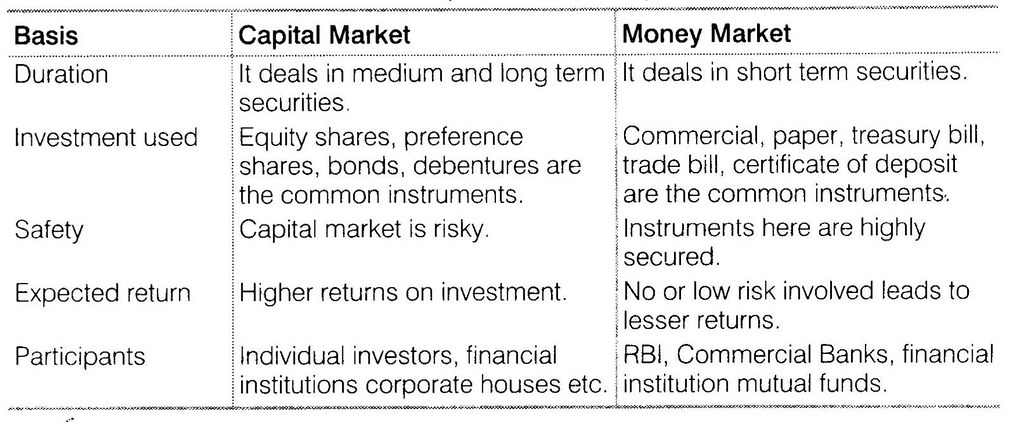
Q4. What are the functions of a Stock Exchange?
Answer: The term “stock exchange” refers to a market where existing securities are bought and sold. The primary functions of a stock exchange are as follows.
(i) Provides Liquidity and Marketability: The stock exchange provides a ready-to-trade platform for existing securities. In another way we can say, it provides a continuous market for the sale and purchase of securities. Securities can be easily converted into cash via stock exchange whenever needed. Furthermore, long-term securities can be converted to medium-term and short-term securities via stock exchange.
(ii) Determination of Prices: A stock exchange aids in determining the value of the monetary assets traded in that market. It provides a platform for interaction between buyers and sellers of securities, assisting in the determination of securities prices through the forces of demand and supply.
(iii) Fair and Safe Market: As a legal and well-regulated market, the stock exchange. It operates within the boundaries of the defined and existing legal framework. As a result, it ensures transactional safety and fairness.
(iv) Facilitates Economic Growth: Securities are constantly bought and sold on a stock exchange. This ongoing process of disinvestment and reinvestment aids in directing savings and investments to the most productive uses. This boosts capital formation as well as economic growth.
(v) Spreading Equity Cult: A stock exchange can help educate people about investing by regulating issues and improving trading practices. It encourages and promotes people to invest in ownership securities.
(vi) Acts as an Economic Barometer: A stock exchange reflects changes in economic conditions through changes in share prices. For example, the rise (or fall) in share prices reflects a boom (or recession).
(vii) Scope for Speculation: It is widely assumed that some degree of speculation is required for improved liquidity and the maintenance of demand and supply for securities. Within the confines of the law, the stock exchange allows for a reasonable and controlled scope of speculation.
Q5. What are the objectives of the SEBI?
Answer: Securities and Exchange Board of India (SEBI) was established for promoting an orderly and healthy growth of the securities market in India. The following points highlight the overall objectives of SEBI.
- Regulation :- The basic objective of SEBI is to regulate the functioning of stock exchange and the securities market. It aims at providing a place where the issuers of securities (i.e. companies) can raise funds in an easy and confident manner.
- Protection :- SEBI works on educating the investors and provide guidelines related to investment. It provides them adequate and reliable information about the companies and thereby, helps them in taking wise and informed investment decisions.
- Prevention :- To combat the malpractice in trading of securities was the basic reason for the establishment of SEBI. Malpractice such as insider trading, violation of rules and regulations, non-adherence to Companies Act, etc. erodes the confidence of investors. SEBI aims at checking these malpractice by creating a balance between the self regulation of a business and the legal statutory regulations.
- Code of Conduct :- Through regulation, SEBI develops a code of conduct for the fair trade practices by the intermediaries such as brokers, merchant bankers, underwriters, etc. SEBI controls the activities of these intermediaries and provides them a professional and competitive environment.
Q6. State the objectives of the NSE.
Answer: The following are the objectives of NSE or National Stock Exchange
- It was aimed at setting up a national trading facility which deals with all types of securities. This system increases the confidence of the investors.
- It provided an easy and equal access through a communication network which increased the liquidity of the securities.
- It was looking to provide transparency and fairness in securities dealing by using electronic trading system.
- It enabled faster settlements by having shorter settlement cycles.
- It was looking to fulfill the benchmarks and international standards of stock exchange.
Q7. Name the document prepared in the process of online trading of securities that is legally enforceable and helps to settle disputes/claims between the investor and the broker
Answer: Once the trade is conducted, the broker issues a Contract Note. The contract note contains number of shares that are sold and brought, price, date and time of the deal and the brokerage charges. It is an important document as it has legal validity and can be submitted as a proof during claim settlement or disputes which can arise between broker and the investor. The contract note contains the unique order code number that is assigned by stock exchange for each transaction.
Long Answer Type:
Q1. Explain the various Money Market Instruments.
Answer: Call Money: Call money is short term finance repayable on demand with a maturity period of one day to fifteen days, used for inter bank transactions. It is a method by which banks borrow from each other to maintain the cash reserve ratio. Cash reserve ratio is the minimum cash balance which banks have to maintain. The interest rate paid on call money loans is known as the call rate. Treasury Bill: Treasury bill is the short term instrument which the Central Government issues to the financial institutions or the general public in order to meet its short term financial needs. Its maturity period cannot be more than a year. It is issued by the RBI on behalf of the government.
Commercial Paper: Commercial papers are those unsecured promissory notes which are issued by reputed companies. Their buyers are banks, insurance companies, unit trust and firms. The minimum face value of a commercial paper is five lakh rupees. It is used to meet the demand of a short term seasonal need and requirement of working capital.
Certificate of Deposit: refers to a time deposit or fixed deposit which can be sold in the secondary market. Only a bank can issue Certificate of Deposit.
Commercial Bill: A commercial bill is a bill of exchange used to finance the working capital requirements of business firms.
Q2. Explain the recent Capital Market reforms in India.
Answer: The National Stock Exchange is the latest, most modern and technology driven exchange. NSE has setup a nationwide fully automated screen based trading system. The NSE was setup by leading financial institutions, banks, insurance companies and others financial intermediaries. It is managed by professionals, who do not directly or indirectly trade on the exchange. The trading rights are with the trading members who offer their services to the investors. The Board of NSE comprises senior executives from promoter institutions and eminent professionals, without having any representation from trading members.
Objectives of NSE
(i) Establishing a nationwide trading facility for all types of securities.
(ii) Ensuring equal access to investors all over the country through an appropriate communication network.
(iii) Providing a fair, efficient and transparent securities market using electronic trading system.
(iv) Enabling shorter settlement cycles and book entry settlements.
(v) Meeting international bench marks and standards..
Within a span of 10 year, NST was able to achieve its objectives for which it was set up. It has been playing a leading role as a change agent in transforming the Indian capital market.
Q3. Explain the objectives and functions of the SEBI
Answer: The Securities and Exchange Board of India (SEBI) was established in 1988 to promote the orderly and healthy growth of the Indian securities market. SEBI was established with the overarching goal of protecting investors and promoting the development and regulation of securities market functions.
Objectives of SEBI:
SEBI’s overarching goal is to protect investors’ interests while also promoting the development and regulation of the securities market. This can be expanded as follows:
- To promote the orderly operation of stock exchanges and the securities industry by regulating them.
- To protect the rights as well as interests of the investors, basically individual investors, as well as to guide and educate them
- To prevent trading malpractices and strike a balance between the securities industry’s self-regulation and statutory regulation.
- To regulate as well as develop a code of conduct & fair practices for intermediaries such as brokers and merchant bankers in order to make them more competitive and professional.
Functions of SEBI:
Given the nascent nature of India’s securities market, SEBI was entrusted with the dual task of securities market regulation and development.
Regulatory Functions:
- Registration of brokers, sub brokers, and other market participants.
- Collective investment schemes and mutual funds must be registered.
- Stock bankers, portfolio exchanges, and merchant bankers are regulated.
- Prohibition of deceptive and unfair business practices.
- Controlling insider trading and takeover bids, as well as imposing penalties for such behavior.
- Inquiring for information through inspections, inquiries, and audits of stock exchanges and intermediaries.
- Imposing fees or other charges in order to carry out the Act’s purposes.
- Carrying out and exercising such powers as may be delegated by the Government under the Securities Contracts (Regulation) Act 1956.
Development Functions:
- Educating investors
- Intermediary training
- Advocating for fair practices and a code of conduct for all SROs.
- Conducting research and disseminating information that is beneficial to all market participants.
Q4. India’s largest domestic investor Life Insurance Corporation of India has once again come to government’s rescue by subscribing 70% of Hindustan Aeronautics’ `4,200-crore initial public offering.
a. Which market is being reflected in the above case?
b. State which method of floatation in the above identified market is being highlighted in the case? (Primary Market)
c. Explain any two other methods of floatation. (Private Placement, Offer through prospectus, offer for sale)
Answer: (a) The above case shows the primary market. It is the market where securities are being issued for the first time.
(b) The method of floatation that is applied is right issue of shares. It is a type of privilege that existing shareholders get at the time of issue of new shares as per the terms and conditions of the company.
(c) Two other methods of floatation are:
i. Offer for Sale: In this method securities are issued to the intermediaries such as stock brokers or issue house instead of issuing to the public directly. In this example securities are sold to brokers at an agreed price who will be selling those shares to the public.
ii. Offer through prospectus: It is one of the most popular method of raising funds by public companies in the share market or the primary market. It involves issuing of prospectus through inviting of subscriptions. It makes an appeal to raise investment by publishing of ads in magazines and newspapers. The contents of the prospectus should be in accordance with the Companies Act, investor protection guidelines and SEBI disclosure.
Q5. Lalita wants to buy shares of Akbar Enterprises, through her broker Kushvinder. She has a Demat Account and a bank account for cash transactions in the securities market. Discuss the subsequent steps involved in the screen-based trading for buying and selling of securities in this case.
Answer: The following steps are involved and is discussed in a sequential manner
1) Investor wishing to buy or sell any type of security has to approach a broker or sub broker and make an agreement. The investor needs to sign broker-client agreement and fill client registration form prior to start trading in securities. Also, some essential details need to be filled which include the following:
i. PAN number
ii. Date of birth and address
iii. Educational qualification and the occupation
iv. Residential status
v. Bank account details
vi. Depository account details
2) The next step is opening of Demat account or Beneficial owner account with a depository participant for transferring of securities in Demat form also a bank account needs to be opened for performing cash transactions in the market.
3) An order is placed by the investor with the broker for buying and selling shares. Information should be provided about the number of shares and price of shares that need to be bought. Broker issues a order confirmation slip to investor once the order is placed.
4) Broker goes online and connects with the stock exchange for matching share and the prices which are available for the share.
5) When shares can be either bought or sold as per the price mentioned by investor, the broker will be notified about that and order will be processed electronically. On transaction being done, broker will issue a trade confirmation slip for the investor.
We Think the given NCERT Solutions for class 12 Business Studies book Chapter 10 Financial Markets with Answers Pdf free download will assist you. If you’ve got any queries regarding CBSE Class 12 Business Studies Financial Markets NCERT Solutions with Answers, drop a comment below and that we will come back to you soons.