
We have completed the NCERT/CBSE Solutions chapter-wise for Class 12 Business Studies Chapter 11 Marketing with Answers by expert subject teacher for latest syllabus and examination. Prepare effectively for the exam taking the help of the Class 12 Business Studies NCERT Solutions PDF free of cost from here. Students also can take a free NCERT Solutions of Marketing. Each question has right answer Solved by Expert Teacher. Download the Business Studies NCERT Solutions with Answers for Class 12 Business Studies Pdf and prepare to help students understand the concept very well.
NCERT Solutions for Class 12 Business Studies Chapter wise
EXERCISES
Very Short Answer Type:
Q1. State any two advantages of branding to marketers of goods and services?
Answer: Advantages of branding to marketers of goods and services are:
- It enables a firm in distinguishing their product from the competitor firm.
- A product when is provided branding will make it known among customers, it will attract new business. Branding makes advertising of the product easier.
Q2. How does branding help in differential pricing?
Answer: Brand name helps in creating an image among the consumers about the product quality. It helps customers in differentiating products of different firms. Marketers can charge different prices and having a good brand image the organisation can charge premium prices.
Q3. What is the societal concept of marketing?
Answer: The societal concept is the new concept of marketing that aims at satisfying customer needs by taking proper care of society and the environment. According to this concept customer satisfaction must be within the ethical and ecological aspects of society.
Societal marketing should consider the following things
- The consumer needs are most important
- Genuine modern and continuous development should be introduced in the product so as to increase its life and value
- The emphasis should be on building long-term customer relationships and not on doing business
- An organisation should market the product keeping in mind the consumer organisational and societal long-term needs and welfare
Q4. List the characteristics of convenience products.
Answer: Products that can be bought immediately on a frequent basis and with minimum effort are referred to as convenience products. Following are the characteristics of convenience products:
- Products are easily available and there is minimum effort and time is required. Also, products are located at convenient places.
- These products are frequently consumed and have a ongoing demand. Essential commodities are classified as convenience products.
- The convenience goods are available in low price and in units of small products.
- These products have high competition and require a good amount of advertising.
Q5. Enlist the advantages of packaging of consumer products.
Answer: Packaging refers to the process of developing and designing the container for a product.
A good packaging has the following advantages:
It enables differentiation and identification of a product from other products.
It acts as a promotional tool. Use of colours, symbols, pictures, symbols in packaging helps in attracting the customers.
Appropriate packaging contributes to the convenience of handling the product.
It helps in protecting the quality of the product from any kind of damage, spoilage, breakage etc. particularly at the time of storage and transportation.
Q6. What are the limitations of advertising as a promotional tool? Enlist.
Answer: Limitations of Advertising
(i) Less forceful Advertising is an impersonal form of communication. It is less forceful than the personnal selling as there is no complusion on the prospects to pay attention to the message.
(ii) Lack of feed back The evaluation of the effectiveness of advertising message is very difficult as there is no immediate and accurate feed back mechanism of the message that is delivered.
(iii) Inflexibility Advertising is less flexible as the message is standardised and is not tailor made to the requirements of the different customer groups.
(iv) Low Effectiveness : As the volume of advertisement is getting more and more expanded it is becoming difficult to make advertising messages heard by the target prospects. This is affecting the effectiveness of advertising.
Q7. List five shopping products purchased by you or your family during the last few months.
Answer: (i) Curtains (ii) Shirts (iii) Cosmetics (iv) Travelling bags (v) Hand bags
Q8. A marketer of colour TV having 20% of the current market share of the country aims at enhancing the market share to 50 per cent in next three years. For achieving this objective, he specified an action programme. Name the function of marketing being discussed above. (Ans. Marketing planning.)
Answer: Marketing planning. An important activity or area of work of a marketer is to develop appropriate marketing plans so that the marketing objectives of the organisation can be achieved. For example, a marketer of colour TV, having 10 percent of the current market share in the country, aims at enhancing his market share to 20 percent, in the next three years. He will have to develop a complete marketing plan covering various important aspects including the plan for increasing the level of production, promotion of the products, etc., and specify the action programs to achieve these objectives.
Short Answer Type:
Q1. What is marketing? What functions does it perform in the process of exchange of goods and services? Explain.
Answer: Marketing is the process where there is interaction of buyers and sellers for the purchase of goods and services. Marketing was having different approaches sometimes involving pre and post production processes. Marketing performs the following functions in exchange of goods and services:
- Planning
- Designing of the product
- Packaging
- Labelling
- Branding
- Warehousing
- Transportation
- Support services
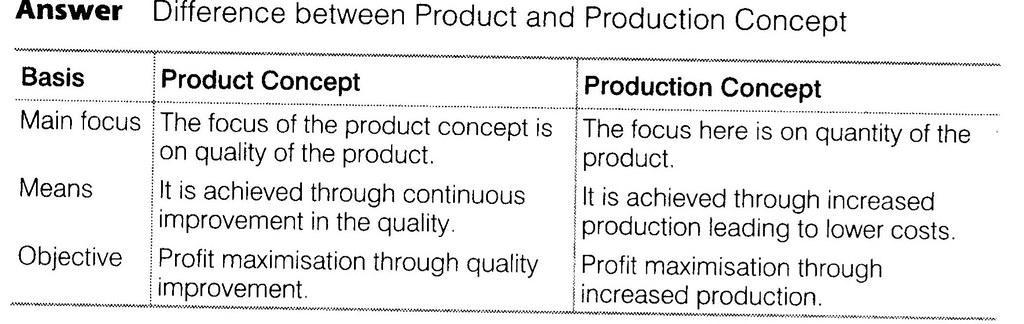
Q2. Distinguish between the product concept and production concept of marketing.
Answer:
Q3. Product is a bundle of utilities? Do you agree? Comment.
Answer: When a customer decides to purchase a product, his or her primary focus is on the utility that he or she will receive from using it. A customer seeks various levels of satisfaction from a product. A product’s benefits can be classified into three types: functional benefits, psychological benefits, and social benefits. For example, when a consumer buys a car, it provides him with functional utility as a mode of transportation. In addition, having purchased a car provides him with a psychological benefit in the form of pride and self-esteem. It also comes with a social benefit in the form of peer acceptance. As a result, a product is said to be a bundle of utilities, and a buyer values all such utilities when purchasing a product.
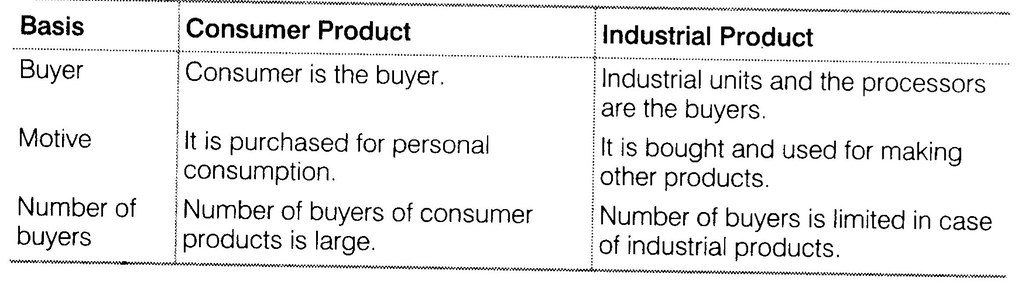
Q4. What are industrial products? How are they different from consumer products? Explain.
Answer: Industrial products are those products, which are used as inputs in providing other products e.g., raw material, engines, tools, lubricants etc.
The difference between consumer products and industrial products is based on their ultimate use and nature of purchases.
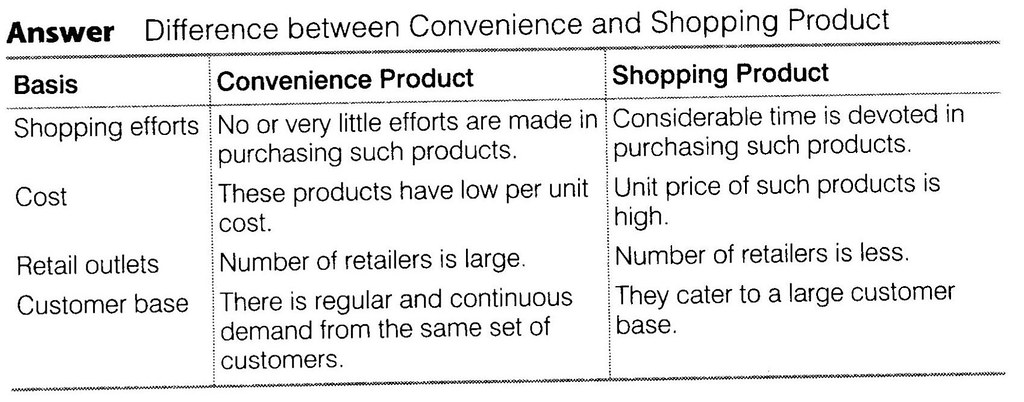
Q5. Distinguish between convenience product and shopping product.
Q6. Describe the functions of labelling in the marketing of products.
Answer: Labeling plays an important role in product packaging during the marketing process. Labeling essentially provides information about the product in the form of a tag (in the case of unbranded local products such as rice, wheat, and so on) or graphics (such as a lady applying cream on face for a face cream). Labeling serves several functions, the most important of which are as follows.
i) Contents and Description of Use: The primary function of labeling is to provide information about the product’s use, application, warnings, content, and so on. For example, the contents of a shampoo bottle are written on the bottle, along with warnings such as “keep away from children under the age of 10.” Similarly, a picture of noodles describing its appearance can be found on food products such as Maggie Cuppa Mania. Along with this, the ingredients and method of preparation are specified.
ii) Identification and Distinction: A label makes it easier to identify a product. It assists consumers in differentiating their preferred products from others. In a potato chip product, for example, a man eating potato chips is imprinted for identification. A label also contains useful information such as the manufacturer’s name or address, net weight, maximum retail price, batch number, and so on.
iii) Standardization and Evaluation: A label also aids in the determination of a product’s grade. This allows marketers to categorize the product into different categories based on specific qualities or features. For example, a face-cream brand may be divided into three categories: oily skin, dry skin, and normal skin.
iv) Encourages Production: An appealing label also aids marketers in promoting the product. It aids in attracting new customers to the product. For example, the label for Maggi Noodles reads, “Taste bhi, Health bhi.” In this case, the label is crucial in highlighting the product and promoting its sale.
v) Information Necessary for Law: The label also provides and mentions the information that is required by law to be included. On a packet of tobacco, for example, it says, ‘chewing tobacco is harmful to your health.’
Q7. Discuss the role of intermediaries in the distribution of consumer non-durable products.
Answer: Intermediaries play an important role in the distribution of consumer non-durables. They facilitate the transfer of goods from the place of production to the place where they are consumed.
The following are the different functions performed by the intermediaries in the case of non-durables.
Arrangement:- An intermediary receives the supply of goods from various sources. He then sorts these goods into homogeneous groups based on their characteristics such as size, quality, etc. For instance, an electronic goods seller receives a supply of different electronic goods (T.V., washing machine, etc.) and then sorts them based on their functions.
Collection:- An intermediary maintains a large stock of the goods so as to ensure easy flow of supply. For instance, the electronic goods seller maintains a large stock of each type of electronic item.
Allocation and Packing:- This function includes breaking the larger stock into smaller units. For instance, each electronic item as well as its spare parts are packed separately.
Building Variety:- An intermediary acquires various goods from different sources and assembles them in a single place. Thus, it maintains a variety of goods. He procures the products and then sells them in different combinations as desired by the consumers. For instance, a television and a video player are preferred together by most people. Thus, the retailer can sell a combination of both.
Promotion of Product:- They assist in the promotion activities undertaken by the manufacturers. For example, the manufacturers use advertising for the promotion of their products. The intermediaries can aid this process by putting banners and displays. For example, an electronic goods retailer puts up banners for various products highlighting their features.
Mediation:- Middlemen perform the function of setting a deal that can satisfy both the producers and the consumers. They negotiate the price, quality, quantity, etc. for efficient transfer of ownership so as to satisfy the need of both parties.
Q8. Explain briefly the components of physical distribution.
Answer: The movement of products from place of production to place of consumption is called physical distribution. The components of a physical distribution are:
- Order processing: Order processing consists of steps such as order placement, order transmission, inventory maintenance, goods delivery etc. As such processes are time consuming, a physical distribution system must ensure proper order processing. Customer satisfaction can be achieved by fast and accurate order processing.
- Product Transportation: Product transportation is the physical movement of goods from the production unit to the consumers.
- Warehousing: It is the process of storing of the goods obtained from manufacturers before being introduced for sale to the customers. Warehouses provide ready stock of goods that can be made available in the market.
- Inventory Maintenance: Inventory is maintained to provide timely supply of goods; it promotes customer satisfaction. Inventory maintenance is cost intensive therefore a firm must find the balance between inventory and customer satisfaction.
Q9. Define advertising. What are its main features? Explain.
Answer: Advertising can be defined as the paid form of non-personal presentation and promotion of ideas, goods or services by an identified sponsor.
Following are the important features of Advertising: Non-Personal: Advertising is a non-personal form of presenting information regarding a product, service or idea. There is no face to face contact. The advertisement is directed to a large number of persons simultaneously. Identified Sponsor: Advertising is done by an identified seller or the manufacturer who makes efforts for getting the product or service advertised and also bears all its costs. Paid form: Advertising is a paid for of communication. Sponsor has to bear the cost of advertising the product to the target customers.
Q10. Discuss the role of ‘sales promotion’ as an element of promotion mix.
Answer: Sales promotion includes those marketing activities other than personal selling, advertising and publicity that stimulate consumer purchasing and dealer effectiveness, such as display, shows and exhibitions, demonstrations and various non-current selling efforts not in the ordinary routine. The main objectives of sales promotion activities are
(i) Creation of demand for the product.
(ii) Educating the consumers about new products or new uses of the old product.
(iii) Building the brand loyalty for the product among the consumers.
Q11. As marketing manager of a big hotel located at an important tourist destination, what societal concerns would be faced by you and what steps would you plan to take care of these concerns? Discuss.
Answer: According to the societal concept of marketing, organizations must identify the market’s and target consumers’ needs and efficiently deliver the desired results. The organization should identify not only the market’s immediate needs, but also the consumers’ long-term well-being. Thus, in addition to customer satisfaction, organizations should strive for ecological, ethical, and social goals such as pollution, resource scarcity, and so on.
- Rainwater harvesting
- Solar geyser use
- waste recycling
- proper drainage
- use of CNG-powered vehicles
Q12. What information is generally placed on the package of a food product. Design a label for one of the food products of your choice.
Answer: The most common information provided in food packages are:
- Product name
- Manufacturer name and address of plant
- Logo of the product
- Ingredients of the products
- Directions of use/ How to prepare
- Product features
- Caution (if needed to be taken)
- Customer care or grievance cell number
Q13. For buyers of consumer durable products, what ‘customer care services’ would you plan as a manager of a firm marketing new brand of motorcycle. Discuss.
Answer: Customer care services for marketing of motorcycles are as follows
- Support for EMI payments
- Support for extended warranty on bikes
- Zero finance schemes
- Servicing reminders
- Two-wheeler insurance schemes support
Long Answer Type:
Q1. What is marketing concept? How does it help in the effective marketing of goods and services?
Answer: Marketing concept of marketing management lays emphasis on customer satisfaction; It believes that customer satisfaction plays a vital role in the success of any organisation. In the long run, any organisation can survive and maximise profits only if it identifies customer needs and effectively work towards fulfilling them. This concept identifies the fact that people purchase a product for satisfaction of specific needs such as functional, social, psychological needs. Any organisation must aim towards identifying such needs and satisfy them in an effective manner. That is it must take all decisions based on needs and requirements of the customer. An organisation works and sells not according to what it has but according to what the customers wants.
The marketing concept is based on the following points:
The effort of all marketing activities must be directed towards a particular segment of market or group of customers.
The organisations must clearly identify the needs and requirement of the target customers.
It should develop such products and services that satisfy the needs of the customers.
It should not just independently work towards customer satisfaction but should also aim at satisfying the customers better than its competitors.
The main aim of all marketing is profit.
Marketing concept helps in effective marketing of goods and services. If all marketing activities are directed towards customer satisfaction, marketing of goods and services would take place in an effective manner. If decisions of production, pricing, designing, etc are based on needs of the customers, selling would not be a problem.
Q2. What is marketing mix? What are its main elements? Explain.
Answer: Meaning of Marketing mix
Marketing mix is the policy framework adopted by the marketeer to get success in the field, of marketing. It refers to the amounts and kinds offnarketing variables, the firm is using at a particular time. Under .marketing mix, we include product mix, promotion mix and distribution mix.
It is rightly remarked that it is not the product but the satisfaction ‘ that are sold now-a-days in order to be a successfull marketeer. One ‘must care for customer satisfaction. For this one should know the real need of his customer and then use the resources to purchase the products which will best satisfy the identified needs. A customer- oriented firm performs number of functions to satisfy customer needs.The effective coordination of these function is often called as marketing mix.
Definition of Marketing Mix
Marketing mix is the combination of the product, the distribution system, the price structure and the promotional activities. Different authors define the term marketing mix in the following manner :
According to R.S. Davar, “The policies adopted by the manufacturer to attain success in the market constitute the marketing
According to Me Carthy, “Marketing mix in the park of four sets of variables namely product, price, promotion and place variables. According to William J. Stanton, “Marketing mix is the term used to describe the combination of the four inputs which constitute , the core of a company’s marketing system – the product the price structure, the promotional activities and the distribution system.
Nature of Marketing Mix
Marketing mix is the instrument for the attainment of marketing goals. Marketing mix denotes a combination of various element which in their totality constitute firm’s marketing system. It should be noted that four ingredients, elements of marketing mix are interrelated because the decision takes in one area usually affects the other. The nature of marketing mix concept should be clean from the following explanation : .
Q3. How does branding help in creating product differentiation? Does it help in marketing of goods and services?
Answer: Branding helps a firm in distinguishing its products from that of its competitors. This helps the firm to secure and control the market for its products. If products were sold by generic names, it would be very difficult for the marketers to distinguish their products from its competitors. Thus, most marketers give a name to their product, which helps in identifying and distinguishing their products from their competitors product. This process of giving a name or a sign or a symbol etc to a product is called Branding.
Q4. What are the factors affecting the determination of the price of a product or service? Explain
Answer: Price refers to the money paid by the customers to obtain a product and this price affects its demand. Thereby, pricing plays an important role in the marketing of goods. The price charged by a firm for its product affects its revenue and profits as well. In addition to this, pricing also acts as a competitive tool. Firms producing similar substitutable products compete with each other on the basis of price. Thus, the firms must pay due to emphasis on proper pricing of their products. The marketers must analyse properly the various factors that determine the price and decide a suitable price for the product.
The following are the factors that affect the determination of the price of a product or a service.
- Cost of Product:- Cost of the product plays an important role in determining the price. It comprises the cost involved in the production, distribution, and sale of the product. Cost of product can be classified into three broad categories, namely, fixed cost, variable cost, and semi-variable cost. Fixed cost refers to those costs that do not vary with the level of output produced. For example, for the production of a good, a firm incurs a cost on the purchase of machinery, land, etc. Such costs are fixed costs. On the other hand, variable cost refers to those costs that vary in direct proportion with the volume of production. That is, as the level of output increases, the variable cost also increases. For example, the cost incurred on labour, raw material, etc. is a variable cost. Semi variable cost refers to those costs that vary with the level of output but not in direct proportion. For example, commission paid to intermediaries for the sale of a good is a semi-variable cost.
Generally, the firms decide the price of a product such that they are able to cover all their cost. In addition, they also aim at earning some profit over and above the cost incurred by them. Thus, the firms decide upon the price keeping into consideration the cost as well as the profit factor.
- Demand for the Product:- While determining the price, a firm must also consider the demand for its product. Herein, the elasticity of demand plays an important role. Elasticity of demand refers to the proportionate change in demand due to a given proportionate change in price. If due to a small proportionate change in price, the demand changes by a larger proportion, the demand is said to be elastic. That is, demand is said to be elastic if a small rise (or, fall) in price leads to a relatively large fall (or, rise) in price. In this case, the firm cannot charge a higher price as it would lead to a large fall in the demand. On the other hand, demand is said to be inelastic, if a change in price does not affect the demand much. In this case, the firm has the privilege of charging a higher price, as even at a higher price, the demand would not fall much. Thus, the price for goods having elastic demand is generally lower than the price for goods having inelastic demand.
- Degree of Competition in the Market:- Generally, the higher the competition in the market, the lower is the price that a firm can charge for its product. This is because in case of high competition if a firm attempts to charge a high price, it would lose its customers to the competitors. On the other hand, if a firm faces very little competition for its product then it has the freedom of charging a higher price.
- Government Regulations:- At times to protect the interest of the public at large, the government intervenes in the determination of price. For example, in the case of essential commodities, the government can declare a maximum price that can be charged.
- Objectives of Pricing:- Every firm has various pricing objectives which it considers while deciding a price. The following are some of the objectives of pricing.
Profit Maximisation:- Every firm aims at profit maximisation. However, if the firm aims at maximising profits only in the short run, then it may decide to charge a higher price and increase its revenue. On the other hand, if the firm aims to maximise profit in the long run, it would charge a lower price so as to acquire a greater share of the market and benefit from larger sales.
Acquiring Market Share:- If a firm desires to capture a greater market share, it would charge a lower price so as to attract a greater number of customers towards its product.
Surviving Competition:- In face of high competition, a firm would keep the price for its product lower. This is because if it charges a higher price, it would lose its customers to the competitors.
Focus on Quality:- If the firm emphasizes enhancing the quality of the product, it charges a higher price to cover the additional cost incurred.
- Method of Marketing:- Methods of marketing used by the firm such as distribution, advertisement, customer services, branding, etc. also affect the determination of prices. For example, if the firm uses intense advertising for the promotion of the product, then it would charge a higher price.
Q5. What do you mean by channels of distribution? What functions do they play in the distribution of goods and services? Explain.
Answer: Channels of distribution are those institutions, agents or individuals who help in the process of providing distribution. Due to spread of customers across large areas it is not possible for the businesses to reach them by alone. In this case, these channels of distribution will help the customers in making the product available.
The functions of the channels of distribution are as follows:
- Supply of goods are received from different sources. But the goods can be of different shapes and sizes, it needs to be taken care of by the intermediary as per the characteristics.
- The segregated items will be collected by a middleman and stored for ensuring a good supply.
- Goods are packed into units by another middlemen
- Intermediaries such as retailer will keep a stock of different items for selling to the consumer.
- Retailer will help manufacturers in promoting the product and by offering sales promotions.
- The intermediaries form a link between producer and the consumer.
- Intermediaries also bear the risk of storing goods in uncertain situations or situations of low demand.
Q6. Explain the major activities involved in the physical distribution of products.
Answer: Physical distribution refers to movement of products from the place of production to the place of consumption. The following are the major activities involved in the physical distribution of products:
- Processing of order: Processing of order comprises number of steps such as placement of order, transmission of order by the intermediaries to the manufacturer, maintenance of inventory as per the requirement, delivery of goods etc. As all such processes take time, a physical distribution of system should be such that it should ensure speedy and proper order processing and customer satisfaction.
- Transportation of products: Transportation of products refer to the physical movement of goods from the place where they are manufactured to the place where they are consumed. To make the goods physically available to the customers, they must be transported from the place of production to the place of consumption.
- Warehousing: Warehousing refers to the process of storing the produced goods before the final act of sale. If a company has a larger number of warehouses, it will be able to provide goods on time at different locations.
- Maintenance of inventory: The firms maintain inventory so as to ensure timely supply of products. Similar to warehousing, maintenance of inventory shares a positive relation with customer service. Maintenance of inventory also involves cost as a huge amount of capital remains tied up in the stock unless it is sold. A firm’s decision to maintain inventory is based on several factors such as how well the distribution system responds to the orders and the deliveries, cost involved in holding the inventory, firms’ objectives etc.
Q7. Expenditure on advertising is a social waste’ Do you agree? Discuss
Answer: Though there are many advantages of advertising, it cannot be said that there is no disadvantage of advertising and that it is free from critical. The fact is that it has been strongly criticised by many eminent scholars because of many reasons. Some scholars have commented that, “Money spent on advertising is wasteful.
Some other scholars have commented. “Advertising leads to falsehood in Business.” In the light of such strong criticisms, it becomes necessary to analyse the reasons for which it is criticised, Important disadvantages of advertising may be explained as under .
(1) Increase in Price The expenses incurred on advertising are added to the sale price of the product it increases the price of a commodity unduly. Generally, manufactureres spend a lost of money on advertisement, which increase the cost of production.
(2) Increases in Consumer needs It just takes business from one concern and gives, it to another for example, people today are acquainted with the use of soap, paste, telcom powder.
(3) Advertising is not productiveIt is true that the advertising does not produce any tangible goods. But all productive work not necessarily results in tangible goods.
(4) Advertising forces people to desire and buy things which in fact are not with in their means ft is true that advertising arouses interest for buying. But there is no physical force exerted on customers to buy things. ‘
(5) Tendency of MonopolyAdvertising encourages monopoly because almost all the effective media of advertisement are too costly to be afforded by the manufacturers of large scale only which encourages monopoly.
(6) Use of obscene advertisementThe statement, pictures etc. in many cases are offensive, vulgar and immoral.
(7) Social evilCigarattes, biri, wine, etc. are harmful to health. Advertising makes people to buy these, ft affects their health.
(8) False advertisementThere is often superlative description or false description of the product in the advertisement. Every advertiser portrays his product as the best, e.g. ’Number one in India,’ ’Best Product’.
Money spent on Advertisement is not a Waste . It is often said that advertising is a waste. Advertisement increases cost and the money spent on advertisement is fruitless, as such it should be stopped. Advertising has proved its success and effectiveness in enhancing the consumtion and production. Some of the criticism above may be true but not absolutely correct. Following are the arguments advanced against above criticims.
(1) False advertisementMany advertisement; give superflows and false statements claiming their product to be the best. There is exaggeration of real facts. But such products are short lived. Such products soon go out of the market.
(2) Cost of advertising is not a burden upon consumers One of’the strong criticisms against advertising is that the cost of advertisement is added to the cost of production which increase the cost per unit and in this manner proves a burden upon
consumers. Increase in scale of production brings savings as it decreases per unit cost of production.
(3) It does not encourage monopoly Advertising is strongly criticised on the ground that it encourages monopoly but it is also not ture. It creates healthy competitive market for the products.
(4) No wastage of Natural and National resources Some of the critics of the advertising argue that it involves the wastage of natural and national resources. This argument cannot be regarded well as it supported the use of resources for right purpose.
(5) Social evils It is said that advertising is responsible for causing and creating many social evils but it is not absolutely true.
(6) It does not encourage the use of Luxuries The criticism that advertising encourages the use of luxuries is also not very true. The fact is that is makes the new products and their uses known to the consumers which helps in making their selections and in increasing their standard of living.
(7) It does not make the selection difficult Advertising is said to make the selection difficult but the fact is that it helps the consumers in making their selections because with the help of advertisement, consumers can decide what to purchase and from where to purchase.
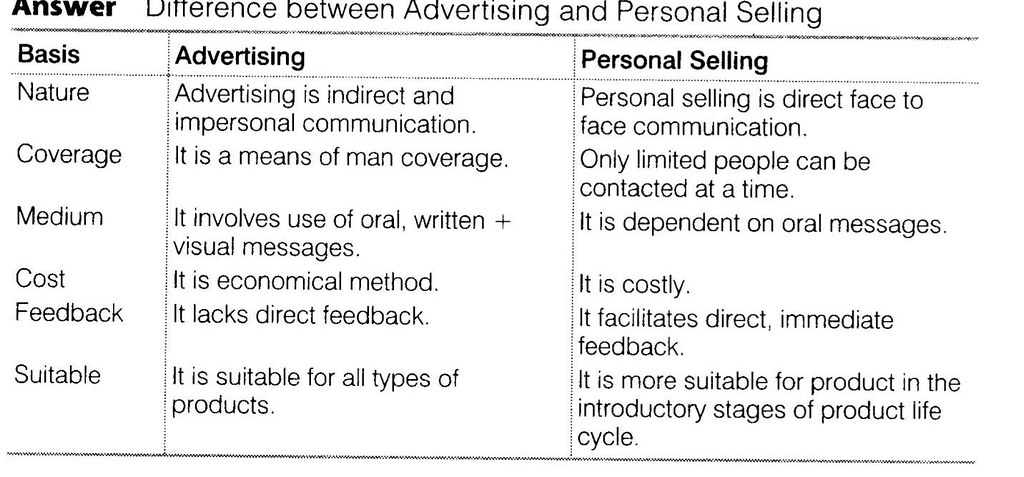
Q8. Distinguish between advertising and personal selling.
Answer:
Q9. Explain the factors determining choice of channels of distribution.
Answer: One of the important decisions of marketing involves the choice of which channel of distribution to opt for. The following factors determine the choice of channels.
- Product Type
The choice of channel of distribution is based on the type of product that is produced. It is important to check whether the product is perishable or non-perishable, whether it is an industrial or a consumer product, whether its unit value is high or low, and also, the degree of complexity of the product. For instance, if a good is perishable then short channels should be used rather than long ones. Similarly, if a product has a low unit value then longer channels are preferred. Similarly, consumer products are distributed through long channels while industrial products are distributed through short channels.
- Characteristics of the Company
The two important characteristics of a company that affects the choice of the channel are its financial strength and the degree of control that the company wishes to hold on the intermediaries. Shorter channels require greater funds than longer channels and also offer greater control over the members of the channel (intermediaries). Thus, companies that are financially strong or wish to command greater control over the channel of distribution opt for shorter channels of distribution.
- Competitive Factors
The degree of competition and the channels opted by other competitors affect the choice of distribution channel. Depending on its policies a company can adopt a similar channel as adopted by its competitors or opt for a different channel. For example, if competitors of a company opt for sale through a retail store, it may also do the same or it can opt for a different channel such as direct selling.
- Environmental Factors
Environmental factors such as economic constraints and legal policies play an important role in the choice of channel of distribution. For example, the requirement of complex legal formalities at each step of distribution induces the companies to opt for shorter channels.
- Market Factors
Various other factors such as the size of the market, geographical concentration of buyers, quantity demanded, etc. also affect the choice between the channels. For instance, if potential buyers are concentrated in a small geographical area then, shorter channels are used. As against this, if the buyers are dispersed in a larger area then longer channels of distribution may be used.
We Think the given NCERT Solutions for class 12 Business Studies book Chapter 11 Marketing with Answers Pdf free download will assist you. If you’ve got any queries regarding CBSE Class 12 Business Studies Marketing NCERT Solutions with Answers, drop a comment below and that we will come back to you soons.